
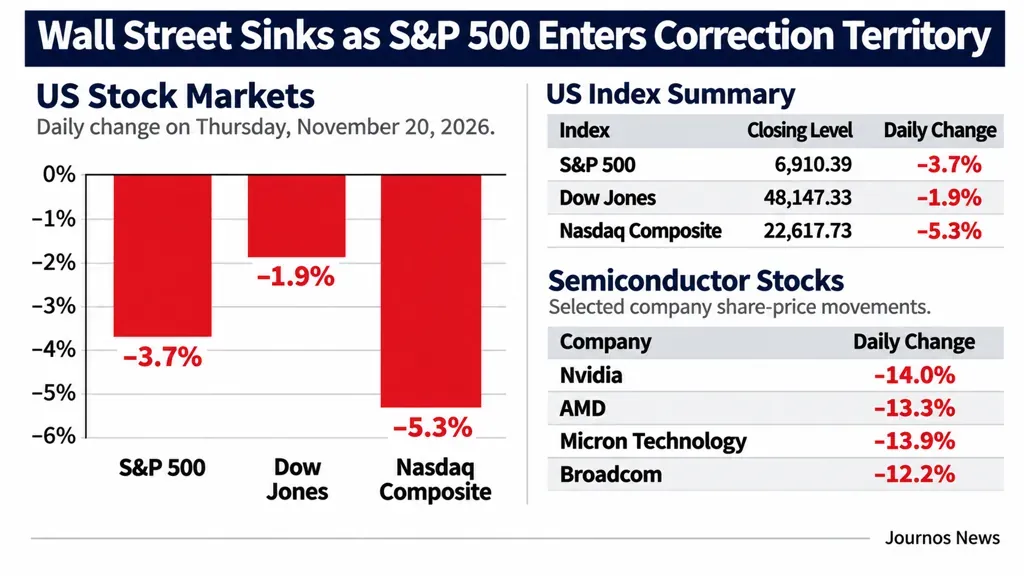
NEW YORK, United States – The S&P 500 entered correction territory on Friday, November 20, after a sharp sell-off in artificial intelligence and technology stocks drove the benchmark down 3.7%, extending a week of losses that erased a significant portion of Wall Street’s gains this year.
The index closed at 6,910.39, down 265.44 points, placing it more than 10% below its record closing high reached on October 6. A market correction is conventionally defined as a decline of at least 10% from a recent peak.
The Dow Jones Industrial Average also entered correction territory, falling 949.73 points, or 1.9%, to close at 48,147.33. The technology-heavy Nasdaq Composite dropped 1,261.47 points, or 5.3%, to 22,617.73, moving into negative territory for the year.

Technology stocks lead the decline
Semiconductor companies and businesses connected to artificial intelligence infrastructure experienced some of the steepest losses.
Nvidia shares fell approximately 14% on Friday, while Advanced Micro Devices declined 13.3%. Micron Technology lost 13.9%, and Broadcom dropped 12.2%.
The Philadelphia Semiconductor Index, which tracks major chipmakers, fell 10.7%. The losses reflected growing investor concerns about the valuations of companies benefiting from the AI boom and whether the enormous investments in data centres and computing infrastructure will generate sufficient returns.
The sell-off also extended beyond chipmakers. Corning, which supplies optical communications products, fell 10.9%, while energy company Bloom Energy declined 15.3%.
AI spending and valuations face renewed scrutiny
The decline followed growing questions about the sustainability of spending across the artificial intelligence industry.




Technology companies have committed substantial resources to data centres, advanced processors and other infrastructure needed to develop and operate AI systems. Investors are increasingly examining whether the expected commercial returns can justify the scale of those expenditures.
Concerns about AI valuations were compounded by political developments following the November midterm elections. Candidates advocating restrictions or slower expansion of data-centre construction won several contests, adding uncertainty around the industry’s future infrastructure growth.
Anthropic, the developer of the Claude AI system, also experienced a decline in its second trading session following its high-profile initial public offering. Its shares fell 8.5% on Friday, despite remaining above the $83 offering price.
Nasdaq records its worst week in years
The technology-heavy Nasdaq Composite lost approximately 10% over the week, marking its largest weekly decline since March 2020. Its Friday close also erased its gains for 2026.
The S&P 500 declined 8.6% for the week, its steepest weekly loss in more than 18 months. Its seven consecutive sessions of losses marked its longest losing streak since February 2020.
The Dow fell approximately 8% over the same period, while the Russell 2000, which tracks smaller US companies, declined 7.5%.
Correction does not necessarily signal a bear market
Despite the severity of the losses, a correction does not automatically mean that the market has entered a prolonged downturn.
A correction is generally defined as a decline of 10% or more from a recent high, while a bear market conventionally refers to a decline of at least 20%.
Chris Larkin, managing director of trading and investing at E*TRADE from Morgan Stanley, said that historically most corrections from all-time highs have not developed into bear markets. He cited data showing that only five of the previous 15 such corrections since 1983 became bear markets.
The immediate direction of the market will depend partly on whether investors regain confidence in technology valuations and the profitability of AI infrastructure spending. The latest decline, however, has demonstrated how heavily the broader US stock market has become exposed to the performance of a relatively concentrated group of technology companies.
Primary Sources: Reuters, “Wall St ends sharply lower on AI selloff, S&P 500, Dow in correction,” November 20, 2026, reporting the closing performance of the major US stock indexes and attributing market developments to investor concerns about artificial intelligence valuations and spending; Associated Press, “S&P 500 sinks 3.7%, Nasdaq composite goes negative for the year as tech sell-off worsens,” November 20, 2026, documenting index closing levels, weekly losses and individual technology-stock declines. The original exchange-level market data and company announcements were not independently retrieved for this article; these figures are attributed to the cited financial reporting.