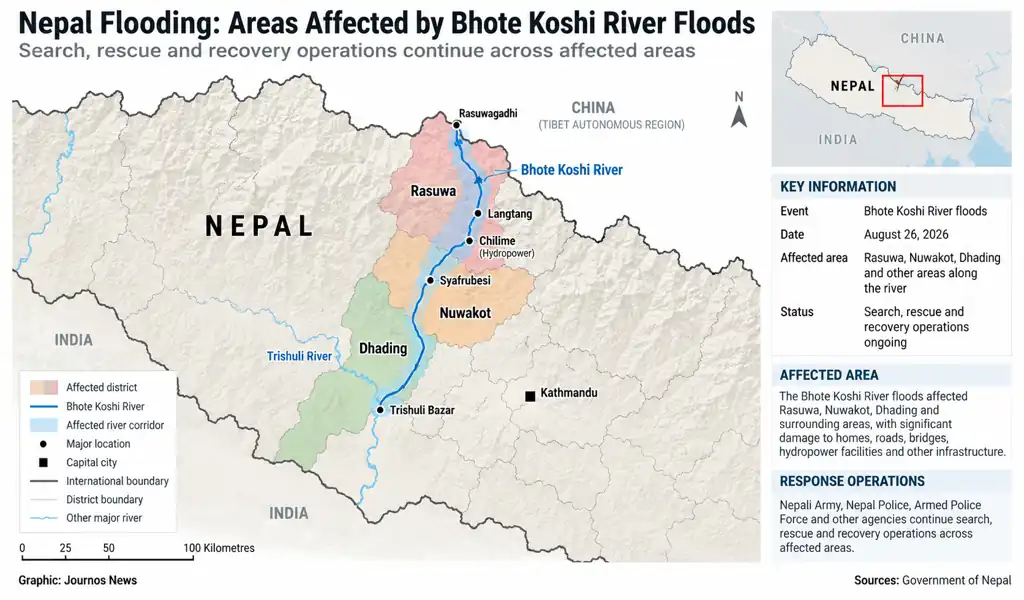
DISASTER TRACKER: Nepal Flooding Updates September 6, 2026
Major Developments We’re Following
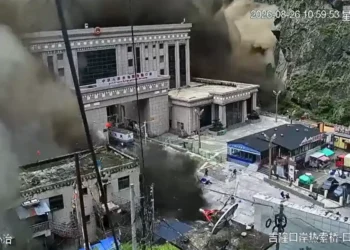
- Search-and-rescue operations continue in areas affected by the August 26 Bhote Koshi River floods, with teams working at damaged hydropower facilities and other affected locations.
- A Chinese national was rescued alive from a 225-meter tunnel at the Upper Trishuli-1 Hydropower Project, while two Nepali workers had been rescued from the Upper Trishuli 3A tunnel the previous day.
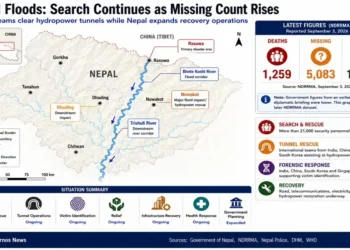
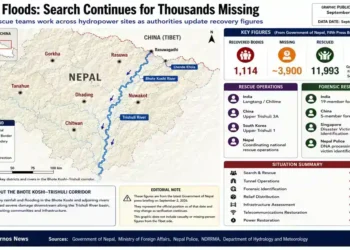
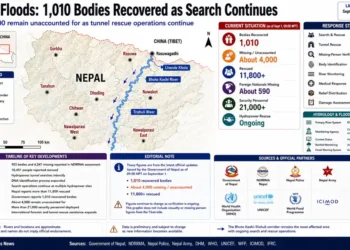
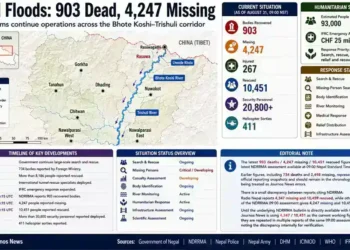
- The Government of Nepal reported 1,344 bodies recovered and 13,098 people rescued as of its September 5 situation update. Around 5,000 people remained missing, although the exact figure was still being revised through ongoing verification.
- International rescue support is continuing, with specialist teams from countries including India, China, South Korea, Australia and Malaysia assisting Nepali authorities.
- Authorities are continuing to restore roads, bridges, electricity and telecommunications in affected areas while conducting preliminary damage assessments.
What We Know
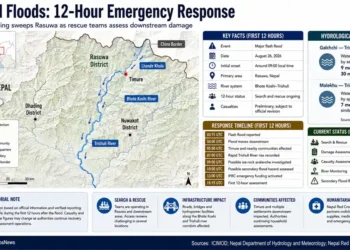
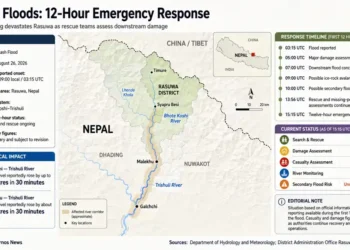
- The disaster began on August 26, 2026, after severe flooding along the Bhote Koshi River affected northern and central parts of Nepal.
- The Government of Nepal’s latest situation report records 1,344 bodies recovered and 13,098 people rescued.
- About 5,000 people remain missing, according to the latest government assessment. The figure remains subject to search, identification and verification.
- Rescue operations remain concentrated around several hydropower projects where workers were reported missing or trapped.
- The government has begun forensic identification work, including DNA collection, to identify recovered remains and establish links with missing persons.
- Preliminary government assessments indicate extensive damage to homes, roads, bridges, hydropower facilities and other infrastructure.
- Nepal’s security, disaster-management and health authorities remain mobilized for search, rescue, evacuation, medical assistance and relief operations.
What We Don’t Know
- The final death toll has not yet been established.
- The final number of missing people remains uncertain as authorities continue search operations and reconcile reports.
- The identities of many recovered bodies have not yet been established.
- The full extent of damage to homes, infrastructure, hydropower facilities and agricultural land remains under assessment.
- The final economic cost of the disaster has not yet been established through a completed comprehensive assessment.
- The number of people who may still be trapped inside damaged hydropower tunnels remains uncertain.
- The full geographic extent of damage in some difficult-to-access areas remains unclear.
Public Safety Information
- Nepal’s security and disaster-management agencies remain mobilized for emergency response, while authorities continue monitoring river systems and downstream flood risks.
- Residents in affected areas should follow current instructions issued by local authorities and Nepal’s official disaster-management agencies rather than relying on unverified social-media reports.
- Road, bridge and other infrastructure restrictions may change as restoration work progresses. Travelers should rely on official transportation and local-authority notices for current access information.
- Emergency assistance and information concerning affected foreign nationals are being coordinated through the Government of Nepal’s Emergency Control Room.
The Bhote Koshi River flood disaster entered its 11th day as Nepali authorities continued search, rescue, recovery and relief operations across Rasuwa, Nuwakot, Dhading and other affected areas. During the latest 24-hour period, two workers were rescued alive from the Upper Trishuli 3A hydropower tunnel, another Chinese national was rescued from the Upper Trishuli-1 tunnel, and a woman was rescued from a damaged house in Betrawati. The government also reported 1,344 bodies recovered and about 5,000 people still missing as of its September 5 situation update.
14:00 NST, September 4 — Government Reports 1,287 Bodies Recovered
The Government of Nepal said 1,287 bodies had been recovered from areas affected by the Bhote Koshi floods, while approximately 5,083 people remained missing.

The government also reported that 13,093 people had been rescued, including more than 300 foreign nationals. Authorities said the figures remained subject to continuing search and verification.
September 4 — Two Workers Rescued From Upper Trishuli 3A
Two workers were rescued alive from the tunnel of the Upper Trishuli 3A Hydropower Project as Nepali security forces continued operations at flood-damaged hydropower facilities.
The Government of Nepal confirmed the rescue in its September 4 situation update and said tunnel teams from India, China and South Korea were continuing to support operations alongside the Nepali Army.
September 4 — Temporary Burial and DNA Identification Begin
Nepali authorities began temporary burial of recovered bodies after required forensic procedures, with the aim of allowing later identification and return of remains to families.
Forensic teams from India, China, Singapore and South Korea joined Nepal Police and other authorities in DNA collection, analysis and identification work.
■ Related News



September 4 — Authorities Continue Restoration of Roads and Communications
The Government of Nepal said work was continuing to restore road, electricity and telecommunications connections in affected areas.
Authorities were also requesting specialized equipment, including high-capacity drones, LiDAR systems, temporary bridges, ground-penetrating radar, DNA-testing equipment and other search-and-rescue equipment.
September 5 — Additional International Rescue Teams Arrive
Nepal’s Ministry of Foreign Affairs said a 15-member Australian Disaster Assistance and Response Team had arrived the previous day, while an 11-member Malaysian Special Disaster Assistance and Rescue Team arrived on September 5.
The teams joined continuing international support for search and rescue operations at damaged hydropower projects.
September 5 — Chinese National Rescued From Hydropower Tunnel
A Chinese national was rescued alive from a 225-metre tunnel at the Upper Trishuli-1 Hydropower Project after being trapped following the flooding.
The Nepal Army said a joint team of Nepali military personnel and South Korean disaster specialists carried out the rescue. The survivor was taken for medical assessment.
The Government of Nepal later included the Chinese national among four people rescued alive during the latest rescue operations.
September 5 — Woman Rescued Alive From Damaged House
A Nepali woman was rescued alive from a damaged house in Betrawati, Nuwakot, according to the Government of Nepal.
The woman was taken for medical treatment after rescuers reached her in the flood-affected area. The rescue was among the four latest live rescues recorded in the government’s September 5 situation report.
11:00 NST, September 5 — Nepal Police Reports 1,344 Bodies Recovered
Nepal Police reported that 1,344 bodies and body parts had been recovered by 11:00 NST on September 5.
The police breakdown included 522 male bodies, 321 female bodies and 501 partial body parts. Nepal Police said 1,030 recovered bodies had been buried and 96 had been handed over to families.
11:00 NST, September 5 — Nearly 4,900 People Still Missing
Nepal Police reported that 4,887 people remained missing as of 11:00 NST on September 5, including 2,930 Nepali nationals and 606 foreign nationals.
The police said 2,272 DNA samples had been collected, including samples from deceased people and relatives, as identification efforts continued.
14:00 NST, September 5 — Government Updates Recovery Figures
The Ministry of Foreign Affairs reported that 13,098 people had been rescued and 1,344 bodies had been recovered as of its 14:00 NST situation update.
The ministry said around 5,000 people remained missing, including approximately 600 foreign nationals from 35 countries. It stressed that the figures continued to change as search and verification progressed.
14:00 NST, September 5 — Search Continues at Multiple Hydropower Projects
The Government of Nepal said tunnel rescue operations remained active at Upper Trishuli 1, Upper Trishuli 3A, Upper Trishuli 3B, U216 Haku, Chilime and Langtang, among other affected projects.
India, China and South Korea continued working with the Nepali Army, while additional technical personnel and equipment were being deployed.
14:00 NST, September 5 — Road Connectivity Restoration Underway
The Nepali Army and engineers were working to restore the Galchhi–Trishuli Road by constructing a temporary bridge over the Tadi River.
The government also said two cable-pulley crossings had become operational at Trishuli Indrenighat and Devighat to help restore movement across affected areas.
14:00 NST, September 5 — Preliminary Damage Assessment Expands
The Government of Nepal’s preliminary Rapid Damage and Needs Assessment found approximately 7,570 houses affecting about 32,933 people and 48 government offices had been affected.
The assessment also identified damage to 55 kilometres of roads, 37 motorable bridges, 68 suspension bridges, about 1,806 hectares of agricultural land, 13 hydropower projects, one solar power plant and two transmission lines. The government estimated that 783 MW of hydropower generation capacity had been affected.
The government emphasized that the assessment remains preliminary and that a comprehensive Post Disaster Needs Assessment is being conducted to determine the full extent of losses and reconstruction requirements.
14:00 NST, September 5 — Nepal Continues International Relief Coordination
Nepal said international assistance continued arriving from neighbouring countries, international organizations and other partners.
The Ministry of Foreign Affairs said it had coordinated clearance for 24 flights carrying flood-relief assistance and rescue teams. Australia and Malaysia were among the countries that had recently deployed specialist response teams.
14:00 NST, September 5 — Emergency Control Room Remains Active
Nepal’s Ministry of Foreign Affairs continued operating an Emergency Control Room for coordination with diplomatic missions, authorities and families seeking information about missing foreign nationals.
The ministry said the control room operates from 7:00 a.m. to 10:00 p.m. Nepal time.
14:00 NST, September 5 — Current Situation
Search, rescue, recovery and relief operations remain active on the 11th day after the August 26 Bhote Koshi River floods.
The latest Government of Nepal situation update records 1,344 bodies recovered, 13,098 people rescued and around 5,000 people still missing. The figures remain subject to further search, identification and verification.
What remains unclear: The final death toll, final number of missing people, complete infrastructure losses and total reconstruction requirements have not yet been established.
Emergency Response
Nepal continues large-scale search, rescue and relief operations in areas affected by the August 26 Bhote Koshi River floods. The Nepal Army, Nepal Police, Armed Police Force and other government agencies remain involved in the response.
Specialist teams from India, China and South Korea are assisting Nepali authorities with tunnel-rescue operations at several hydropower projects. Australia and Malaysia have also deployed specialist disaster-response personnel.
The latest government update reported 13,098 people rescued and 1,344 bodies recovered. Authorities continue searching for missing people and verifying casualty and recovery figures.
Health Response
Nepal continues forensic identification and management of recovered remains. Authorities have begun temporary burial after required forensic procedures, including the collection of DNA samples.
Forensic specialists from several countries are supporting Nepal Police with DNA analysis and identification. The process is intended to help authorities identify recovered remains and return them to families when identification is established.
Health and emergency teams are also supporting survivors rescued from affected areas, while authorities continue coordinating medical assistance as rescue operations progress.
Infrastructure Recovery
Government agencies and security forces are working to restore roads, bridges, electricity and telecommunications in affected areas.
The Government of Nepal reported preliminary damage to 7,570 houses, 55 kilometres of roads, 37 motorable bridges and 68 suspension bridges. Thirteen hydropower projects, one solar power plant and two transmission lines were also affected.
The government said approximately 783 MW of hydropower generation capacity had been affected. It stressed that the figures are preliminary and that a broader Post-Disaster Needs Assessment remains underway.
The Nepali Army and engineers are also working to restore road connectivity, including construction of a temporary bridge over the Tadi River and the operation of cable-pulley crossings at Trishuli Indrenighat and Devighat.
Weather and Flood Monitoring
The Government of Nepal continues to coordinate disaster monitoring and emergency operations through the National Disaster Risk Reduction and Management Authority and other relevant agencies.
The current government situation report focuses on continuing search, rescue, recovery and relief operations. It does not provide a new nationwide flood forecast that would support an independent assessment of whether flood conditions are worsening or improving.
JournosNews should therefore avoid adding unsupported forecasts or statements about future flood conditions. Any new warning, rainfall forecast, river-level assessment or other hazard information should be added only after confirmation from the responsible Nepalese scientific or government authority.
What Changed During This 24-Hour Window
- The Government of Nepal’s reported number of recovered bodies increased from 1,287 on September 4 to 1,344 on September 5.
- The number of people rescued increased from 13,093 to 13,098 in the government’s successive situation reports.
- Two Nepali workers were rescued alive from the Upper Trishuli 3A hydropower tunnel on September 4.
- A Chinese national was subsequently rescued alive from a 225-metre tunnel at Upper Trishuli-1, while a woman was rescued from a damaged house in Betrawati.
- Australia and Malaysia added specialist disaster-response teams to the international assistance supporting Nepal’s operations.
- Nepal continued forensic identification and DNA collection while temporary burial of recovered remains proceeded under established procedures.
- Infrastructure-recovery work continued, including temporary bridge and cable-pulley installations intended to restore access across damaged areas.
- The government’s preliminary damage assessment identified extensive impacts on homes, roads, bridges, hydropower facilities and other infrastructure.
Primary and Official Sources Used for This Tracker
- Government of Nepal — Ministry of Foreign Affairs: Daily Situation Update on Bhote Koshi River Floods, September 5, 2026.
- Government of Nepal — Ministry of Foreign Affairs: Daily Situation Update on Bhote Koshi River Floods, September 4, 2026.
- National Disaster Risk Reduction and Management Authority (NDRRMA): Disaster-response and assessment information incorporated into Government of Nepal reporting.
- Nepali Army: Search-and-rescue and tunnel-rescue operations reported through official government updates.
- Nepal Police: Recovery, missing-person and forensic-identification operations incorporated into official government reporting.
- Armed Police Force of Nepal: Emergency response operations incorporated into Government of Nepal reporting.
- Government of Nepal Emergency Control Room: Coordination concerning missing foreign nationals and consular assistance.