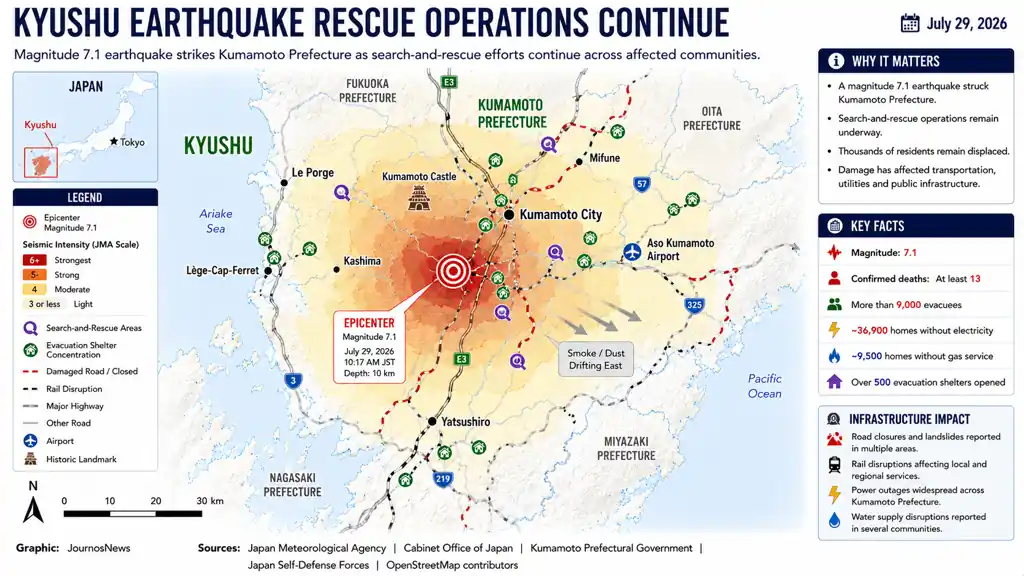
KUMAMOTO, Japan – Emergency workers and Japan’s Self-Defense Forces continued searching collapsed buildings in southwestern Japan on Wednesday after the death toll from a powerful earthquake rose to at least 13, with rescue teams racing to locate people believed trapped beneath debris.
The magnitude 7.1 earthquake struck the Kumamoto area on the southern island of Kyushu, disrupting transportation, damaging critical infrastructure and forcing thousands of residents into evacuation shelters as authorities continued assessing the full extent of the disaster.
The earthquake has renewed concerns about disaster preparedness in one of the world’s most seismically active countries, where memories of the devastating 2016 Kumamoto earthquake remain strong.

Rescue Operations Continue at Damaged Sites
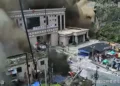
Soldiers and emergency responders searched multiple damaged locations, including a shopping mall in the town of Kashima where part of the building collapsed following an explosion believed to have been caused by a gas leak.
Japan’s Self-Defense Forces joined rescue crews at the damaged Aeon Mall, where the collapse of the second floor trapped people inside. Authorities had not announced how many individuals might still be missing at the site.
At a factory operated by Nippon Paper Industries Co. in Yatsushiro, a collapsed chimney trapped workers beneath debris. Kumamoto emergency officials said seven people were believed to remain trapped as of Wednesday, while rescuers had recovered two survivors and two bodies.
Prime Minister Sanae Takaichi said rescue efforts remained the government’s highest priority and urged emergency personnel to continue searching for survivors.
“There are people who are still waiting to be rescued, and it’s a race against time,” Takaichi said.



Thousands Remain Without Essential Services
The earthquake disrupted electricity, gas and communications across parts of the affected region.
Chief Cabinet Secretary Minoru Kihara said approximately 36,900 homes remained without electricity, while about 9,500 households continued to lack gas service. Communications networks also remained unavailable in some communities.
More than 9,000 people were staying in over 500 evacuation shelters, where authorities worked to provide additional electrical power so air conditioning could operate during an ongoing heat wave. Temperatures in the region were forecast to exceed 32 degrees Celsius (90 degrees Fahrenheit).
The government said it was preparing deliveries of food, water and other essential supplies to affected communities.
Takaichi also expressed condolences to the families of those killed and urged evacuees to take precautions against heat-related illness while remaining in shelters.
Transportation and Historic Sites Sustain Damage
Transportation services remained disrupted as engineers inspected infrastructure for damage.
The Kyushu Shinkansen bullet train service remained suspended, while Aso Kumamoto Airport gradually resumed operations after one of its runways was temporarily closed for inspections. Officials warned that some flight cancellations were still possible.
Kumamoto Castle, one of the region’s best-known historical landmarks, also sustained damage, with sections of its stone walls affected by the earthquake, according to Kyodo News. The castle has been undergoing restoration work since suffering extensive damage during the 2016 Kumamoto earthquake.
Residents said the latest earthquake revived memories of the earlier disaster. Hiroki Shimoda, an official in Mifune town, said the shaking reminded him of the 2016 earthquake, which killed at least 50 people.
Authorities continued search-and-rescue operations while evaluating structural damage across the region, warning that the full impact of the disaster remains under assessment.
This report is based on reporting by The Associated Press.