Journos News - Breaking News, World News, Top Stories, Todays Headlines and Flash Reports
Thursday, September 10, 2026
  • Login
  • Home
  • World
    • Africa
    • Americas
    • Asia
    • Europe
    • Middle East
    • Oceania
  • Politics
  • Business
  • Technology
  • Health
  • Science
  • Sports
  • Entertainment
  • Culture
No Result
View All Result
  • Home
  • World
    • Africa
    • Americas
    • Asia
    • Europe
    • Middle East
    • Oceania
  • Politics
  • Business
  • Technology
  • Health
  • Science
  • Sports
  • Entertainment
  • Culture
No Result
View All Result
Journos News - Breaking News, World News, Top Stories, Todays Headlines and Flash Reports
No Result
View All Result
Home Technology Innovation & Emerging Technology

Japan Develops New Quantum Error-Correction Method for More Reliable Quantum Computers

University of Tokyo researchers develop a simple decoding technique that can sharply reduce logical errors in some quantum codes.

The Daily Desk by The Daily Desk
September 10, 2026
in Innovation & Emerging Technology, Technology
0
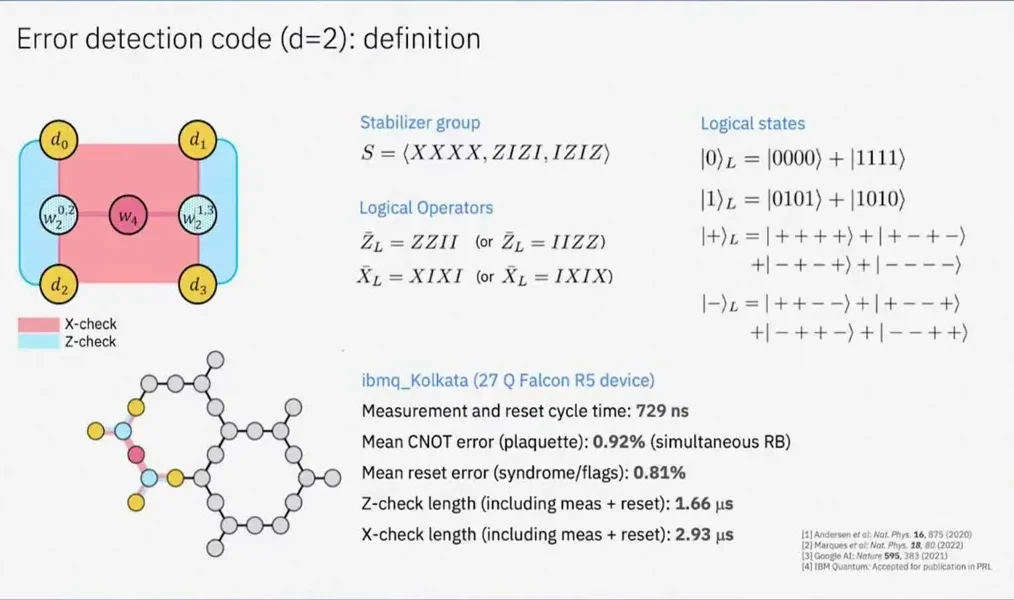
IBM Research presentation explaining efforts to make quantum error correction more practical in a 2022 research video.

Frame from IBM Research’s “Making quantum error correction more practical,” published March 22, 2022.

TOKYO, Japan — Japanese and Chinese researchers have developed a new method for testing the reliability of quantum-error-correction results, offering a potentially simple way to reduce errors that threaten the practical operation of quantum computers.

The technique, called Argument Reweighting (AR), was developed by researchers from the University of Tokyo and the China Academy of Engineering Physics. The researchers say it can be applied across a broad range of quantum-error-correcting codes and decoding algorithms because it does not require a fundamentally different error-correction architecture.

Quantum computers are highly sensitive to disturbances and noise. Their basic information units, or qubits, can lose their intended state during computation, making error correction essential for building machines capable of carrying out long and complex calculations reliably.

The new approach focuses on a problem that occurs after error-correction data have been processed: determining whether the decoder’s proposed correction is itself reliable.

Researchers use repeated decoding to test stability

In conventional quantum-error-correction decoding, measurements from a quantum processor are analyzed to determine which errors most likely occurred and what correction should be applied.

The researchers’ AR method deliberately changes the weighting of the leading correction candidate and then runs the decoding process again. If the decoding produces the same result despite the change, the result is considered stable enough to retain. If the outcome changes, the result is rejected through a process known as post-selection.

The method effectively uses the stability of a decoding result as an additional indication of whether that result can be trusted.

That makes AR different from simply attempting to correct more errors. Instead, it provides a mechanism for identifying correction results that may be unreliable and filtering them out.

■ Related News

JournosNews market graphic showing mixed Asian indexes, rising oil prices, U.S. economic indicators and geopolitical energy risks.

Asian Markets Mixed as Oil Rises After Wall Street Extends Weekly Gains

August 10, 2026
Diorama at Hiroshima Peace Memorial Museum showing the city after the atomic bomb blast, with a red marker indicating the blast location.

Nagasaki Anniversary Highlights Japan’s Nuclear Policy Dilemma

August 10, 2026
Japan Maritime Self-Defense Force frigate JS Mogami (FFM-1) moored at Yokosuka Naval Base, viewed from the left rear during a port visit.

Japan Prioritizes Combat Drones and AI as Defense Strategy Evolves Amid Regional Security Challenges

August 4, 2026
Japan's Sanae Takaichi and Italian Prime Minister Giorgia Meloni meet during the Italy–Japan summit in Tokyo on January 16, 2026.

Japan Begins Recovery as Prime Minister Visits Earthquake-Hit Kumamoto

August 4, 2026

Tests showed a large reduction in logical errors

In tests involving a family of quantum codes known as BB codes, the researchers reported that rejecting only about one result in every 70,000 could reduce the logical error rate to one-sixtieth or less.

The researchers described the method as particularly attractive because of its simplicity and broad compatibility. Their findings were published in Physical Review Letters under the title “Simple, Efficient, and Generic Post-Selection Decoding for qLDPC Codes.”

The reported results are experimental and computational evidence for the method rather than a demonstration that large-scale fault-tolerant quantum computing has been achieved.

That distinction is important. Quantum-error correction remains one of the central obstacles to building useful large-scale quantum computers, and substantial additional hardware and engineering work is required before techniques such as AR can be deployed in practical systems.

The method could apply beyond quantum computing

The researchers said the technique could have implications across quantum-information technologies that rely on quantum-error correction.

Those include quantum communication, quantum sensing and quantum cryptography, where errors can similarly undermine the reliability of information encoded in quantum states.

Japan is pursuing quantum-error correction through several parallel research programs.

The country’s Moonshot Goal 6 program is targeting a fault-tolerant universal quantum computer by 2050, with the second phase beginning in 2026. The program has set an objective of demonstrating quantum-error correction by 2028 and a small-scale fault-tolerant quantum-computing proof of concept by 2030.

Other Japanese research teams are pursuing hardware approaches alongside improvements to error-correction algorithms. A project led by Kyoto Institute of Technology, for example, is developing a scalable, highly integrated quantum-error-correction system, while RIKEN-led research is targeting fault-tolerant silicon quantum-computing technologies.

The University of Tokyo team’s latest work therefore represents one component of a much broader effort to make quantum computation sufficiently stable for practical use.

For the technology to become commercially useful, researchers must ultimately combine reliable error correction with scalable quantum hardware capable of maintaining large numbers of logical qubits while controlling the physical errors generated during computation.

Reporting Credit: The University of Tokyo — research findings and description of the Argument Reweighting method; Physical Review Letters — publication of the research; Japan Science and Technology Agency — Japan’s Moonshot Goal 6 quantum-computing targets.


 

Tags: #FaultTolerantComputing#Japan#QuantumComputing#QuantumErrorCorrection#QuantumResearch#QuantumTechnology#ScienceAndTechnology#UniversityOfTokyo
The Daily Desk

The Daily Desk

The Daily Desk is the editorial byline of Journos News, representing reporting produced by the newsroom across world news, politics, business, technology, disasters, and other areas of public interest. Stories published under this byline are independently researched, verified, and edited in accordance with Journos News’ editorial standards, with an emphasis on accuracy, transparent sourcing, attribution, context, and editorial independence.

Related Posts

Editorial map showing the magnitude 7.1 earthquake in Kumamoto Prefecture, Japan, with the epicenter, rescue operations, damaged infrastructure, evacuation shelters, and affected communities across Kyushu.

Japan Earthquake Rescue Efforts Continue as Death Toll Rises in Kyushu

July 29, 2026
Editorial locator map showing the magnitude 7.1 earthquake in Japan's Kyushu region, including the epicenter, affected areas, infrastructure disruptions, and emergency response locations.

Japan Earthquake Triggers Mall Collapse as Rescuers Search for Dozens Missing

July 28, 2026
Mountain landscape in Olympus National Park, Greece, showing forested slopes, rocky peaks, and natural scenery beneath a clear sky.

UNESCO Grants World Heritage Status to Normandy D-Day Beaches, Mount Olympus and Key Cultural Sites

July 27, 2026
Members of Japan's imperial family attend a ceremonial session of the National Diet. — Photo: Prime Minister's Office of Japan

Japan Approves Imperial Family Reform, Keeps Male-Only Succession

July 17, 2026
Chinese ballistic missile test raises security concerns across the South Pacific. - AP Photo/Ng Han Guan, File

China Conducts Ballistic Missile Test in South Pacific, Prompting Regional Security Concerns

July 8, 2026
Chinese coast guard patrols near Taiwan amid rising international tensions - Taiwan Coast Guard via AP, file

China Defends Taiwan Strait Patrols After European Nations Express Security Concerns

June 27, 2026
US HIMARS rocket launcher during military exercise near Mount Fuji - AP Photo/Hiro Komae

US and Japan Expand Missile Coordination in Mount Fuji Rocket Drill

May 22, 2026
Japanese defence site on Yonaguni island near Taiwan - Credit: Getty Images

Japan to Deploy Missiles on Yonaguni Near Taiwan by 2031

May 12, 2026
Load More
JournosNews logo

Journos News delivers globally neutral, fact-based journalism that meets international media standards — clear, credible, and made for a connected world.

  • Categories
  • World News
  • Politics
  • Business & Markets
  • Technology
  • Health
  • Science
  • Sports
  • Arts & Culture
  • Resources
  • Editorial Standards
  • Submit a Story
  • Advertise with Us
  • Syndication & Partnerships
  • Site Map
  • Press & Media Kit
  • Editorial Team
  • Careers

Join thousands of readers receiving the latest updates, tips, and exclusive insights straight to their inbox. Never miss an important story again.

  • About Us
  • Editorial & Trust Center
  • Contact Us
  • Privacy Policy
  • Terms of Use & Copyright Notice

© JournosNews.com All rights reserved.

Welcome Back!

Login to your account below

Forgotten Password?

Retrieve your password

Please enter your username or email address to reset your password.

Log In
JournosNews

Independent Journalism.
Verified Facts.

You're about to read a professionally edited article from JournosNews.com.

Every article is produced in accordance with our editorial standards, emphasizing factual accuracy, transparent attribution, fairness, editorial independence, and meaningful context.

Editorial Standards
No Result
View All Result
  • Home
  • World
    • Africa
    • Americas
    • Asia
    • Europe
    • Middle East
    • Oceania
  • Politics
  • Business
  • Technology
  • Health
  • Science
  • Sports
  • Entertainment
  • Culture

© JournosNews.com All rights reserved.

This website uses cookies. By continuing to use this website you are giving consent to cookies being used. Visit our Privacy and Cookie Policy.