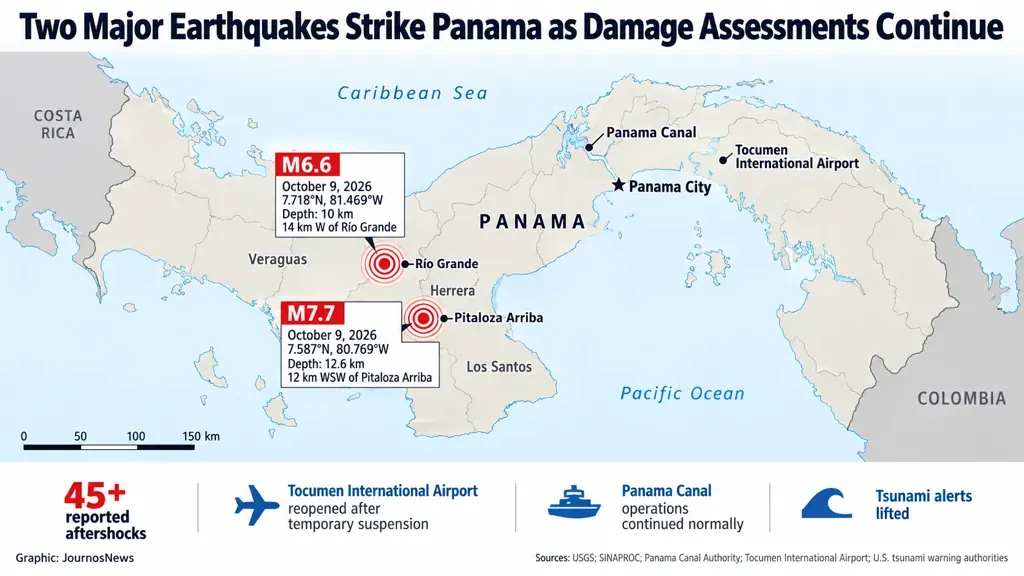
PANAMA CITY, Panama – Two powerful earthquakes struck Panama on October 9, including a magnitude 7.7 tremor followed by a magnitude 6.6 earthquake, prompting evacuations, infrastructure inspections and temporary transport disruptions as authorities assessed damage across the country.
The US Geological Survey recorded the first earthquake near Pitaloza Arriba in Herrera province at a depth of about 12.6 kilometres. The second, measuring magnitude 6.6, struck near Río Grande later the same day.
More than 45 aftershocks were reported as shaking affected central Panama and other areas. The tremors damaged buildings and roads, disrupted electricity in several provinces and prompted authorities to inspect public infrastructure.

Panamanian President José Raúl Mulino said no deaths had been documented by Friday evening. Reports of injuries and structural damage emerged as assessments continued, so the casualty situation remained subject to official updates.
Buildings and roads damaged
Damage was reported in Herrera, Veraguas, Los Santos and other parts of central Panama. Some structures partially collapsed, while cracks appeared in roads and buildings. Historic sites, including the Church of San Atanasio, were also reported damaged.
Authorities began inspections to determine the extent of the damage and whether affected structures could be safely occupied. Visible cracks or partial collapses do not automatically establish that a building is unsafe; those decisions require assessment by qualified officials or engineers.
The earthquakes prompted people to leave buildings and seek safer locations. Officials continued evaluating affected areas as aftershocks followed the main tremors.
The number of aftershocks alone does not establish that a larger earthquake is imminent. Residents should follow official emergency instructions and avoid damaged buildings until authorities declare them safe.
■ Related News


Airport temporarily suspends operations
Tocumen International Airport, Panama’s main international aviation hub, temporarily suspended operations during the emergency before reopening. The disruption prompted concerns about passenger movements and flight schedules while authorities assessed conditions.
The Panama Canal Authority said canal operations continued normally. The canal, a critical route for international shipping, remained operational while safety checks focused on personnel, vessels and facilities.
The distinction is important: the earthquake caused temporary disruption at the airport, but available information did not indicate that the Panama Canal had been closed.
Passengers were advised to check directly with airlines for current schedules and possible changes, as transport conditions can change during post-earthquake inspections.
Tsunami alerts lifted
The magnitude 7.7 earthquake triggered tsunami warnings and alerts for parts of the Pacific coast, including areas in Central and South America. Authorities subsequently lifted the warnings after assessments found that the threat no longer warranted them.
The US tsunami warning system later reported that no tsunami warning, advisory, watch or threat remained in effect for the event.
The lifting of the alerts ended the immediate tsunami warning, but it did not remove the need for continued monitoring of earthquake-related damage and aftershocks.
Emergency response continues
The earthquakes affected a country that serves as a major international transport and logistics centre. The Panama Canal remained open, but the damage to buildings, roads and electricity infrastructure highlighted the broader emergency response required beyond the immediate earthquake zone.
Authorities continued to assess damaged structures and public infrastructure. The final impact would depend on the results of inspections, reports from affected communities and any additional damage caused by subsequent shaking.
The US Geological Survey’s earthquake records provide the principal measurements for the two major tremors. Its reviewed record places the first earthquake at magnitude 7.7 and the second at magnitude 6.6. Preliminary estimates and reports can change as seismic data are reviewed, so the latest official measurements should be used.
For residents, the immediate priorities are to follow civil-protection instructions, stay away from damaged structures and monitor official updates. For travellers, airport reopening should not be taken as confirmation that every flight is operating normally.
The emergency response now centres on confirming the full extent of the damage, checking infrastructure and maintaining public safety while aftershocks continue.
Reporting Credit: U.S. Geological Survey; Panama National Civil Protection System (SINAPROC); Panama Canal Authority; Tocumen International Airport.