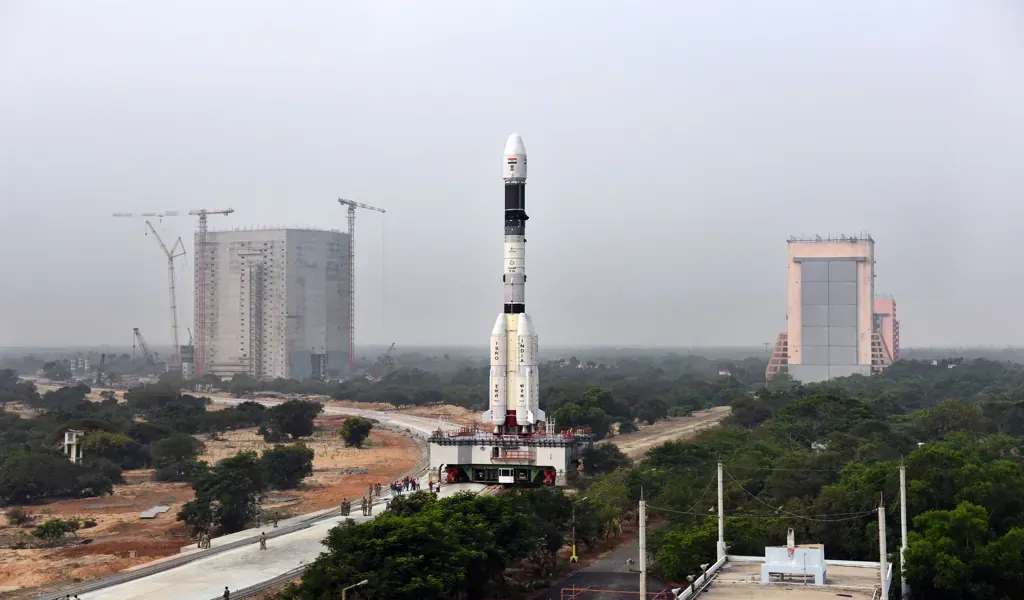
INDIA,New Delhi – India is accelerating the expansion of private participation in its space industry while reaffirming that the Indian Space Research Organisation will remain central to the country’s most advanced scientific, strategic and national space activities.
ISRO said Sept. 6 that reports and speculation suggesting the agency could be privatized or lose its importance were “baseless and incorrect.” The organization said its responsibilities will continue to include advanced space research and technology development, national and strategic missions, space science and exploration, and critical frontier capabilities.
The clarification comes as reforms introduced since 2020 have opened a substantially larger role for private companies, startups and investors across India’s space economy.

Private Industry Takes on More Responsibilities
India began opening its space sector to private participation in 2020, followed by the Indian Space Policy 2023 and the establishment of regulatory and commercial mechanisms intended to bring companies deeper into the industry.
By mid-2026, the Indian National Space Promotion and Authorisation Centre, or IN-SPACe, had authorized 113 non-government entities to conduct space activities, including satellite operations, payload development and launch-related work. Eighteen of those entities were startups.
The government said in August that India had about 440 registered space startups, while private investment in the sector had reached $618.5 million by March 2026.
ISRO Defines a Changing Role
ISRO’s clarification does not reject the expansion of private industry. Instead, it describes a division of responsibilities in which companies increasingly take on mature commercial systems while the government agency concentrates on advanced research, national infrastructure and strategic capabilities.
Pawan K. Goenka, chairman of IN-SPACe, described ISRO as the “bedrock” of India’s space sector while saying industry would assume greater responsibility for manufacturing and scaling mature launch vehicles, satellites and related systems.
■ Related News




The intended model is to expand India’s overall space capacity rather than reduce the public agency’s responsibilities.
Government Funding Supports Commercialization
The private-sector push is supported by a growing network of government programs.
India has established a ₹1,000 crore venture-capital fund for space startups and a ₹500 crore Technology Adoption Fund intended to help commercialize indigenous space technologies. The government has also facilitated private-sector access to ISRO facilities, technical expertise and technology transfers.
The government says the measures are designed to help companies progress from early-stage development toward commercial production and services.
ISRO Technologies Move Into Private Industry
Technology transfer is another part of the transition.
Government figures released in August said NewSpace India Ltd. had signed 118 technology-transfer agreements covering 83 technologies developed by ISRO and the Department of Space. The technologies include systems associated with the Small Satellite Launch Vehicle and satellite platforms.
The arrangement allows companies to commercialize technologies developed through India’s public space program while ISRO focuses on more advanced research and missions.
Earth Observation Shows the Emerging Model
Earth observation provides an example of the evolving public-private structure.
Under the emerging framework, private companies can design, build, own and operate Earth observation constellations, while government agencies retain regulatory oversight and establish mechanisms for access to infrastructure and technology.
The approach reflects a broader shift in India’s space program. Government institutions continue to provide strategic direction and critical capabilities, while commercial operators assume more responsibility for production and service delivery.
Strategic Missions Remain With ISRO
ISRO’s reassurance is particularly significant for activities India considers strategically sensitive.
The agency said it will continue to lead national and strategic missions as well as space science and exploration. Goenka also identified major future national projects, including India’s planned Bharatiya Antariksh Station and a crewed lunar mission, as areas where ISRO will retain a central role.
That distinction separates the reforms from a conventional privatization of a government space institution.
Employees Seek Clarity Over the Transition
The clarification followed concerns from ISRO employee organizations about the direction of the reforms.
Several staff bodies had sought greater clarity over the agency’s future as private companies assume responsibilities previously concentrated within ISRO. Their concerns have included the division of work, the future workforce and the organization’s long-term mandate.
ISRO’s response seeks to frame the transition as an expansion of the wider national space ecosystem rather than a retreat by the agency itself.
India Targets a Larger Commercial Space Economy
The government’s broader objective is to build a significantly larger commercial space industry.
An August government factsheet valued India’s space economy at about $9 billion and projected it could reach $40 billion to $45 billion over the next decade. It also said private participation had expanded across launch systems, satellites and space applications.
The strategy depends on private companies being able to scale while public institutions retain responsibility for capabilities that are strategic, technically complex or commercially difficult to develop independently.
A New Division of Responsibilities
India’s space program is therefore entering a different phase.
ISRO is no longer expected to carry the entire commercial burden of developing and operating space systems. At the same time, the agency is not being removed from the center of India’s broader space ambitions.
The emerging model gives industry a larger role in manufacturing, launches, satellite services and downstream applications, while ISRO concentrates more heavily on technological frontiers and national missions.
ISRO Remains Central as Industry Expands
India’s immediate message is one of continuity alongside expansion.
The government wants a larger private space industry, more investment and greater commercial activity. ISRO, meanwhile, says those changes are intended to increase national capability rather than diminish its role.
The challenge will be maintaining that balance as private companies scale while the public agency continues to lead India’s most demanding scientific and strategic space missions.
Reporting Credit: Indian Space Research Organisation; Department of Space, Government of India; Press Information Bureau of India; Indian National Space Promotion and Authorisation Centre.