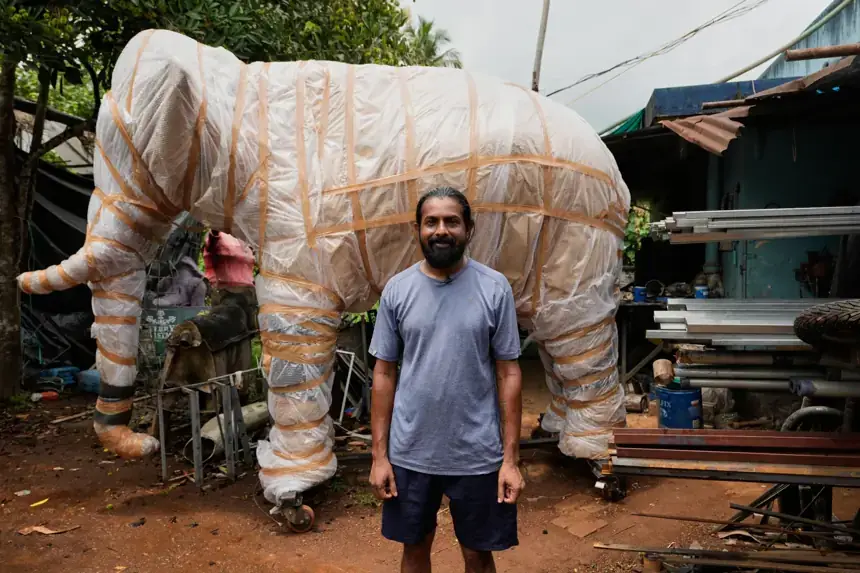
CHALAKUDY, India — Life-sized robotic elephants are drawing growing attention at Hindu temples in India’s southern state of Kerala, where they are being introduced as alternatives to live elephants used in religious ceremonies. Supporters say the animatronic animals improve safety and animal welfare, while critics argue they cannot replace an important element of centuries-old temple traditions, according to Associated Press.
Built from fiberglass, iron and rubber, the robotic elephants feature moving ears, trunks and tails, with electric motors powering lifelike head and eye movements. Although they remain stationary, their creator says future versions are expected to be capable of walking.
Mechanical engineer Prasanth Prakashan, who manufactures the models in Kerala, acknowledged that the machines cannot fully replicate real elephants.

“You can’t create an original elephant just as you cannot duplicate a human,” Prakashan said. “But we try to capture the majestic animal’s essence as much as we can.”
Animal Welfare Drives Adoption
Animal rights organizations, including People for the Ethical Treatment of Animals India, have donated about 40 robotic elephants to temples across India. Each unit costs roughly $6,000 and is intended to reduce the need for captive elephants in festivals and religious processions.
According to Khushboo Gupta, live elephants are often exposed to stressful conditions, including prolonged periods in high temperatures, loud music, fireworks and dense crowds.
Gupta argued that the animals can become unpredictable under such circumstances. She noted that nine people were killed during elephant rampages at Kerala temple festivals in 2024.
The robotic elephant project gained momentum after Prakashan’s animatronic creations were featured in a viral video from a festival in Dubai in 2023. Following that exposure, PETA India approached him and artist Sooraj Nambiat to adapt the technology for temple use.
■ Related News




Elephants Hold Deep Religious Significance
Elephants have long occupied an important place in religious and cultural traditions across South Asia.
In Hinduism, elephants are widely regarded as sacred and are closely associated with temple festivals, particularly in Kerala. The annual Pooram festival at the Vadakkunnathan Temple features around 100 decorated elephants, while the Guruvayur Sree Krishna Temple maintains nearly 50 elephants and hosts annual elephant-centered ceremonies.
Temple elephants have also achieved celebrity status. One of the best-known, Thechikkottukavu Ramachandran, has attracted a large online following, while the late Guruvayur Keshavan has been commemorated with a statue and inspired both a film and a television series.
Researcher Andrea Gutierrez said Kerala’s temple elephants are typically adult males, which can present additional safety challenges because they periodically experience musth, a condition that significantly increases testosterone levels and aggressive behavior.
Smaller Temples See Practical Benefits
Some temple authorities say robotic elephants offer a practical solution without compromising religious observances.
At the Irinjadapilly Sree Krishna Temple, Prakashan’s first robotic elephant was introduced in 2023. Head priest Rajkumar Namboothiri said religious texts governing temple rituals do not require live elephants and argued that today’s urban environments are unsuitable for keeping the animals.
He also noted that children can safely approach the robotic elephant, something that would not be possible with a live animal.
Temple devotee P.C. Subhash said robotic elephants may be especially suitable for smaller temples because maintaining live elephants involves significant expenses, including insurance and care costs.
Similarly, K.I. Purushottaman said his temple’s robotic elephant has eased concerns about potential accidents involving live animals.
Traditionalists Remain Opposed
Not everyone supports replacing live elephants.
Elephant owner K. Mahesh, who rents his elephant for temple festivals, said the animals are sacred and remain central to religious ceremonies.
“If you don’t believe elephants are sacred, what’s the point of a robotic elephant in a temple?” he asked.
Some temple administrators have also rejected the use of robotic elephants during festivals and rituals, arguing that they diminish long-standing traditions.
Artist Nambiat said the controversy has affected him personally, adding that he is sometimes unwelcome at temple events because of his involvement in developing the robotic alternatives. He said his goal is not to undermine religious customs but to reduce the commercial use of captive elephants.
Wildlife biologist P.S. Easa, who helped draft Kerala’s captive elephant regulations, said stronger protections have improved conditions to some extent but remain difficult to enforce. He believes financial incentives tied to religious tourism continue to encourage the use of captive elephants.
Easa said widespread acceptance of robotic elephants is likely to take time, reflecting the challenge of changing traditions that have been practiced for generations.
Tags: India, Kerala, Robotic Elephants, Hindu Temples, Animal Welfare, PETA India, Temple Festivals, Captive Elephants, Religious Tradition, Wildlife Conservation, Cultural Heritage, Asia