Hurricane Marie is generating dangerous surf along Southern California despite remaining hundreds of miles offshore, with weather officials warning of life-threatening rip currents and hazardous beach conditions.
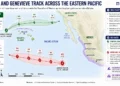
The National Hurricane Center said Sunday that swells generated by Marie would continue affecting Southern California for several days. At the time, the storm was about 695 miles south-southwest of San Diego with maximum sustained winds of 75 mph.
Marie is forecast to weaken while remaining offshore and is not expected to make landfall in California.

Long-Period Swells Reach Southern California
Marie’s influence is reaching the coast through long-period southerly swells traveling across the Pacific.
The National Weather Service office in Los Angeles and Oxnard said a significant southerly swell would produce hazardous surf along portions of the Southern California coast. Forecasters warned of large and potentially deadly waves, strong rip currents and minor coastal flooding.
The effects of a distant tropical cyclone can extend far beyond the storm’s center because ocean swells can travel hundreds or even thousands of miles across open water before reaching shore.
Rip Currents Pose Major Beach Risk
For swimmers and surfers, the most immediate danger is the strength of the ocean currents rather than hurricane-force winds.
The National Weather Service warned that dangerous and potentially life-threatening rip currents could become widespread along parts of the coast. These currents can rapidly pull people away from shore, creating hazardous conditions even when weather on the beach itself appears relatively calm.
■ Related News



Officials are advising people to stay out of the water during the most dangerous conditions or remain near staffed lifeguard towers when entering the ocean.
Large Waves Increase Exposure
The incoming swell is also producing unusually large breaking waves.
The National Weather Service reported that elevated surf could continue along parts of Southern California through Tuesday, while forecasts for portions of the broader California coast called for breaking waves around 10 feet.
Large waves can travel farther up the beach than normal, increasing risks for people near shorelines, rocks, jetties and other exposed locations.
Flooding And Erosion Remain Possible
The elevated surf is arriving alongside relatively high tides, raising the potential for localized coastal flooding.
The Los Angeles-area National Weather Service office warned of possible minor flooding around the coast and said large surf and dangerous rip currents could persist through at least Tuesday.
Repeated large waves can also contribute to beach erosion as water reaches farther inland than under normal conditions.
Marie Expected To Stay Offshore
Marie is not forecast to strike California directly.
The National Hurricane Center said the storm was moving northwest and was expected to turn west-northwest before continuing to weaken. Forecasters expected Marie to become a post-tropical remnant low by Wednesday.
The lack of a direct landfall does not remove the coastal threat. The storm’s swells can reach the California shoreline while the center of Marie remains far offshore.
Swells Extend Beyond Southern California
Marie’s effects are not confined to beaches around Los Angeles and San Diego.
The National Hurricane Center said storm-generated swells would continue affecting portions of southwestern Mexico, the Baja California Peninsula and Southern California for several days.
Other sections of the California coast have also experienced hazardous conditions associated with long-period swells generated by tropical activity in the eastern Pacific.
Officials Urge Beachgoers To Exercise Caution
Weather officials are urging residents and visitors to exercise extra caution while the swell persists.
The National Weather Service recommends staying out of hazardous water, remaining near lifeguard towers when entering the ocean and avoiding rocks and jetties, where large waves and strong currents can create particularly dangerous conditions.
The primary threat from Marie is therefore not a hurricane striking California, but the powerful ocean energy generated by a distant Pacific storm reaching a heavily populated coastline.
Reporting Credit: National Hurricane Center; National Weather Service Los Angeles/Oxnard; National Weather Service San Francisco Bay Area.