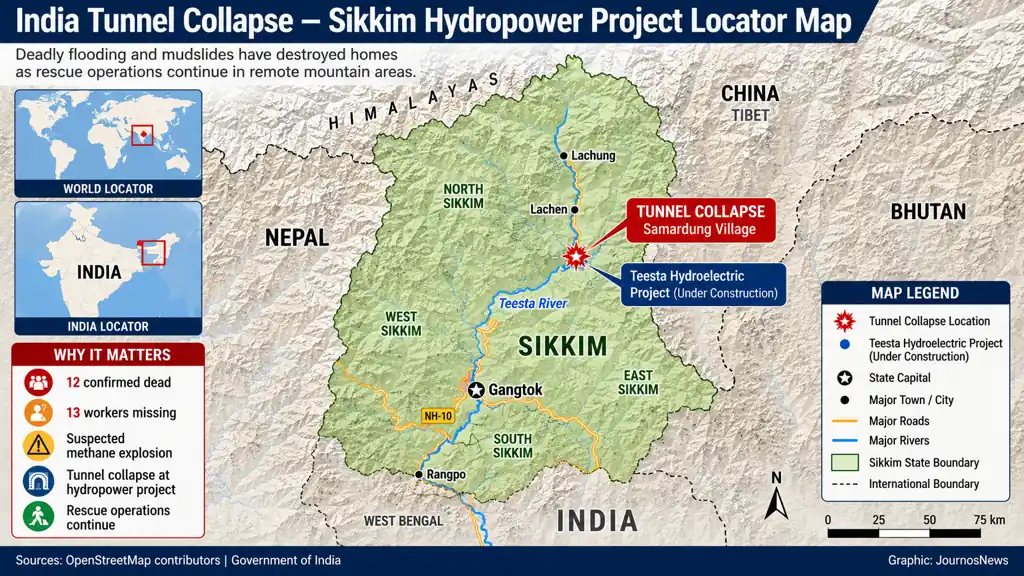
GUWAHATI, India – At least 12 people were killed and 13 remained missing Tuesday after a suspected gas explosion triggered the collapse of part of a tunnel under construction at a hydropower project in India’s northeastern state of Sikkim, authorities said.
The explosion occurred Monday inside the 500-megawatt Teesta hydroelectric project in Samardung village near the Chinese border, where 21 laborers were working underground. Two workers escaped following the blast, while six officials from the power utility later entered the tunnel to assist rescue operations but also became trapped, officials said.
Emergency crews continued rescue efforts Tuesday as specialized teams worked in hazardous conditions to reach those believed to be trapped beneath the collapsed section of the tunnel.

Toxic Gases Complicate Rescue Efforts
Specialized teams from India’s National Disaster Response Force (NDRF) deployed breathing equipment after detecting dangerous concentrations of methane, carbon monoxide and hydrogen sulfide inside the tunnel.
NDRF official Nitin Kumar said the hazardous atmosphere severely restricted rescue operations, forcing personnel to work in shifts of about 15 minutes despite using protective breathing equipment.
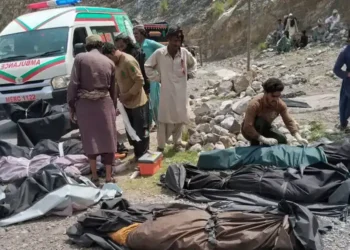
Officials said 12 bodies had been recovered by Tuesday while search teams continued efforts to locate the remaining missing workers.
Methane Buildup Suspected as Cause
Sikkim Chief Minister Prem Singh Tamang, who visited the disaster site, said preliminary findings indicate the explosion was likely caused by an accumulation of methane gas inside the tunnel.
Civil official Anupama Tamling said survivors reported hearing a powerful explosion moments before debris collapsed around them.
■ Related News




Authorities have not released the findings of a formal investigation, and the exact cause of the explosion remains under examination.
Himalayan Terrain Presents Engineering Challenges
The accident highlights the difficulties of constructing large infrastructure projects in India’s Himalayan region, where unstable geology and seismic activity create additional risks for underground engineering.
Construction accidents occur periodically across India as rapid infrastructure development encounters challenging geological conditions, workplace safety risks and severe weather.
The Himalayan states are particularly vulnerable because of fragile mountain formations and unpredictable underground conditions. In neighboring Meghalaya state, an explosion inside a coal mine killed at least 18 workers in February. In 2023, 41 workers trapped for 17 days after a tunnel collapse in Uttarakhand were successfully rescued following an extensive operation.
Experts Cite Fragile Geology
Geologists say the Teesta River basin lies within a seismically active region characterized by relatively young rock formations containing fractures and underground pockets capable of trapping natural gases.
Dr. Devesh Walia, a geology professor at North-Eastern Hill University in Meghalaya, said the area’s geology includes rock formations associated with coal-bearing strata.
He said methane and other gases may have accumulated underground before triggering the explosion.
Rescue efforts remained focused on reaching those still missing as authorities continued monitoring hazardous conditions inside the tunnel.
This report is based on reporting by The Associated Press.
Article Topics: India | Sikkim | Tunnel Collapse | Hydropower Project | Industrial Accident | Search and Rescue | Infrastructure | Himalayan Region