BANGKOK, Thailand – Criminal organizations rooted in Southeast Asia are rapidly expanding their operations beyond the region by leveraging advanced technology, integrated financial networks and artificial intelligence, creating an increasingly global illicit economy responsible for billions of dollars in losses, according to a United Nations report released Tuesday.
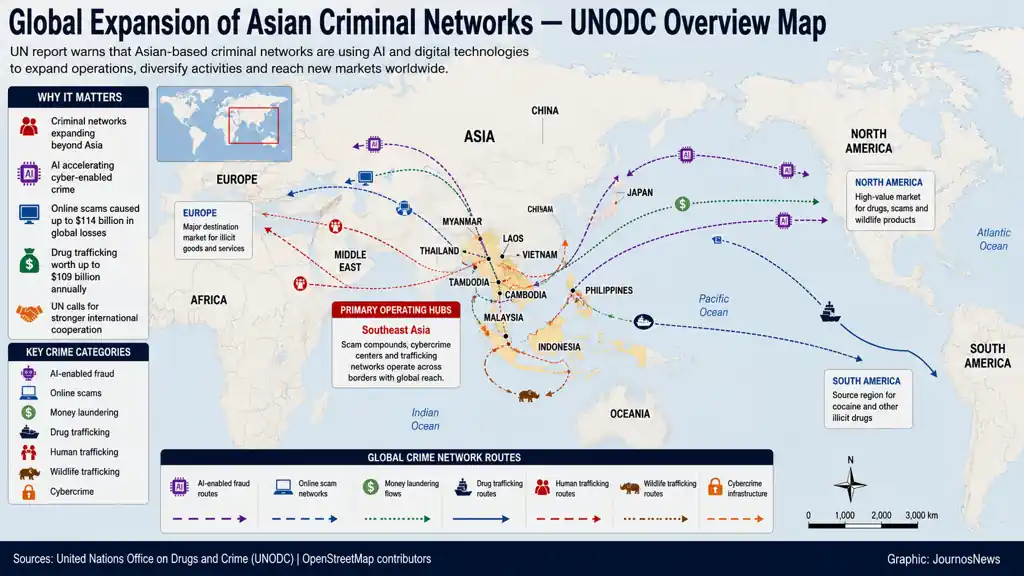
The report by the United Nations Office on Drugs and Crime (UNODC) estimates that online scams alone caused between $88.3 billion and $114.1 billion in global losses during 2025. It says criminal groups are increasingly operating across borders while diversifying into drug trafficking, human trafficking, wildlife smuggling and sophisticated financial crimes.
UNODC warned that technological advances are enabling organized crime networks to scale their operations more efficiently while extending their reach well beyond Asia.

Artificial Intelligence Accelerates Cybercrime and Child Exploitation
The report highlights growing concerns over the use of artificial intelligence to facilitate fraud, cybercrime and child exploitation.
According to UNODC researcher and report coordinator Inshik Sim, authorities are seeing a significant increase in AI-generated child sexual abuse images distributed through encrypted communication platforms.
The report says East Asian criminal syndicates are employing malware, generative AI and deepfake technology to conduct sexual extortion, online grooming and other forms of exploitation. It warns these tools increase the risks of both online abuse and crimes involving direct contact with victims.
UNODC also said hundreds of scam compounds operating across Southeast Asia have become centers for sex trafficking and the production and distribution of child sexual abuse material.
Beyond sexual exploitation, victims may also be forced into domestic servitude, begging and other forms of forced labor, according to the report.
■ Related News




Online Platforms Expose Children to Growing Risks
The report identifies social media, online gaming and internet gambling as additional areas of concern for children and teenagers.
UNODC cited regional surveys indicating that large numbers of young people across Southeast Asia participate in online gambling, with some developing addictive behavior.
Officials said digital platforms are increasingly being exploited by criminal organizations to recruit, exploit and target vulnerable users.
Drug Trafficking Routes Continue to Evolve
The report estimates that illicit drug sales across Southeast Asia and neighboring regions generate up to $109 billion annually, with authorities recording increasing seizures of methamphetamine, heroin and ketamine.
UNODC identified the Sulu-Celebes maritime corridor between Indonesia, Malaysia and the Philippines as an increasingly important route for cocaine shipments originating in Latin America and destined for Asian markets. The report says traffickers sometimes conceal illicit cargo within legitimate commercial shipments, including Chinese tea.
The same maritime corridor is also used to smuggle wildlife products and small arms, according to the report.
Meanwhile, Thailand and Vietnam have become increasingly important sources of cannabis trafficked to Japan, where the drug remains illegal, as well as to European markets.
The report noted that authorities in Malaysia’s Sabah state earlier this year seized more than three tons of methamphetamine, ketamine and ecstasy in the largest drug seizure ever recorded there.
Criminal Networks Strengthen Global Financial Infrastructure
UNODC said organized crime groups increasingly rely on cross-border financial and communications systems that support what it describes as a global “criminal service infrastructure.”
According to the report, criminals use cryptocurrency, encrypted communications and generative AI to create convincing phishing campaigns, real-time deepfake video and voice impersonations, and AI-powered language translation that enables fraud schemes to target victims simultaneously across multiple countries.
Satellite communications also allow scam compounds to operate from remote locations or areas under increased surveillance.
UNODC said these technologies have significantly strengthened the resilience and adaptability of international criminal organizations.
Crackdowns Force Scam Operations to Adapt
Authorities in countries including Thailand and China have conducted major operations targeting large scam compounds located primarily along the border regions of Myanmar, Laos and Cambodia.
According to the report, those enforcement actions have not eliminated criminal activity but instead prompted organizations to relocate or restructure their operations.
UNODC analyst Seong Jae Shin said many large scam centers have moved into smaller facilities such as private villas, making them more difficult for authorities to detect and dismantle.
He said the operations had disrupted criminal networks but had not stopped them, with many groups increasingly moving underground as governments intensify enforcement efforts.
UN Calls for Coordinated International Response
The report concludes that the increasingly interconnected nature of organized crime requires governments to strengthen international cooperation across law enforcement, financial regulation, digital communications and online platforms.
UNODC said isolated national enforcement efforts are unlikely to be sufficient against criminal organizations that operate seamlessly across borders while exploiting rapidly evolving technologies.
This report is based on reporting by The Associated Press.
Article Topics: United Nations | Organized Crime | Southeast Asia | Artificial Intelligence | Cybercrime | Human Trafficking | Drug Trafficking | Money Laundering