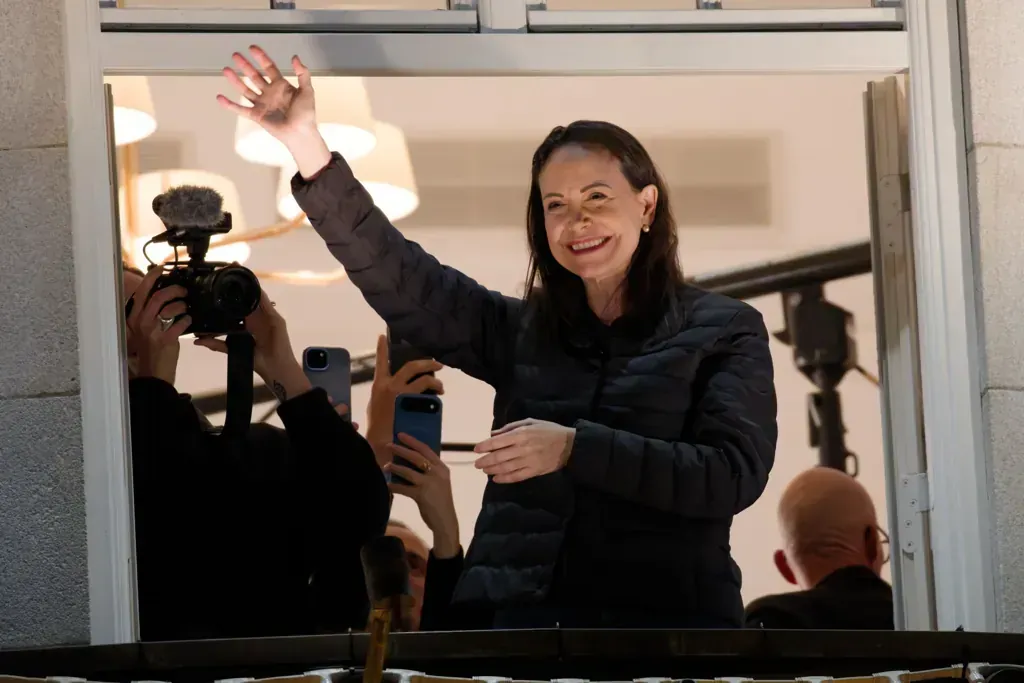
CARACAS, Venezuela — María Corina Machado returned to Venezuela on October 25 after nearly a year abroad. Her return brings a leading opposition figure back into a country still facing an uncertain political future after Nicolás Maduro’s removal in January.
Machado, who won the Nobel Peace Prize, announced her return on X. “I’m here. With you all,” she wrote. Her team shared images of her at a church in Lara state, in western Venezuela. Reuters also reported that supporters gathered along her route towards Caracas.
Edmundo González Urrutia, the opposition candidate in Venezuela’s disputed 2024 presidential election, confirmed her return. He said he planned to join her.

Machado’s return is a major political development. She spent much of the period after the 2024 election in hiding. In late 2025, she left Venezuela to receive the Nobel Peace Prize.
Now she is back as pressure grows for a new presidential election.
However, her return does not mean Venezuela has completed a democratic transition. Delcy Rodríguez remains in charge of the interim government. Election officials have not announced a date for a presidential vote. Opposition groups also disagree over how to take part in talks about the country’s future.
The key question is whether Machado’s return will help secure a fair election or whether the transition will continue without her movement at the negotiating table.
How Machado returned—and what the US knew
Machado travelled from Panama through Colombia before entering Venezuela by land. Her team has not shared every detail of the journey. Images from her team and independent reporting from Lara state support reports that she returned.
■ Related News


Her journey has also raised questions about the role of the United States.
Reuters cited a person briefed on Machado’s plans who said the United States, Panama and Colombia helped coordinate her return. The source also said President Donald Trump approved the plan.
Trump said on October 25 that he did not know about Machado’s return. The White House and State Department did not immediately answer Reuters’ questions about the trip.
These accounts leave important details unclear. The public record does not yet explain the full chain of decisions behind her return.
Questions about US involvement began before she arrived. In September, Reuters reported that US officials had privately asked Machado to delay her return. The report cited four opposition sources and two political analysts. A Congressional Research Service report later discussed questions about the US role.
Those reports show that the alleged requests became an issue. They do not fully explain why Washington may have wanted Machado to wait.
The Trump administration has focused on stabilizing Venezuela, supporting economic recovery and encouraging political talks. Machado has called for free and fair elections. The administration has also backed talks between Rodríguez’s government and an opposition faction that does not include Machado’s movement.
The White House has not given a full public account of its decisions about Machado’s return. Direct responses from the White House, State Department, Machado’s team and the governments of Panama and Colombia are still needed.
The disputed 2024 election
Venezuela’s current crisis began with the presidential election on July 28, 2024.
The National Electoral Council (CNE), which was aligned with Maduro’s government, declared him the winner. But it did not publish the full results from individual polling stations needed to support that announcement.
The opposition backed González after authorities barred Machado from running. Its supporters collected and published thousands of voting-machine tally sheets that they said showed González had won.
The Carter Center observed the election and later concluded that it failed to meet international standards for democratic elections. It criticized the CNE’s failure to publish detailed results. The center also said the tally sheets published by the opposition showed a clear victory for González.
A United Nations panel of experts also raised concerns about the lack of transparency in the results process. The US government said the available evidence supported González’s victory.
Maduro’s government rejected the opposition’s claims and maintained that he had won.
The public record does not support treating all claims about the election as equally established. The CNE failed to publish the detailed official results needed to settle the dispute transparently. Independent assessments also found serious problems with the election process.
The disputed result led to protests, arrests and further limits on political activity. Opposition figures and human-rights groups reported detentions and intimidation. The government disputed some allegations and said its security measures were needed to maintain public order.
Each case needs careful checking against court records, named individuals and updated reports from human-rights organizations.
Maduro’s removal changed the government, not the election process
The situation changed sharply on January 3, 2026. US forces captured Maduro and his wife, Cilia Flores, and took them to the United States to face criminal proceedings. Both have denied the charges against them.
The operation removed Maduro from power. But it did not lead to a new election or install González, the opposition candidate who claimed victory in 2024.
Instead, Delcy Rodríguez, Maduro’s vice president, took over as acting president under a ruling by Venezuela’s Supreme Tribunal of Justice (TSJ).
This created a central problem for the transition. Maduro left power through a US operation, and a Venezuelan court then directed Rodríguez to take charge. Voters did not choose a new president in a fresh election.
That leaves questions about the legal basis for Rodríguez’s continued rule and how the country will return to an elected government.
The 90-day limit and Rodríguez’s legal authority
The legal basis for Rodríguez’s continued presidency remains a key issue.
On January 3, the TSJ’s Constitutional Chamber issued ruling No. 00001 in case 2026-00001. The ruling addressed Maduro’s absence and directed Rodríguez to assume the presidency in an acting role.
The court described Maduro’s absence as forced and temporary. It said the arrangement was needed to preserve the state’s continuity and protect national security.
The ruling referred to Article 234 of Venezuela’s Constitution. That article allows the executive vice president to assume the presidency during a temporary absence for up to 90 days. The National Assembly may approve an extension for another 90 days. Article 239 sets out the executive vice president’s duties.
The problem is that Rodríguez remained in office after the first 90 days expired.
The Associated Press reported in April that the National Assembly had not publicly voted to extend her mandate. That raised questions about the legal basis for her continued tenure.
However, that report does not replace a full review of later court rulings and legislative records. The newsroom must obtain all relevant TSJ decisions, National Assembly resolutions and official notices issued since January.
The key question is whether the authorities extended Rodríguez’s mandate, replaced the original legal basis or adopted a new interpretation of the Constitution.
The government may argue that extraordinary circumstances require continuity. Critics may argue that Rodríguez has remained in office beyond the constitutional period without the required legislative approval.
Both positions must be tested against the legal documents. Until the full record is verified, her legal status should be described as disputed rather than definitively lawful or unlawful.
Venezuela still has no presidential election date
As of October 26, no presidential election date has been announced.
Rodríguez told the United Nations General Assembly in September that Venezuela would hold elections as part of a transition to what she called “full democracy.” She did not give a date.
Machado has called for an election by July 2027. She says Venezuela needs a clear path towards a free and fair vote.
The lack of a date leaves several important questions unanswered:
- Which institution will set the election timetable?
- What legal process will determine how long Rodríguez remains in office?
- Who will appoint members of a reformed electoral council?
- Will all eligible opposition candidates be able to register?
- Will Venezuelans living abroad be able to enroll and vote?
- What protections will candidates, organizers, journalists and election observers receive?
The CNE runs elections, but it cannot be considered in isolation from the courts, legislature and government. The legal framework and the independence of these institutions will shape whether a future vote can be trusted.
Officials have argued that institutional reforms must come before an election. Such reforms may be needed to restore public confidence. But a process without clear deadlines could also delay the return to elected government.
A credible timetable should name the institutions responsible for each step. It should set deadlines, explain the legal process and show how candidates and observers can check the results.
Machado’s return may increase pressure for answers. It does not provide them.
The opposition wants more than an election date
Machado and González continue to argue that the 2024 election result must be recognized and that Venezuela needs a genuine democratic transition.
Their position draws on the opposition’s tally sheets and independent assessments that challenged the CNE’s announcement.
They want more than a date on the electoral calendar. A credible election would require an independent electoral authority, full publication of polling-station results and fair access to the campaign. Political parties must be able to organise freely. Voters living abroad must also have a workable way to register and vote.
The 2024 election showed why these safeguards matter. The Carter Center reported unequal conditions for candidates, barriers to overseas voter registration and a failure to publish detailed results.
Authorities also barred Machado from running in 2024, prompting the opposition to support González instead. The current status of other candidate bans, party registrations, arrest warrants and court cases needs to be checked against current legal records.
Machado’s return alone cannot prove that these restrictions have ended.
A real transition would require evidence that opposition candidates can compete without arbitrary exclusion, organizers can work without intimidation and courts can settle election disputes independently.
Allowing a prominent opposition leader to return is relevant. It is not proof that every political group now has the freedom to compete.
Washington’s role in the transition
The United States has become a major player in Venezuela’s post-Maduro transition.
Washington has described its approach in terms of stabilization, economic recovery, political reconciliation and a later move towards a political transition. A Congressional Research Service report published in August outlined these stages. It also noted that US officials had not publicly clarified what role they would support for Machado in the talks.
The Trump administration has backed Rodríguez’s interim government and pursued arrangements affecting Venezuela’s oil industry.
In September, international energy companies committed to expanding projects at a ceremony overseen by Rodríguez and US Energy Secretary Chris Wright, Reuters reported. US officials have presented economic recovery as part of the wider effort to stabilize the country.
This approach raises an important question: can economic recovery move forward while political rights and independent institutions remain uncertain?
Oil production and investment may support economic activity and government revenue. But they do not automatically create fair elections or independent courts.
Machado argues that lasting stability requires a democratic government. Her return gives her another opportunity to press Washington for a clear election timetable.
However, the administration’s support for Rodríguez shows that Washington’s immediate priorities may not match Machado’s preferred path to a transition.
The US role should be assessed through documented actions. These include the capture of Maduro, support for Rodríguez, negotiations with the interim government, decisions affecting sanctions and oil, and reports that officials asked Machado to delay her return.
The timing of oil deals and political talks does not, by itself, prove that energy interests drove every US decision. Reports of coordination around Machado’s journey also do not explain who approved every step.
The White House, State Department, Machado’s team and Rodríguez’s government should be asked to explain their roles. Congressional testimony, sanctions documents and published agreements could help establish what Washington has committed to and what remains unresolved.
Talks continue without Machado’s movement
Rodríguez’s government has been negotiating with representatives linked to Venezuela’s 2015 National Assembly. That opposition-controlled legislature was elected before Maduro’s government tightened its hold on state institutions.
Jorge Rodríguez, the current National Assembly president and Delcy Rodríguez’s brother, leads the government’s side. Dinorah Figuera leads the opposition delegation. Figuera headed the 2015 National Assembly and returned from exile in 2026.
The talks began in August and have received US diplomatic support, according to government and congressional reporting.
Machado and González are not taking part. In a joint statement on July 26, they said their group would not join the talks but would not obstruct them.
Their absence matters because their movement claims that González won the 2024 election and has a large base of support.
The US State Department says the talks have produced several commitments. In an October 9 fact sheet, it reported changes involving the Supreme Court, restored access to more than 70 blocked internet domains, changes to a restrictive law and the release of more than 1,000 political prisoners since January. It also reported 177 additional releases since the talks began.
The department said later rounds would address electoral-council reform and guarantees for political parties and leaders.
These figures need independent checks. Researchers should compare them with Venezuelan court records, judicial appointments, tests of internet access and human-rights reports. Prisoner releases should be checked against names, dates, legal conditions and any restrictions that remain.
Negotiations can make progress even when some opposition groups stay outside them. But agreements among a limited group of participants do not guarantee that all political forces can compete freely.
The main test is whether the talks produce changes that people can verify. These include a transparent process for appointing judges, an independent electoral council, changes to laws that restrict political activity and enforceable guarantees for opposition parties.
The existence of talks does not, by itself, prove that political reconciliation has succeeded.
Political prisoners and exiles
The treatment of political prisoners and returning exiles offers another way to measure progress.
The US State Department has reported large numbers of releases since January and described improvements in civil liberties. It has also referred to the return of opposition figures who had lived abroad.
These claims should be checked against independent records rather than repeated as a single total.
Foro Penal, a Venezuelan human-rights organization, tracks political detention. It is an important source for dated records of arrests and releases. United Nations human-rights bodies and other independent groups can provide further information about charges, court cases and reports of mistreatment.
A release does not always mean that a person has regained full freedom. Some people may still face travel limits, reporting requirements, pending charges or restrictions on political activity.
The newsroom should distinguish between release without conditions, release with restrictions, dismissal of charges and acquittal.
The same care applies to exiles. One person’s return does not prove that others can return safely or that legal threats against them have ended.
Machado’s return should therefore be assessed alongside the experiences of other opposition figures, organizers and civil-society groups.
Can people organise openly? Can they hold public meetings and contact supporters? Can they take part in politics without facing arbitrary detention or intimidation?
A credible transition needs consistent protections for all political actors, not just individual permissions for prominent figures.
Electoral and judicial reform will be key tests
Reforming the Supreme Tribunal and the National Electoral Council is among the stated goals of the reconciliation talks.
The way these institutions select leaders and make decisions will affect whether a future election can earn public trust.
Judicial reform must answer several questions. Who selects judges? What standards must they meet? Are appointments transparent? Can judges rule against the government without fear of punishment? Are court decisions published and enforced?
The same questions apply to the electoral council. Replacing its members will not guarantee independence if one political faction still controls the selection process or if the council cannot publish results and resolve complaints openly.
The 2024 election provides a clear test. The CNE announced a winner without publishing the detailed polling-station results needed to support its claim. The Carter Center said that failure fell short of international standards for electoral integrity.
A reformed electoral council should publish complete results quickly. It should allow candidates and observers to check the count, provide fair access to electoral procedures and resolve complaints through a transparent process.
Voter registration must also be accessible, including for Venezuelans living abroad.
Machado’s Vente Venezuela movement has launched an initiative to collect information from Venezuelans abroad ahead of possible future reforms. But this initiative cannot replace official voter registration or guarantee that the CNE will accept the data.
Its value will depend on whether the authorities create a lawful and accessible process for overseas voters.
Progress should be measured through enacted laws, transparent appointments, published election procedures and evidence that opposition parties can compete on equal terms.
What Machado’s return changes—and what remains unresolved
Machado’s return gives the opposition leader a direct presence in Venezuela. She can seek to mobilize supporters, meet families of political prisoners and press for a date for free and fair elections.
Her return may also increase pressure on Rodríguez’s government and Washington to explain the transition timetable.
But several central questions remain unanswered. Her arrival does not settle Rodríguez’s legal authority, set an election date or establish that the courts and electoral council are independent.
It also does not prove that all political prisoners have been released or that opposition organizers can work without restrictions.
Those issues require documents, independent checks and continued reporting.
The next milestones are clear. Authorities need to publish the legal basis for Rodríguez’s continued role and announce a formal election timetable. The country also needs verifiable judicial and electoral reforms, independent checks on prisoner releases and guarantees that all political forces can organize and compete.
Venezuela has moved beyond the political order that existed before Maduro’s removal. But the country has not yet shown that it has established a fully competitive democratic process.
Machado’s return is an important event in that uncertain transition. Whether it becomes a turning point will depend on what happens next—and whether the government’s promises lead to lasting change.
Reporting Credit: Venezuela’s Supreme Tribunal of Justice; National Assembly records; National Electoral Council; official statements from María Corina Machado and Edmundo González Urrutia; US State Department and White House statements; court and legislative documents; human-rights records.