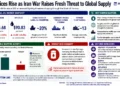
NEW YORK – U.S. stocks finished mixed Monday as a sharp decline in oil prices eased concerns about global energy supplies after the United States and Iran paused military operations and renewed efforts to restart negotiations aimed at ending their conflict.
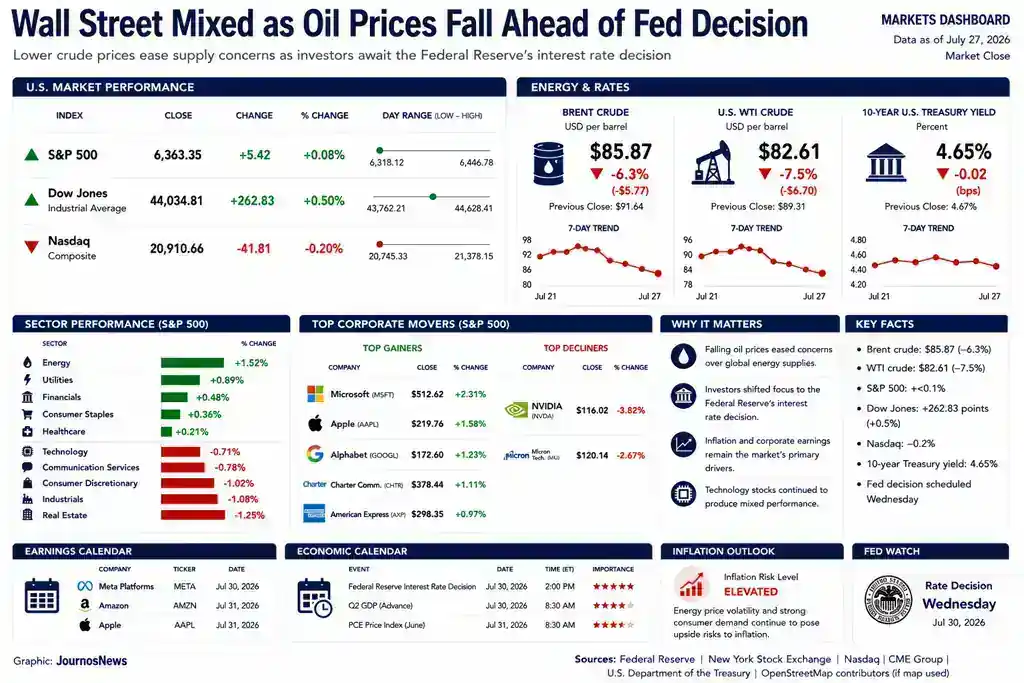
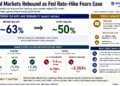
The S&P 500 edged up less than 0.1% after fluctuating between modest gains and losses throughout the session, recovering from two consecutive weekly declines. The Dow Jones Industrial Average rose 262.83 points, or 0.5%, to close at 52,210.08, while the Nasdaq Composite fell 43.74 points, or 0.2%, extending its losing streak to four sessions.
Despite Monday’s relatively stable trading, all three major U.S. stock indexes remained on pace to finish the month lower, with the S&P 500 and Nasdaq positioned for a second consecutive monthly decline.

Falling Oil Prices Calm Markets
A sharp retreat in crude oil prices helped ease investor concerns after energy markets surged the previous week amid escalating tensions between Washington and Tehran.
Brent crude, the international benchmark, fell 6.3% to settle at $85.87 per barrel for October delivery, while U.S. crude for September delivery dropped 7.5% to $82.61 per barrel.
Oil prices had climbed above $100 per barrel during the previous week’s heightened tensions as investors feared disruptions to global supplies. According to The Associated Press, the conflict significantly reduced, and at times halted, shipping through the Strait of Hormuz, one of the world’s most important energy transit routes.
Higher fuel costs have already contributed to rising gasoline prices and increased transportation expenses, adding inflationary pressure as businesses pass some of those costs on to consumers.
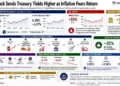
The bond market also reflected easing investor anxiety. The yield on the benchmark 10-year U.S. Treasury note declined to 4.65% from 4.69% on Friday, indicating increased demand for U.S. government debt.


Technology Stocks Deliver Mixed Performance
Large technology companies produced mixed results, limiting broader market gains.
Nvidia fell 5%, while Micron Technology declined 2.3%. Their losses were partially offset by gains in Microsoft, which rose 1.9%, and Apple, which added 1.2%.
Because of their large market capitalizations, movements in these companies continued to have an outsized influence on the broader market indexes.
Although most companies in the S&P 500 finished higher, weakness among several major technology stocks kept overall gains modest.
Communication and Financial Stocks Advance
Communication services companies ranked among the session’s strongest performers.
Alphabet, Google’s parent company, rose 2.1%, while Charter Communications gained 6.7%. Comcast also advanced 2.3%.
Financial companies tied to consumer spending also posted gains. American Express climbed 2.8%, Capital One Financial added 2.1%, Visa rose 1.9% and Mastercard gained 2.2%.
Chinese Chipmaker Debut Draws Attention
Outside the United States, Chinese memory chipmaker CXMT attracted investor attention during its debut on Shanghai’s technology-focused exchange.
According to The Associated Press, the company’s shares surged after listing, giving it an estimated market capitalization of about 3.3 trillion yuan, or approximately $490 billion, making it China’s most valuable publicly listed company.
Investors Await Federal Reserve Decision
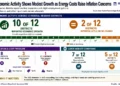
Investors are now turning their attention to several key economic reports and the Federal Reserve’s latest monetary policy decision later this week.
Scheduled U.S. data releases include a consumer confidence report on Tuesday and an inflation report on Thursday, both of which could influence expectations for future interest rate policy.
The Federal Reserve is expected to announce its latest interest rate decision Wednesday as policymakers continue assessing inflation, higher energy costs and the economic effects of recently imposed U.S. tariffs.
According to The Associated Press, financial markets were pricing in roughly a 36% probability that the Fed would raise its benchmark interest rate at this week’s meeting.
Higher interest rates are intended to slow inflation by reducing borrowing and spending, but they can also weigh on consumer demand, business investment and economic growth.
The Federal Reserve has kept rates unchanged for much of the year while monitoring inflation trends, though markets continue to anticipate at least one additional rate increase before year-end.
Earnings Season Remains in Focus
Corporate earnings will provide another key test of the U.S. economy this week as investors assess consumer demand and business performance.
Sherwin-Williams, Boeing and Visa are scheduled to report quarterly results Tuesday, followed by Starbucks, Chipotle and Microsoft on Wednesday. Amazon and Apple are expected to release earnings Thursday.
Technology companies remain under particularly close scrutiny because their strong share-price gains have played a major role in Wall Street’s performance over the past year.
Investors will be watching whether corporate earnings and forward guidance continue to justify elevated market valuations amid persistent inflation, higher borrowing costs and ongoing geopolitical uncertainty.
This report is based on reporting by The Associated Press.