Global financial markets rebounded Thursday after Federal Reserve Governor Christopher Waller said he could support leaving interest rates unchanged at the September policy meeting if forthcoming inflation data show continued improvement.
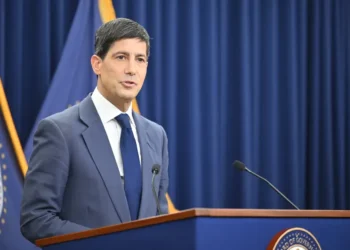
The comments reduced expectations of another rate increase after more hawkish signals from Federal Reserve Chair Kevin Warsh at the Jackson Hole economic symposium had unsettled investors.
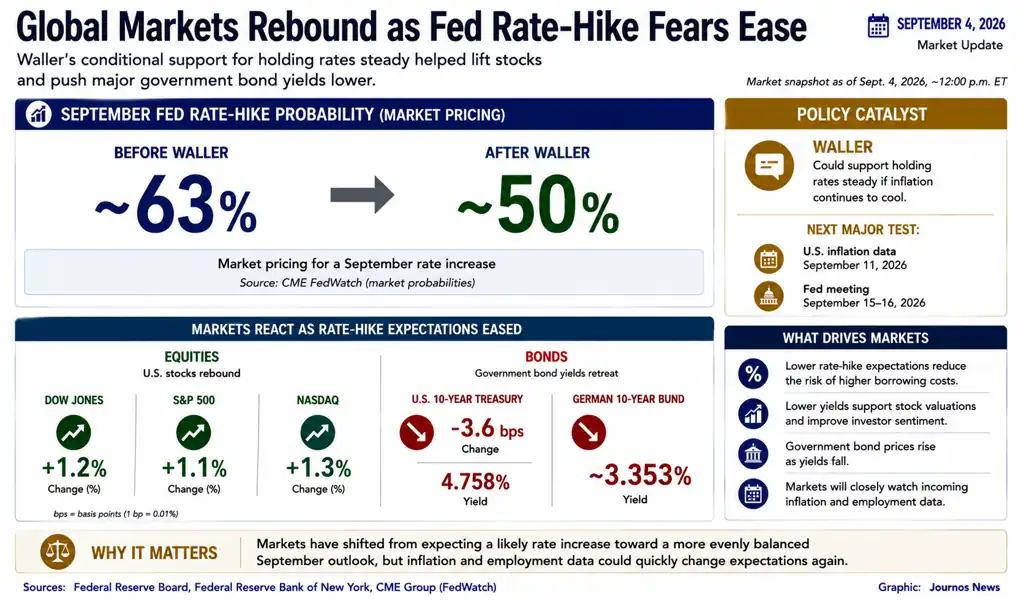
CME FedWatch data showed markets had priced in roughly a 63% probability of a September rate increase before Waller’s remarks. That probability fell to about 50% afterward, reflecting a more evenly balanced outlook for the Federal Reserve’s next decision.

Stocks Recover Across Major Markets
U.S. equities rose as expectations of further monetary tightening eased.
The Dow Jones Industrial Average gained about 1.2%, while the S&P 500 rose roughly 1.1% and the Nasdaq Composite advanced about 1.3%. European shares also moved higher, contributing to a broader recovery in global equity markets.
The gains followed several sessions in which investors had been preparing for the possibility that persistent inflation could require the Federal Reserve to tighten policy further.
Waller’s comments introduced a different possibility: policymakers could wait for additional economic evidence before deciding whether further tightening is necessary.
Bond Yields Retreat
Government bond markets also recovered from recent selling pressure.
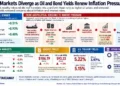


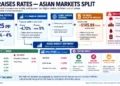
The benchmark 10-year U.S. Treasury yield fell about 3.6 basis points to 4.758%, while Germany’s 10-year government bond yield declined to around 3.353%.
The decline in yields reflected reduced expectations for further immediate tightening. Recent increases in borrowing costs had been driven by concerns about inflation, government borrowing and the prospect of additional Federal Reserve rate increases.
Lower bond yields can also support equity valuations by reducing borrowing costs and easing pressure on the cost of capital.
Inflation Data Become the Key Test
Waller’s position remains dependent on the next round of economic data.
He said he would support keeping rates unchanged if inflation continues to moderate, while a stronger inflation reading could lead him to favor another increase.
The August inflation report is due on Sept. 11, only days before the Federal Reserve’s Sept. 15–16 policy meeting.
That timing makes the next inflation data particularly significant for financial markets. Investors may have shifted toward expecting a pause, but policymakers must still determine whether inflation is moving sustainably toward the Federal Reserve’s target.
Fed Officials Offer Different Signals
The debate over the September decision remains unresolved.
Warsh has emphasized that inflation remains above the Federal Reserve’s 2% objective and that policymakers may need to take further action if price pressures fail to improve. Markets interpreted his remarks as increasing the possibility of another rate increase.
New York Fed President John Williams has taken a more measured position, saying recent increases in Treasury yields reflected economic strength while emphasizing the need to continue monitoring inflation.
The differing views mean that investors cannot yet regard a September pause as a settled outcome.
Oil Prices Add to Inflation Risks
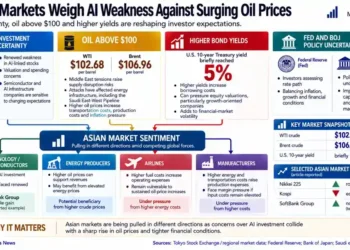
The market recovery is occurring while oil prices remain elevated amid renewed fighting between the United States and Iran and concerns over energy shipments through the Strait of Hormuz.
Higher energy costs could complicate the Federal Reserve’s inflation outlook if they persist.
That creates competing pressures for policymakers. Continued improvement in underlying inflation and weaker labor-market conditions could support keeping rates unchanged, while sustained increases in energy prices could make progress toward the inflation target more difficult.
Employment Data Could Shift Expectations
Investors are also awaiting the latest U.S. employment report before the September meeting.
A weaker labor-market report could strengthen the case for avoiding another rate increase. Conversely, stronger-than-expected employment or wage figures could renew concerns that economic conditions remain too strong for inflation to decline quickly.
The market response to Waller’s remarks therefore remains vulnerable to incoming economic data.
Global Risk Appetite Improves
The change in U.S. rate expectations spread quickly through international markets.
Asian technology shares rebounded, while equities and government bonds in other major markets benefited from expectations of less aggressive U.S. monetary tightening. South Korean semiconductor companies Samsung Electronics and SK hynix also moved higher as investors reassessed the outlook for interest rates.
Lower expectations for additional U.S. rate increases can improve global financial conditions by reducing pressure from higher borrowing costs.
September Decision Remains Data Dependent
The rally has not removed the broader risks facing markets.
Elevated oil prices, geopolitical uncertainty, heavy government borrowing and persistent inflation remain important pressures for bond and equity markets. The Federal Reserve must also weigh inflation risks against the possibility that further monetary tightening could weaken employment and economic growth.
For now, Waller’s comments have shifted the immediate market outlook away from expectations of a likely September increase toward a more balanced assessment.
Whether the Federal Reserve ultimately leaves rates unchanged will depend on inflation and employment data released before policymakers meet later this month.
Reporting Credit: Federal Reserve Board; Federal Reserve Bank of New York; CME Group market data.