TOKYO, Japan – Asian stocks mostly advanced in early Wednesday trading as lower oil prices provided relief to oil-importing economies and investors continued to assess diplomatic efforts involving Iran and the risks surrounding the Strait of Hormuz.
Optimism surrounding artificial intelligence also supported some regional markets ahead of Nvidia’s latest earnings report, keeping technology stocks in focus.
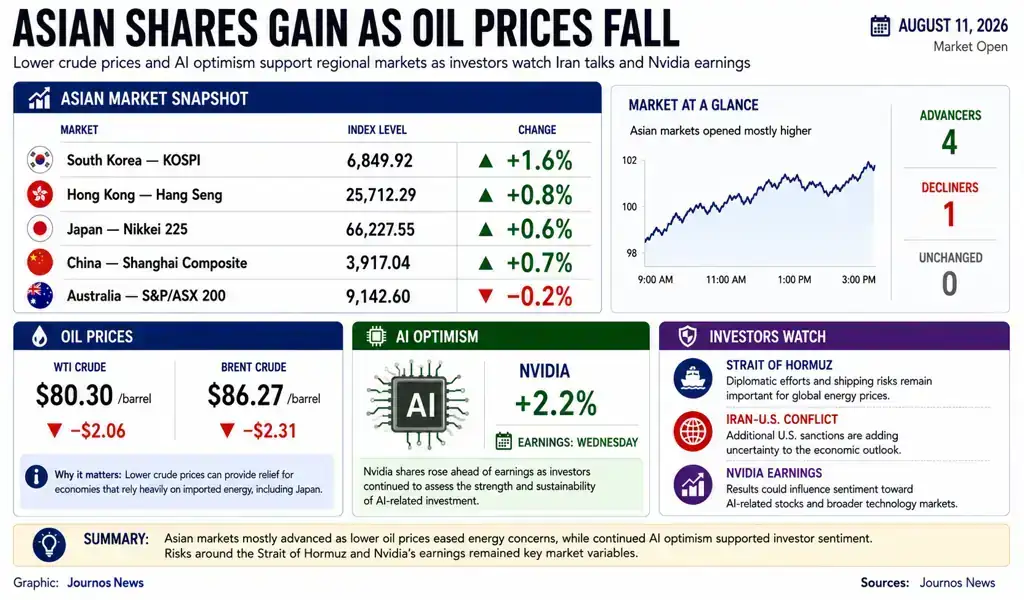
Japan’s Nikkei 225 gained 0.6% to 66,227.55 in morning trading. South Korea’s Kospi rose 1.6% to 6,849.92, while Hong Kong’s Hang Seng advanced 0.8% to 25,712.29. The Shanghai Composite gained 0.7% to 3,917.04.

Australia’s S&P/ASX 200 moved lower, declining 0.2% to 9,142.60.
Lower Oil Prices Ease Pressure on Asian Economies
Oil prices continued to fall despite ongoing tensions between the United States and Iran.
U.S. benchmark crude declined $2.06 to $80.30 a barrel, while Brent crude, the international benchmark, fell $2.31 to $86.27.
Lower crude prices can provide relief to economies that depend heavily on imported energy. Japan, for example, imports virtually all of its oil.
Brent crude has experienced significant volatility over the past month, moving between roughly $72 and $102 a barrel as expectations surrounding a possible U.S.-Iran agreement changed.
■ Related News




For investors, the direction of oil prices remains closely connected to developments around the Strait of Hormuz, a major route for global energy shipments.
Strait of Hormuz Remains a Market Focus
Diplomatic efforts surrounding the Strait of Hormuz remained central to the energy-market outlook.
Iranian and Omani foreign ministers met Tuesday to discuss a possible phased approach to managing ship traffic through the waterway after an oil tanker was disabled in an attack off the coast of Oman.
The incident underscored the risks facing shipping companies attempting to navigate the strategically important route while access remains restricted.
A Pakistani delegation also met with Iranian President Masoud Pezeshkian as Islamabad sought to revive negotiations aimed at ending the Iran-U.S. conflict.
Pakistan Interior Minister Mohsin Naqvi described the meeting as “very positive and productive,” according to Pakistan’s military.
At the same time, Washington announced additional sanctions targeting Iran’s economy, adding another source of uncertainty for markets already sensitive to developments in energy supplies.
Nvidia Earnings Put AI Stocks in Focus
Artificial intelligence remained another major focus for investors.
Nvidia, one of the biggest beneficiaries of the AI investment boom, gained 2.2% on Wall Street ahead of its latest earnings report scheduled for Wednesday.
The rise followed a 2.9% decline in Nvidia shares during the previous session, when the company was among the biggest drags on the S&P 500.
AI-related stocks have experienced sharp swings in recent months as investors debate whether valuations have become excessive and whether the enormous investment in artificial intelligence can continue to generate sufficient returns.
Eric Schiffer, head of Los Angeles-based Patriarch Organization, said he expected demand for AI technology to continue growing even if the sector experiences periods of adjustment.
He argued that companies and governments face pressure to keep investing in artificial intelligence to remain competitive.
“There’s a lot of fear about AI,” Schiffer said, citing the substantial financing required to support the sector. He added that investors could be underestimating the technology’s broader significance.
U.S. Bond Yields Move Lower
U.S. government bond yields also declined.
The 10-year Treasury yield fell to 4.63% from 4.70% late Monday and 4.74% at the end of the previous week.
Despite the decline, the yield remained significantly above its 3.97% level before the Iran war contributed to higher oil prices and increased inflation concerns.
Lower Treasury yields can influence global borrowing costs and investment decisions, making movements in U.S. government bonds relevant to Asian markets as well.
Wall Street Ends Higher
U.S. stocks finished higher in the previous session.
The S&P 500 gained 24.42 points, or about 0.3%, to 7,677.28.
The Dow Jones Industrial Average rose 160.24 points to 53,577.40, while the Nasdaq composite increased 171.11 points to 26,151.30.
Currency markets were relatively stable. The U.S. dollar slipped to 159.02 Japanese yen from 159.20 yen, while the euro declined to $1.1669 from $1.1675.
Markets Balance Energy and Technology Risks
Asian markets are being supported by two developments: lower oil prices and continued investment in artificial intelligence.
But both sources of optimism remain vulnerable to changing expectations.
Oil markets remain sensitive to developments involving Iran and the Strait of Hormuz, while technology investors are watching Nvidia’s earnings for evidence about whether the AI investment boom can continue to justify high valuations.
For Asian economies that rely heavily on imported energy, sustained declines in crude prices could reduce inflation and business costs. At the same time, stronger AI investment could continue supporting technology companies and regional markets.
The broader market outlook therefore remains closely tied to developments in both energy markets and the technology sector.
This report is based on reporting by The Associated Press.