Journos News - Breaking News, World News, Top Stories, Todays Headlines and Flash Reports
Thursday, September 3, 2026
  • Login
  • Home
  • World
    • Africa
    • Americas
    • Asia
    • Europe
    • Middle East
    • Oceania
  • Politics
  • Business
  • Technology
  • Health
  • Science
  • Sports
  • Entertainment
  • Culture
No Result
View All Result
  • Home
  • World
    • Africa
    • Americas
    • Asia
    • Europe
    • Middle East
    • Oceania
  • Politics
  • Business
  • Technology
  • Health
  • Science
  • Sports
  • Entertainment
  • Culture
No Result
View All Result
Journos News - Breaking News, World News, Top Stories, Todays Headlines and Flash Reports
No Result
View All Result
Home Business

U.S.-Iran Fighting Keeps Oil Supply Risks in Focus as Prices Rise

Renewed fighting between Washington and Tehran has pushed Brent crude toward $96 a barrel as traders assess the threat to shipping through the Strait of Hormuz.

The Daily Desk by The Daily Desk
September 3, 2026
in Business, Economy
0
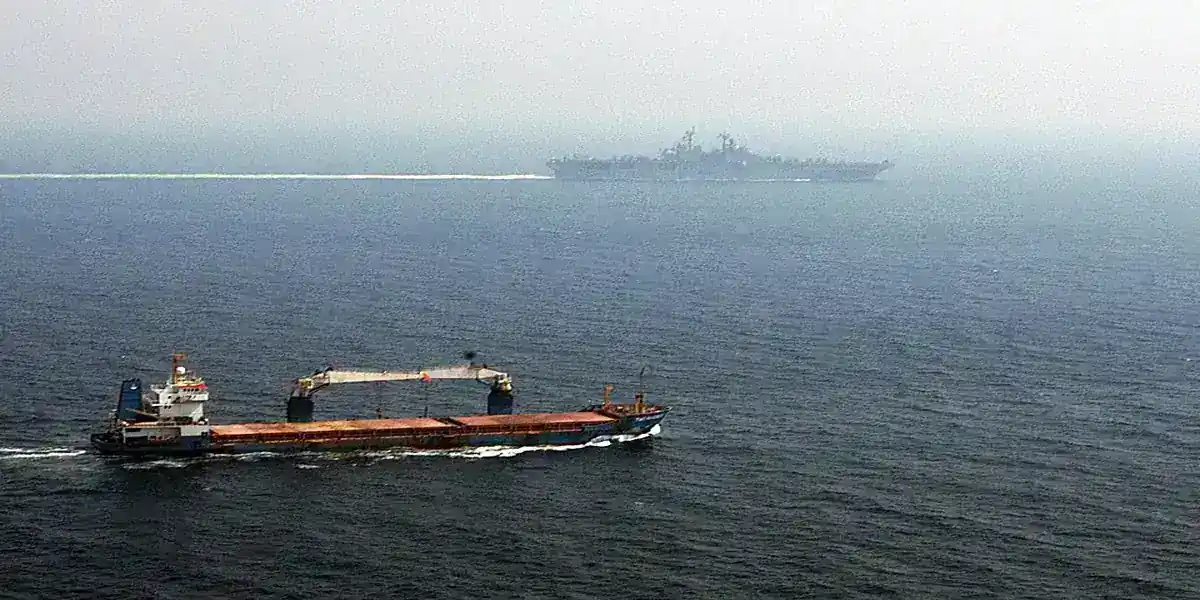
Merchant ship sails alongside USS Kearsarge while the U.S. amphibious assault ship transits the Strait of Hormuz.

Merchant ship sails alongside USS Kearsarge during a transit of the Strait of Hormuz. U.S. Navy photo by Angel Roman-Otero.

LONDON — Oil prices rose Wednesday as renewed U.S.-Iran fighting revived concerns that military escalation could further disrupt crude supplies and commercial shipping through the Strait of Hormuz, one of the world’s most important energy chokepoints.

Brent crude settled at $95.63 a barrel, up 98 cents, while U.S. West Texas Intermediate (WTI) gained 79 cents to $91.01. Both benchmarks traded sharply during the session as investors weighed the possibility of a wider supply disruption against evidence that some oil continues to reach international markets.

The latest gains came after the United States and Iran exchanged some of their most intense attacks since July, adding fresh uncertainty to an energy market that has already experienced months of disruption.

Hormuz remains the central risk

The Strait of Hormuz is critical because large volumes of oil and liquefied natural gas normally pass between the Persian Gulf and global markets.

The disruption has already been substantial. The U.S. Energy Information Administration (EIA) estimated that crude oil and petroleum liquids moving through Hormuz averaged only 4.9 million barrels per day in the second quarter of 2026, compared with 21.6 million barrels per day in the fourth quarter of 2025, before the conflict began.

That reduction has forced producers and traders to rely more heavily on alternative transportation routes and available inventories.

The problem is that those alternatives cannot completely replace Hormuz.

Shipping activity is under pressure

The renewed fighting has raised concerns about whether commercial vessels can continue operating safely through the strait.

■ Related News

Masoud Pezeshkian, president of Iran, appears during an interview with Khamenei.ir in 2025.

Iran President Offers Return to Ceasefire if U.S. Does as Mideast Tensions Rise

September 1, 2026
Business graphic showing higher Treasury yields, rising Brent crude prices, inflation concerns, market impacts, Federal Reserve policy and Strait of Hormuz risks.

U.S. Bonds Sell Off as Rising Oil Prices Fuel Inflation Anxiety

September 1, 2026
Amuay oil refinery complex in Venezuela, showing industrial processing facilities and infrastructure at the major petroleum refining site.

What We Know About Trump’s Deal Giving U.S. Access to Vast Venezuelan Oil Reserves

August 31, 2026
Graphic explaining Iran war economic impacts, showing costs for consumers and farmers, beneficiaries, oil prices, markets, and global trade pressures.

Investors Prosper as Consumers Pay the Price of Six Months of Iran War

August 31, 2026

Recent vessel-tracking data showed a sharp decline in crossings. Reuters reported that only four vessels passed through Hormuz on Tuesday, compared with a 10-day average of about 13, although tracking data can be incomplete when vessels switch off their transponders.

The reduction matters because oil prices respond not only to actual supply losses but also to the risk that future shipments could be delayed or blocked.

A sustained decline in tanker traffic would increase pressure on inventories and could push prices higher.

Oil production has already been disrupted

The conflict has also affected production across the Persian Gulf.

The EIA estimated that production shut-ins averaged 5.5 million barrels per day in July. It expects disruptions to continue affecting regional production as shipping through Hormuz remains constrained.

The agency has warned that it could take until early 2027 for production and international trade patterns to broadly return to their pre-conflict conditions under its current assumptions.

That creates a longer-term risk for global oil inventories.

Prices reflect uncertainty

The latest price increase is partly a risk premium.

Traders are attempting to determine how much physical oil will actually be lost from global markets and how long the disruption could last.

If fighting remains limited and tanker traffic recovers, prices could retreat as supply concerns ease.

If attacks expand to commercial shipping, energy infrastructure or additional regional producers, the market could face a much more serious supply shock.

That uncertainty has made oil prices particularly volatile.

Higher oil prices could spread through the economy

A sustained increase in crude prices would affect more than energy companies.

Higher oil prices can increase the cost of gasoline, diesel, aviation fuel and transportation. Businesses that depend heavily on energy may face higher operating expenses, while consumers could eventually see higher prices for transportation and other goods.

The effect could complicate efforts by central banks to control inflation.

The EIA has already raised its outlook for oil prices because of continuing disruptions. In its August forecast, it projected Brent crude would average about $85 a barrel during the third quarter of 2026, while warning that reduced Hormuz shipments were causing further declines in global inventories.

Recent market prices are now well above that quarterly forecast.

Alternative supplies provide some protection

The global oil market is not completely dependent on uninterrupted Hormuz traffic.

Some Gulf producers can redirect portions of their exports through pipelines and alternative maritime routes. Saudi Arabia, for example, can use routes toward the Red Sea, although those alternatives are more limited and can be more expensive.

Other producers outside the region can also increase supplies, depending on available production capacity.

But these measures cannot fully compensate for a prolonged loss of Hormuz flows.

The next phase of the conflict matters most

For energy markets, the most important question is whether the latest U.S.-Iran escalation remains contained or develops into a broader disruption of Middle Eastern oil infrastructure and shipping.

Markets will closely watch tanker movements through Hormuz, attacks involving commercial vessels, regional production levels and diplomatic efforts between Washington and Tehran.

For now, the latest fighting has returned the Strait of Hormuz to the center of the global oil market, keeping supply risks elevated even as some crude continues to reach international buyers.

Key Facts

  • Brent crude: $95.63 a barrel at Wednesday’s settlement
  • WTI crude: $91.01 a barrel
  • Main risk: Disruption to oil shipments through the Strait of Hormuz
  • Hormuz flows, Q2 2026: 4.9 million barrels per day
  • Hormuz flows, Q4 2025: 21.6 million barrels per day
  • July production shut-ins: About 5.5 million barrels per day
  • Conflict: Seventh month of U.S.-Iran fighting
  • EIA outlook: Major production and trade disruptions could persist into early 2027
  • Status: DEVELOPING — GLOBAL ENERGY MARKETS

Reporting Credit: U.S. Energy Information Administration — oil production, inventories and Strait of Hormuz flow data; U.S. Department of Energy — energy-market information; U.S. and Iranian government statements — conflict and security developments.


Tags: #CrudeOil#EnergySecurity#GlobalEnergy#MiddleEast#OilPrices#OilSupply#StraitOfHormuz#USIran
The Daily Desk

The Daily Desk

The Daily Desk is a contributor at JournosNews.com covering politics, media, governance, and the evolving dynamics of public discourse. Stories published under this byline are produced in accordance with JournosNews' editorial standards, with an emphasis on verified reporting, accuracy, context, and impartiality.

Related Posts

U.S. Navy sailor mans a .50-caliber machine gun aboard USS Kitty Hawk while transiting the Strait of Hormuz toward the Arabian Gulf.

U.S. Strikes Iranian Rocket Launchers Near Strait of Hormuz, Breaking Month-Long Lull

August 31, 2026
Iranian leader pictured in an official image associated with a message marking Workers’ Day and Teachers’ Day in May 2026.

Iran’s Leaders Defy the U.S. Six Months Into War, Signaling Little Tolerance for Dissent

August 29, 2026
Donald Trump speaks at the Conservative Political Action Conference in Washington, D.C., in 2011 during a political address.

After Six Months of Iran War, U.S. Goals Have Shifted. Strait of Hormuz Is Now a Top Concern

August 27, 2026
USS Abraham Lincoln aircraft carrier underway in the Atlantic Ocean during a U.S. Navy training exercise.

USS Abraham Lincoln to Stop in Thailand After Lengthy Middle East Deployment

August 27, 2026
Asian stock markets rise as oil prices fall, with market indexes, crude prices, Nvidia shares and key investor risks highlighted. - Journos News, File

Asian Shares Rise as Lower Oil Prices and AI Optimism Support Markets

August 26, 2026
Russian President Vladimir Putin attends a ceremony presenting Hero of Labour medals and state awards in Russia.

Putin Opens Door to State Control of Russian Sites Hit by Ukrainian Drones

August 26, 2026
Iranian fuel tankers arrive in Lebanon as Hezbollah-linked fuel shipments enter the country amid a severe energy crisis.

Iran’s Fuel Lines Grow as U.S. Sanctions Deepen Economic Pressure

August 26, 2026
Strait of Hormuz connecting the Gulf of Oman and Persian Gulf, photographed from the International Space Station.

LIVE: Middle East Conflict — Ongoing Coverage

August 12, 2026
Load More
JournosNews logo

Journos News delivers globally neutral, fact-based journalism that meets international media standards — clear, credible, and made for a connected world.

  • Categories
  • World News
  • Politics
  • Business & Markets
  • Technology
  • Health
  • Science
  • Sports
  • Arts & Culture
  • Resources
  • Editorial Standards
  • Submit a Story
  • Advertise with Us
  • Syndication & Partnerships
  • Site Map
  • Press & Media Kit
  • Editorial Team
  • Careers

Join thousands of readers receiving the latest updates, tips, and exclusive insights straight to their inbox. Never miss an important story again.

  • About Us
  • Editorial & Trust Center
  • Contact Us
  • Privacy Policy
  • Terms of Use & Copyright Notice

© JournosNews.com All rights reserved.

Welcome Back!

Login to your account below

Forgotten Password?

Retrieve your password

Please enter your username or email address to reset your password.

Log In
JournosNews

Independent Journalism.
Verified Facts.

You're about to read a professionally edited article from JournosNews.com.

Every article is produced in accordance with our editorial standards, emphasizing factual accuracy, transparent attribution, fairness, editorial independence, and meaningful context.

Editorial Standards
No Result
View All Result
  • Home
  • World
    • Africa
    • Americas
    • Asia
    • Europe
    • Middle East
    • Oceania
  • Politics
  • Business
  • Technology
  • Health
  • Science
  • Sports
  • Entertainment
  • Culture

© JournosNews.com All rights reserved.

This website uses cookies. By continuing to use this website you are giving consent to cookies being used. Visit our Privacy and Cookie Policy.