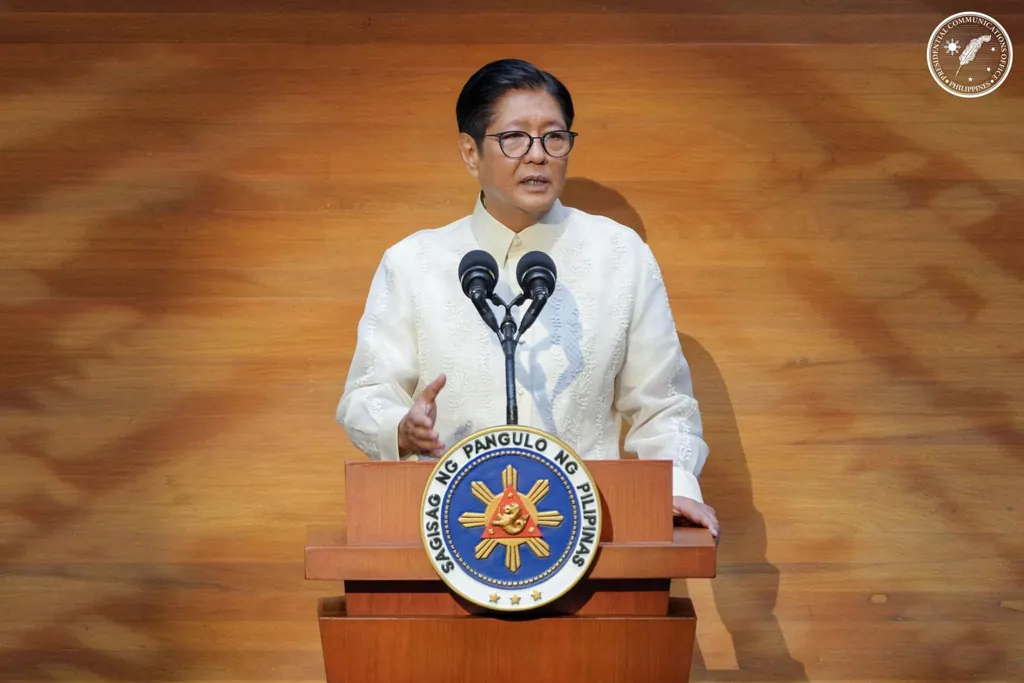
MANILA, Philippine – President Ferdinand Marcos Jr. reaffirmed his government’s commitment to upholding the 2016 international arbitration ruling on the South China Sea during his annual State of the Nation Address on Monday, delivering a pointed but indirect message to China as maritime tensions between the two countries continue.
Without naming China directly, Marcos said his administration would continue defending the arbitration award, which invalidated Beijing’s sweeping claims over much of the South China Sea. He described the ruling as a final and legally binding decision under the 1982 United Nations Convention on the Law of the Sea (UNCLOS) and pledged to uphold it through peaceful and lawful means.
“Your government will do all that is necessary to continue upholding this award, utilizing every peaceful and legal means available to the republic against any attempt, foreign or domestic, to undermine this achievement,” Marcos said.

He added that Filipinos “do not yield” to conquerors.
Marcos Reaffirms Support for Arbitration Ruling
Marcos’ remarks came amid continued maritime disputes between the Philippines and China in the South China Sea, where the two countries have repeatedly confronted each other over competing territorial claims.
The Philippines initiated international arbitration in 2013 following a prolonged standoff with Chinese vessels in disputed waters. In 2016, the tribunal ruled that China’s expansive claims had no legal basis under international law.
China refused to participate in the arbitration proceedings and continues to reject the ruling.
Territorial confrontations have persisted in recent years among Chinese, Philippine and Vietnamese coast guard and fishing vessels in the strategically important waterway, which is also claimed in part by Malaysia, Brunei and Taiwan and serves as one of the world’s busiest maritime trade routes.
■ Related News




China Daily Editorial Sparks Diplomatic Protest
Marcos’ speech followed a diplomatic dispute triggered by an editorial video and cartoons published by the Chinese state-owned newspaper China Daily, which portrayed Filipinos as monkeys while criticizing the arbitration ruling.
The Philippine government condemned the AI-generated images as racist and dehumanizing, demanded their removal and summoned Chinese Ambassador Jing Quan to the presidential palace in Manila last week.
China’s Foreign Ministry later distanced itself from the publication. Foreign Ministry spokesperson Lin Jian said the editorial did not represent the Chinese government’s official position but reiterated Beijing’s longstanding rejection of the arbitration decision, describing it as “a political farce disguised as a legal proceeding” and maintaining that the award is illegal, null and void.
Marcos Says Corruption Charges Will Proceed
Turning to domestic issues, Marcos disclosed that a special anti-corruption prosecutor is preparing to file charges against former House Speaker Martin Romualdez, his cousin and longtime political ally.
Although Marcos did not identify Romualdez by name during the address, he said no personal relationship would shield anyone from accountability.
“This is painful to me, but we have to do the right thing,” Marcos said. “I’m not a president for my family. I’m not a president for my friend.”
Romualdez, who resigned as House speaker last year but remains a member of the House of Representatives, denied any wrongdoing and said he is prepared to defend himself against any charges.
Government and congressional investigations have linked Romualdez and several lawmakers to alleged kickback schemes involving flood control projects.
Marcos said authorities have recovered or frozen nearly 25 billion pesos ($410 million) in cash and assets connected to suspects in the broader investigation, with part of those funds already returned to the national treasury.
President Raises Prospect of Nuclear Energy
Marcos also highlighted energy security as a national priority, citing higher fuel prices linked to the conflict involving Iran and their impact on Filipino households.
He said the Philippines should reconsider developing nuclear power as part of its long-term energy strategy, while emphasizing that any future program must meet strict safety standards and receive public support.
“We will make sure it’s safe,” Marcos said. “We will also make sure that we can explain well to the public the good benefits of nuclear power.”
The Philippines completed the Bataan Nuclear Power Plant during the 1970s, but the facility was never commissioned because of safety concerns, corruption allegations and changing government policy.
Marcos said any future decision on nuclear energy would prioritize public safety while strengthening the country’s long-term energy security.
This report is based on reporting by The Associated Press.