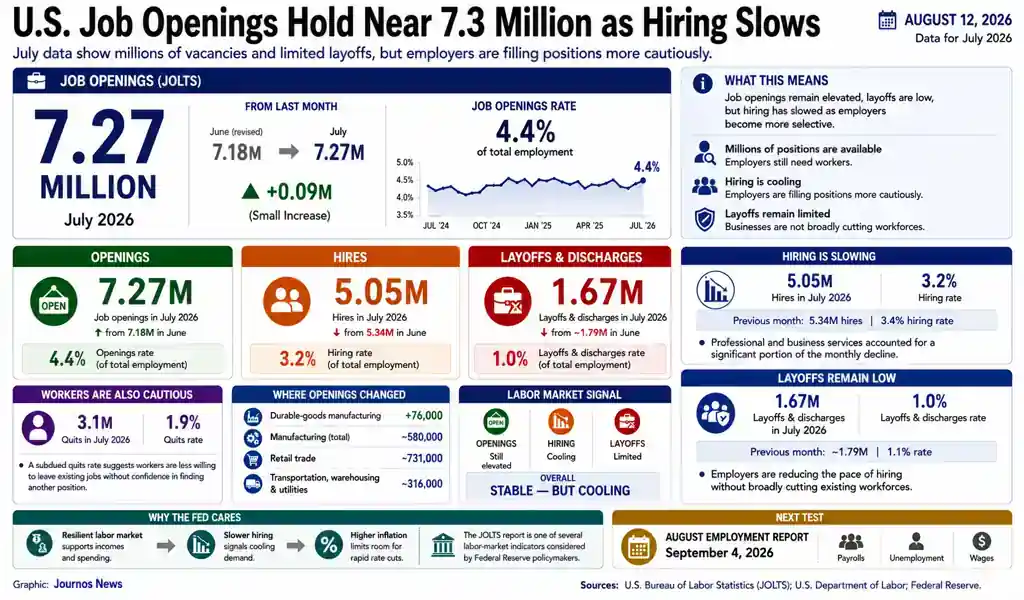
WASHINGTON — U.S. employers had 7.27 million job openings in July, a modest increase from a revised 7.18 million in June, as the labor market remained relatively stable despite higher costs and continued economic uncertainty. The figures were released Tuesday by the U.S. Bureau of Labor Statistics.
The July increase was relatively small, with the job-openings rate holding at 4.4%. The data suggest that employers continue to maintain a significant number of vacancies even as they remain cautious about expanding their workforces.
Hiring slows
The number of people hired during July fell to about 5.05 million, from 5.34 million in June.

The hiring rate declined to 3.2% from 3.4%, with professional and business services accounting for a significant portion of the decline. Hiring in that sector fell by about 188,000 during the month.
The figures point to a labor market where companies continue to recruit but are filling positions more slowly.
Layoffs remain limited
One of the more positive signals was the continued lack of widespread layoffs.
Employers reported about 1.67 million layoffs and discharges in July, down from roughly 1.79 million in June. The layoffs and discharges rate declined to 1.0%.
That remains an important distinction for the economy.
■ Related News

While hiring has weakened, companies have generally avoided large-scale reductions in their existing workforces.
The unemployment rate was 4.1% in July, according to the Labor Department’s separate employment report.
Workers are less willing to quit
The number of workers voluntarily leaving their jobs was also relatively subdued.
About 3.1 million people quit in July, producing a quits rate of 1.9%.
The quits rate is closely watched because workers are generally more willing to leave existing jobs when they believe they can quickly find better opportunities elsewhere.
A subdued quits rate can therefore indicate that workers are becoming more cautious about changing jobs.
Manufacturing provides some strength
The increase in job openings was concentrated partly in manufacturing.
Openings in durable-goods manufacturing increased by 76,000 during July, according to the BLS. Total manufacturing openings rose to about 580,000, compared with 501,000 in June.
Retail trade also continued to have a large number of vacancies, with approximately 731,000 openings in July.
Transportation, warehousing and utilities, however, saw openings decline to roughly 316,000.
The labor market is stable, not booming
The latest figures reinforce a broader pattern that has emerged in 2026.
Employers have continued adding jobs, but at a much slower pace than during stronger periods of the economic expansion.
U.S. employers have added an average of about 61,000 jobs per month so far this year, according to Associated Press analysis of government data. That is modest by historical standards but still better than the extremely weak job growth recorded during 2025.
The combination of low layoffs and slower hiring suggests businesses are taking a cautious approach rather than aggressively expanding or cutting payrolls.
Higher costs remain a concern
The labor market is operating under pressure from higher operating and household costs.
Energy prices have risen sharply amid the continuing conflict involving the United States and Iran, while businesses are also dealing with uncertainty surrounding tariffs and interest rates.
Higher costs can discourage companies from expanding payrolls because maintaining additional workers becomes more expensive.
At the same time, strong demand for workers in selected industries can keep job openings elevated even when overall hiring slows.
The Federal Reserve is watching closely
The JOLTS report will be one of several indicators policymakers consider as the Federal Reserve assesses the economy and inflation.
A labor market that remains resilient can support household income and consumer spending, but persistent strength could also make it more difficult for inflation to cool rapidly.
Conversely, a significant deterioration in hiring would raise concerns about economic growth.
The latest figures therefore provide a mixed signal: job availability remains relatively strong, but the pace at which employers are actually hiring has weakened.
August jobs report comes Friday
The next major test will arrive Friday, when the Labor Department releases its August employment report.
That report will provide more direct information about payroll growth, unemployment and wage trends.
Economists surveyed by FactSet expect employers to have added roughly 65,000 jobs in August, with the unemployment rate potentially rising to 4.2%.
The report could provide a clearer indication of whether July’s subdued hiring reflects temporary caution or the beginning of a broader deterioration.
What Happens Next
Investors and Federal Reserve officials will closely watch Friday’s employment report for evidence of whether the labor market is stabilizing or weakening.
For now, the JOLTS data show an economy where companies continue to advertise millions of positions but are becoming more selective about filling them.
The key question is whether employers can maintain low layoffs and relatively high job openings while navigating higher energy costs, tariffs and economic uncertainty.
Key Facts
- July job openings: 7.27 million
- June revised openings: 7.18 million
- Job openings rate: 4.4%
- July hires: 5.05 million
- Hires rate: 3.2%
- Layoffs/discharges: 1.67 million
- Quits: 3.1 million
- Quits rate: 1.9%
- July unemployment rate: 4.1%
- Next major report: August employment report, Sept. 4
- Status: DEVELOPING — U.S. ECONOMY
Reporting Credit: U.S. Bureau of Labor Statistics — Job Openings and Labor Turnover Survey and labor-market data; U.S. Department of Labor — employment and unemployment data; Federal Reserve — labor-market conditions and monetary-policy assessments.