NEW YORK – U.S. stocks edged lower Monday after reaching record levels last week, as a sharp rise in oil prices renewed concerns about inflation and the potential path of Federal Reserve interest rates.
The S&P 500 fell 0.1% from Friday’s record close. The Dow Jones Industrial Average declined 60.95 points, or 0.1%, to 53,975.98, while the Nasdaq Composite fell 85.26 points, or 0.3%, to 26,605.36.
The retreat followed a strong run for U.S. equities supported by corporate earnings. Companies in the S&P 500 are expected to post earnings-per-share growth of about 50% in the spring compared with a year earlier, according to FactSet, which would represent the strongest growth in five years.

Oil Surge Revives Inflation Concerns
Brent crude, the international benchmark, jumped 5% to $87.72 a barrel as uncertainty continued over when the Strait of Hormuz could reopen and allow oil shipments from the Middle East to return to normal.
Oil prices have remained highly volatile during the conflict. Brent traded between $72 and $102 a barrel last month as expectations shifted over the possibility of an agreement between the United States and Iran that could restore unrestricted tanker traffic through the region.
The latest increase returned Brent to levels recorded earlier this month and during periods in June and July, as well as around the beginning of the war in March.
Higher energy prices can feed into broader inflation, increasing the importance of the latest U.S. inflation data due Wednesday. Economists expect annual inflation to have eased to 3.4% from 3.5% in June.
A weaker inflation reading could reduce pressure on the Federal Reserve to raise interest rates. Higher rates can help contain price increases by reducing demand, but they also increase borrowing costs and can weigh on corporate investment and financial markets.



Fed Rate Expectations Remain Divided
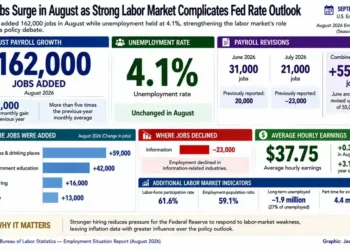
Investors are also reassessing the Federal Reserve’s next steps following Friday’s government employment report, which showed unexpectedly weak hiring.
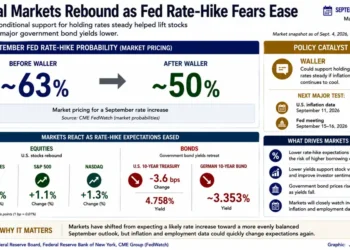
Despite the softer labor-market data, traders still saw a nearly 52% probability of a Federal Reserve rate increase in September, according to CME Group data cited in the report.
The yield on the 10-year U.S. Treasury note rose to 4.70% from 4.65% late Friday. The yield stood at 3.97% before the war with Iran, with the increase contributing to higher borrowing costs for households and businesses.
Markets are therefore balancing two competing forces. Strong corporate earnings continue to support equity valuations, while higher oil prices, elevated Treasury yields and persistent inflation could increase pressure on companies and consumers.
Corporate Deals Move Individual Stocks
Deal activity drove significant moves in several individual stocks.
MarineMax jumped 46.1% after agreeing to be acquired for approximately $1.5 billion in cash by a portfolio company of Blackstone. The company operates in marine retail, marinas and superyacht services.
Varex Imaging rose 48.8% after Teledyne Technologies announced plans to acquire the X-ray imaging components manufacturer for $18.90 a share in cash.
Berkshire Hathaway gained 1.5% after reporting quarterly profit that exceeded analysts’ expectations. The company also disclosed that it had invested part of its substantial cash holdings in stocks under new CEO Greg Abel.
Berkshire has historically used its cash reserves to invest when management identifies attractive opportunities. Rising corporate earnings can also make high stock valuations appear more reasonable when measured against profits.
Intel, meanwhile, fell 4.1% after saying it could sell $15 billion of its stock. The proposed transaction would dilute existing shareholders, while the company said the proceeds would likely support investments associated with increased spending on artificial intelligence technology.
Global Markets Deliver Mixed Results
International markets were mixed Monday, with European indexes uneven after generally stronger trading across Asia.
Japan’s Nikkei 225 rose 2.1%, one of the strongest gains among major global markets.
For U.S. investors, the focus now shifts to Wednesday’s inflation report and its implications for Federal Reserve policy. The interaction between energy prices, employment conditions and corporate earnings is likely to remain central to market expectations for interest rates and stock valuations.
This report is based on reporting by The Associated Press.