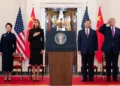
BEIJING, China – Visa has received preliminary approval from the People’s Bank of China to prepare a domestic bank-card clearing institution, moving the US payments company closer to entering China’s tightly regulated domestic payments market.
The approval, announced on October 13, allows Visa Information Technology (Beijing) Co. Ltd., a Visa subsidiary established in China, to begin formal preparations. The company must complete the work within one year before applying for permission to commence operations.
The approval is not a final operating licence. The People’s Bank of China (PBOC) and the National Financial Regulatory Administration must approve the subsequent application before a bank-card clearing business licence can be issued.

For Visa, the decision represents progress in a long-running effort to expand beyond its existing cross-border payment activities in China. A licensed domestic operation could allow the company to support Visa-branded renminbi-denominated bank cards and process domestic transactions, subject to the final regulatory authorization and its permitted business scope.
The decision also marks another step in China’s gradual opening of its bank-card clearing market to foreign payment networks. However, regulatory access alone will not guarantee a substantial commercial presence in a market where established domestic networks and mobile-payment services shape consumer behaviour.
What the preliminary approval allows
China’s bank-card clearing framework governs the systems and rules used to process transactions between participating card issuers, acquiring institutions and merchants, and to facilitate settlement.
The PBOC’s approval allows Visa to prepare the systems, operating arrangements and other requirements for a domestic clearing institution. It does not authorize the company to start processing domestic renminbi transactions immediately.
The remaining licensing stage is substantive, not automatic. Visa must complete its preparations, submit an application to commence operations and obtain the required regulatory approvals.



The distinction also separates domestic clearing from Visa’s existing international activities. The company has operated in China for decades, including in services connected with foreign-currency card transactions and cross-border spending. The proposed institution would create a route toward domestic clearing in renminbi rather than mark Visa’s first presence in China.
China’s regulatory rules define clearing institutions by their role in operating card-network standards and systems, authorizing the issuance and acceptance of cards under their brands, and providing transaction-processing services to participating institutions.
The final licence will determine when Visa can start domestic operations and the conditions under which it may do so.
A large market with established competitors
China has an extensive bank-card infrastructure, but the scale of card transactions should not be confused with the amount of business available to Visa. China UnionPay is the established domestic card network, while Alipay and WeChat Pay play major roles in everyday digital payments.
These systems do not perform identical functions. Bank-card clearing networks process transactions under card-network rules, while mobile-payment platforms provide consumer and merchant interfaces that can support multiple payment methods.
That distinction matters to Visa’s commercial prospects. Even if the company receives final approval, it will need relationships with domestic banks, card issuers, acquiring institutions and merchants to establish a viable network. Pricing, compliance requirements, acceptance coverage and consumer demand will influence how quickly the business develops.
China’s mobile-payment ecosystem also means that an expanded card-clearing presence would not automatically translate into widespread use of physical Visa cards for everyday purchases. The company would need to determine where its network offers a practical advantage to consumers and businesses.
Mastercard and American Express provide precedents
Visa is following other international payment networks that have established domestic clearing operations in China.
American Express began domestic operations in 2020 through Express (Hangzhou) Technology Service Co., a Chinese joint venture. Mastercard later received final regulatory approval for its Mastercard NetsUnion operation in November 2023 and began processing domestic transactions in May 2024.
Their experiences demonstrate that entering the market involves multiple stages: preliminary approval, the development of compliant infrastructure, final regulatory authorization and the start of transaction processing.
Visa’s path is not identical. Its Beijing subsidiary is the entity preparing for the proposed operation, and the final ownership arrangements and licence conditions should be assessed against official records before the structure is described as finalized.
The existence of foreign competitors also does not mean Visa will enter an unrestricted market. Domestic clearing remains subject to China’s regulatory framework, and each institution must meet the applicable requirements.
Financial-services access carries wider significance
Visa’s approval comes amid continued efforts to improve economic engagement between the United States and China. Financial-services market access has been a long-standing issue in bilateral economic discussions.
Visa Chief Executive Ryan McInerney welcomed the decision and credited the leaders of both countries for pursuing a constructive and strategically stable relationship. His statement reflects the company’s view of the broader diplomatic context, but it does not establish that the approval was a concession negotiated as part of a specific political agreement.
The decision can be understood as a concrete regulatory development that expands Visa’s opportunity to pursue domestic business. Its wider significance will depend on how the company completes the preparation process and whether it receives final authorization.
For other foreign financial-services companies, the case illustrates that market access can advance through formal licensing decisions even where domestic institutions have long-established positions. It does not, by itself, establish that China’s financial sector is fully open to foreign competition or that other applications will receive the same treatment.
Commercial success remains uncertain
Visa’s approval creates a potential route into domestic renminbi clearing, but the immediate commercial effect is limited to permission to prepare.
The company still needs to build the operational arrangements required by Chinese rules and obtain the final licence. It will then face the challenge of establishing partnerships and attracting activity in a market where domestic payment networks and mobile platforms are deeply embedded.
There is no basis yet to assign a reliable market-share or revenue forecast to the approval alone. Those outcomes would depend on the eventual business scope, the products offered, the institutions that participate and the level of consumer and merchant adoption.
The next milestone is therefore not the announcement itself but the completion of preparations and the decision on Visa’s application to commence operations. Until that approval is granted, the company remains a prospective entrant to China’s domestic card-clearing market rather than an operating domestic network.
Reporting Credit: People’s Bank of China; Visa Inc.; Ministry of Commerce of the People’s Republic of China.