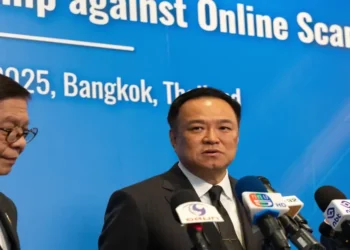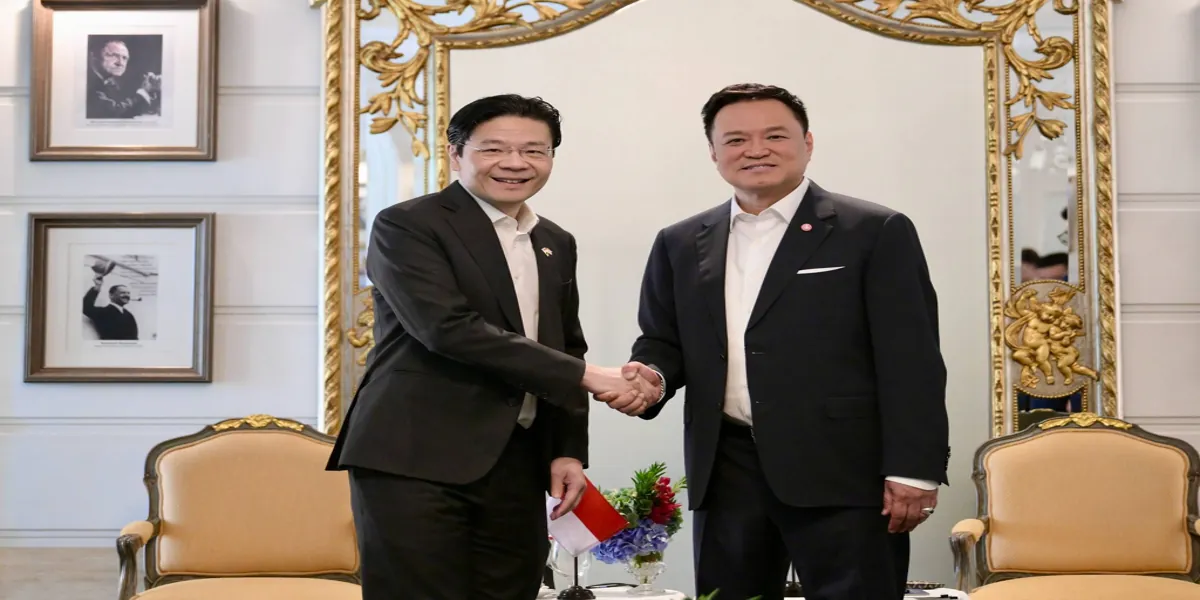
BANGKOK, Thailand – Thailand and Singapore are moving to deepen their economic partnership, with Prime Ministers Anutin Charnvirakul and Lawrence Wong agreeing to expand cooperation in trade, investment, the digital economy, energy and food security during talks in Bangkok.
The discussions come as Southeast Asian economies seek to strengthen supply chains, attract investment and accelerate digital integration amid a more uncertain global trading environment.
Digital economy moves to the center
Thailand and Singapore agreed to step up digital-economy cooperation, including through the renewal of their memorandum of understanding covering the sector.

Singapore also welcomed Thailand’s interest in joining the Digital Economy Partnership Agreement (DEPA), a framework designed to establish common rules and cooperation for digital trade.
The two governments also backed the signing of the ASEAN Digital Economy Framework Agreement (DEFA), which is expected to strengthen digital connectivity and interoperability across the region.
Trade and investment remain central
Singapore has become an important source of investment for Thailand. Thailand’s Foreign Ministry said Singapore was the country’s largest foreign investor in 2024, highlighting the depth of the two economies’ commercial relationship.
The partnership covers investment, manufacturing, services and emerging industries, with both governments seeking to expand cooperation into future-oriented sectors.
For Thailand, stronger ties with Singapore can help attract capital and technology while supporting the country’s ambitions to develop higher-value industries.




For Singapore, closer economic links with Thailand provide access to one of Southeast Asia’s largest economies and strengthen connections with the wider mainland ASEAN market.
Supply-chain resilience becomes more important
The two countries are also seeking greater resilience in trade and supply chains.
Thailand has emphasized the importance of maintaining open trade while strengthening supply-chain security and connectivity. Its broader regional agenda includes logistics, food and energy security, areas that have become increasingly important as geopolitical tensions disrupt global commerce.
Singapore, meanwhile, remains a major regional logistics and financial hub.
Closer coordination between the two economies could help businesses diversify supply chains and improve connections between manufacturing centers, ports and digital services.
Cooperation extends beyond technology
The relationship is not limited to digital industries.
Thailand and Singapore are also strengthening cooperation around food security, energy and the green economy, areas where both governments see opportunities for greater resilience and investment.
The cooperation reflects a broader effort by Southeast Asian governments to combine economic growth with greater resilience against external shocks.
A deeper ASEAN connection
The Thailand-Singapore relationship also has significance for ASEAN.
Both countries are active participants in efforts to develop regional rules for digital trade and economic integration. The planned DEFA framework could eventually make it easier for businesses to operate digitally across ASEAN by improving interoperability and establishing common approaches to digital commerce.
Thailand’s interest in DEPA could further connect its digital economy with international digital-trade standards.
That could benefit companies operating across borders, particularly in e-commerce, financial technology, digital services and technology.
Strategic partnership enters a new phase
Thailand and Singapore celebrated 60 years of diplomatic relations in 2025, and both governments have emphasized expanding the relationship into new areas.
The current push therefore represents an evolution of an already established partnership rather than a new diplomatic alignment.
The emphasis is increasingly shifting toward practical economic cooperation, digital transformation and resilience.
What Happens Next
The two governments are expected to continue implementing agreements covering digital cooperation, investment, trade and economic connectivity.
The key indicators will be new investment commitments, digital-economy agreements, progress on DEPA and DEFA, and cooperation on energy, food security and supply chains.
For Thailand and Singapore, the objective is increasingly clear: build a more connected and resilient economic partnership while strengthening their position within the evolving ASEAN economy.
Key Facts
- Countries: Thailand and Singapore
- Main areas: Trade, investment, digital economy, energy and food security
- Digital cooperation: Renewal of bilateral digital-economy MOU
- DEPA: Singapore supports Thailand’s interest in joining
- Regional framework: ASEAN Digital Economy Framework Agreement
- Investment: Singapore was Thailand’s largest foreign investor in 2024
- Diplomatic milestone: 60 years of relations marked in 2025
- Status: DEVELOPING — BUSINESS & SOUTHEAST ASIA
Reporting Credit: Government of Thailand — bilateral talks, trade, investment and digital-economy cooperation; Ministry of Foreign Affairs of Singapore — bilateral relations and economic cooperation; ASEAN — regional digital-economy integration and DEFA framework.