HONG KONG – The United States will prohibit the import of foreign-made humanoid robots and other advanced robotics systems after the Federal Communications Commission (FCC) announced new restrictions on Tuesday, citing national security and cybersecurity concerns.
The measures primarily affect Chinese manufacturers, which dominate the global humanoid robotics market, and represent another step in Washington’s broader effort to reduce reliance on Chinese technology in strategically important industries.
The restrictions apply to newly imported humanoid robots, quadrupeds—commonly known as robot dogs—and foreign-made power inverters. The FCC said the products present potential supply chain vulnerabilities as well as cybersecurity and national security risks.

Washington Broadens Technology Controls
FCC Chair Brendan Carr said the new restrictions are intended to “secure America’s critical supply chains.”
The action follows a series of U.S. measures targeting Chinese technology in critical sectors. Washington has recently restricted imports of Chinese-made drones and is also considering additional limits on Chinese open-source artificial intelligence models as Chinese AI companies expand their global reach.
The latest policy adds another point of friction in the technological competition between the United States and China.
Decision Comes Ahead of Planned Trump-Xi Meeting
The restrictions were announced as Washington and Beijing prepare for a planned meeting between President Donald Trump and Chinese President Xi Jinping in September following their talks in Beijing in May.
Samm Sacks, a senior fellow at the New America think tank specializing in Chinese technology policy, described the measure as another potential source of tension ahead of the summit.




She characterized the growing number of technology disputes as “a steady drumbeat of potential flashpoints.”
China Leads the Global Humanoid Robotics Market
China remains the world’s largest producer of humanoid robots, significantly outpacing competitors in manufacturing capacity and commercial deployment.
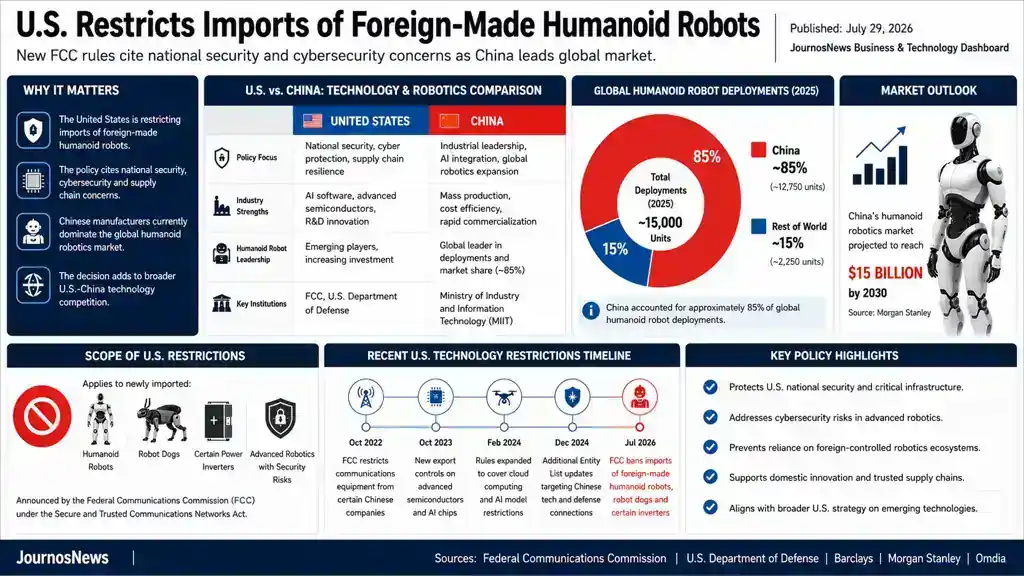
According to Barclays, China accounted for approximately 85% of global humanoid robot deployments last year, supported by government investment and industrial policy. Morgan Stanley projects the country’s humanoid robotics market could reach about $15 billion by 2030.
Morningstar analyst Kangyuxiao Li said Chinese manufacturers have rapidly expanded production while reducing costs, giving them a competitive advantage over many overseas rivals.
Li said the U.S. restrictions eliminate what could become an important export market for Chinese robotics companies while protecting American developers from lower-priced competition. However, he added that the policy is unlikely to significantly slow China’s broader robotics industry because of its large domestic market and access to other international customers.
Chinese Manufacturers Dominate Global Shipments
Technology research firm Omdia estimated that approximately 15,000 humanoid robots were shipped worldwide in 2025.
Chinese companies Unitree and AGIBOT each shipped more than 5,000 units, while U.S.-based competitors, including Tesla and Figure AI, delivered only a few hundred robots or fewer.
Omdia also said Chinese manufacturers are increasingly focusing on Europe as a major export market for advanced robotics systems.
Industry Partnerships May Be Affected
China has rejected criticism of its technology sector, arguing that its innovations create opportunities for global markets rather than posing security threats. Beijing has consistently opposed claims that Chinese technology represents a broader strategic risk.
Lian Jye Su, chief analyst at Omdia, said the new U.S. restrictions could also affect future partnerships between American and Chinese technology companies.
He cited Nvidia’s June announcement of a humanoid robot reference design that uses a humanoid chassis produced by Chinese robotics company Unitree.
The Pentagon has added Unitree to a list of Chinese companies that it says have ties to or support the Chinese military, an allegation that Beijing has rejected.
This report is based on reporting by The Associated Press.