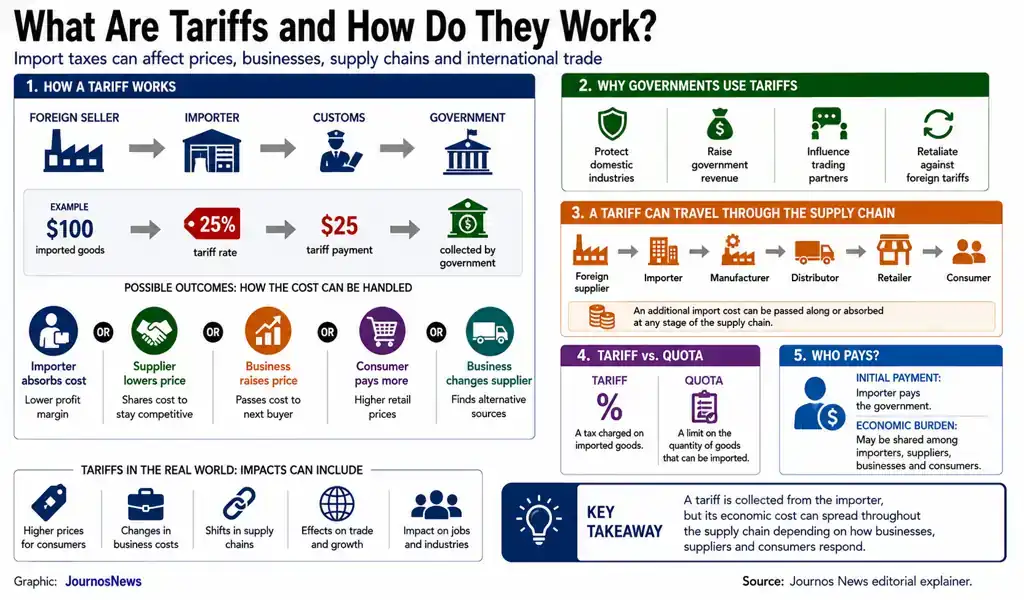
Tariffs are government charges on imported goods and one of the oldest instruments of trade policy. Understanding who pays them initially, how businesses respond and why governments impose them helps explain their effects on prices, supply chains and international trade.
Introduction
Tariffs are taxes imposed by governments on goods brought into a country from abroad. They can serve several purposes: protecting domestic industries from foreign competition, raising government revenue, influencing the policies of trading partners or responding to tariffs imposed by another country.
The basic mechanism is relatively simple. When an imported product enters a country subject to a tariff, the importer generally pays the charge to the government of the importing country. That distinction matters because tariffs are often described as if the foreign government or exporter directly pays the tax.

The immediate payment and the ultimate economic burden, however, are not necessarily the same thing. An importer facing a new tariff can raise prices, accept lower profits, negotiate a lower purchase price with its foreign supplier, change suppliers or adjust its production and distribution strategy. Depending on those decisions and on market conditions, the cost can be distributed among importers, foreign producers, domestic businesses and consumers.
That is why tariffs can have effects far beyond the customs transaction where the tax is collected. A measure aimed at one imported product can influence prices, production decisions, supply chains and investment across multiple countries.
What Is a Tariff?
A tariff is a government charge applied to an imported product.
The amount can be calculated in different ways, but the supplied example illustrates the basic percentage-based approach. If a U.S. company imports $100 worth of Canadian steel and the U.S. government imposes a 25% tariff, the importer would owe $25 in tariff payments.
The calculation is:
$100 × 25% = $25
The importer therefore faces a $100 purchase price plus the $25 tariff when the steel enters the United States.
The Canadian exporter does not automatically send that $25 to the U.S. government. The immediate obligation belongs to the U.S. importer.
This distinction between the legal payment and the economic incidence of a tariff is central to understanding trade policy. The importer is responsible for paying the government, but the importer may attempt to recover some or all of that additional cost elsewhere.
The eventual effect depends on what happens after the tariff is imposed.
How the Tariff Mechanism Works
The basic process can be understood as a chain of transactions.
A foreign company sells a product to an importer. The importer purchases the product and brings it into the importing country. Customs authorities assess any applicable tariff, and the importer pays the government. The importer must then decide how to manage the additional cost.
That decision can take several forms.
The company may increase the product’s selling price. It may accept a lower profit margin. It may negotiate a lower price with the foreign supplier. It may search for a supplier in another country. In some cases, businesses may alter products or production arrangements to reduce their exposure to the tariff.
The sequence is therefore:
Foreign company sells goods → importer purchases goods → goods enter importing country → tariff is assessed → importer pays government → business responds to the additional cost
The government collects the tariff at the point of importation, but the economic consequences continue through the supply chain.
A Simple Example: The Imported Television
Consider a U.S. retailer that imports a television for $500.
If the government imposes a 20% tariff on the television, the importer owes:
$500 × 20% = $100
The immediate cost becomes $600 before transportation, distribution and other expenses.
The retailer then has choices.
It could maintain the existing retail price and absorb the additional $100 as a reduction in its margin. It could raise the television’s price and attempt to pass the cost to consumers. It could negotiate with the foreign manufacturer for a lower price. Or it could find another supplier that is not subject to the same tariff.
These choices illustrate why a 20% tariff does not necessarily result in a 20% increase in the final price paid by consumers.
A tariff creates an additional cost at the import stage. What happens to that cost afterward depends on decisions made by businesses and suppliers, as well as the conditions of the market in which the product is sold.
Why Governments Impose Tariffs
Tariffs can serve different economic and political objectives. The same measure can also have more than one purpose.
Protecting Domestic Industries
One reason governments impose tariffs is to make imported goods more expensive relative to products made domestically.
If imported steel becomes more expensive because of a tariff, for example, domestic steel producers may gain a stronger competitive position. The policy can be intended to protect domestic production, investment and employment in industries considered important to the economy.
The logic is straightforward: if foreign products become more expensive, domestic producers may find it easier to compete for customers.
That protection can benefit producers within the country imposing the tariff. At the same time, companies that depend on imported materials may face higher costs.
The effects therefore do not necessarily move in the same direction across an entire economy.
Raising Government Revenue
Tariffs can also provide revenue to governments.
Historically, tariffs were an important source of government income before modern income and consumption tax systems became widespread. In contemporary economies, governments generally rely on broader tax systems, but tariffs can still generate revenue when imports are subject to them.
The revenue function is different from the protective function. A tariff can raise money for the government while also changing the relative prices of imported and domestically produced goods.
Influencing Trading Partners
Governments can also use tariffs as a tool of economic and foreign policy.
A government may impose or threaten tariffs to pressure another government to change a policy, alter trade practices, open its market or make concessions during negotiations.
In such circumstances, the tariff is not simply a tax designed to raise revenue. It becomes part of a broader strategy for influencing another country’s decisions.
That can make the consequences of a tariff difficult to assess solely through the price of the affected product.
Retaliating Against Other Tariffs
Tariffs can also be imposed in response to measures taken by another country.
If Country A imposes tariffs on products from Country B, Country B may respond with tariffs on goods from Country A. Country A may then introduce additional measures, prompting another response.
The process can become an escalating cycle of trade restrictions.
This is the basic dynamic behind a trade war.
What Is a Trade War?
A trade war occurs when countries repeatedly impose trade restrictions against one another, particularly tariffs.
The measures may begin with a specific dispute over a product, industry or trade policy. Once one government responds to another’s tariffs with its own restrictions, however, the scope of the confrontation can expand.
A simplified sequence is:
Country A imposes tariffs → Country B retaliates → Country A adds further tariffs → Country B responds again
The consequences can reach companies and consumers that were not directly involved in the original dispute.
Businesses may face higher production costs. Importers may have to reconsider suppliers. Manufacturers may adjust production arrangements. Consumers may encounter higher prices or fewer product choices.
The broader impact depends on the scale and duration of the measures and on how businesses respond.
Who Actually Pays a Tariff?
The distinction between who pays a tariff and who bears its economic cost is one of the most important concepts in understanding trade policy.
The importer generally pays the tariff to the government imposing it.
Suppose a company imports machinery worth $1 million and faces a 25% tariff. Its initial obligation would be:
$1 million purchase price + $250,000 tariff
The company is responsible for the $250,000 payment to the government.
But that does not mean the company necessarily absorbs the entire economic cost.
The importer could raise the price of the machinery it sells to customers. It could reduce its profit margin. It could seek a lower price from the foreign supplier. Consumers could ultimately pay more. The foreign producer could reduce its price in an effort to remain competitive.
The economic burden can therefore be divided among several participants.
This is why statements about who “pays” tariffs require precision. The importer is generally the party that makes the tariff payment to the government. The eventual economic cost can be distributed through commercial decisions and market responses.
Do Tariffs Always Raise Consumer Prices?
A tariff creates an additional cost, but its effect on consumer prices is not automatic or uniform.
If an importer passes the entire additional cost to customers, the price of the affected product may rise. If the importer absorbs the cost, the company’s profit margin may decline instead.
A foreign supplier may also reduce its price to preserve access to the importing country’s market. That could offset part of the tariff’s effect before the product reaches the consumer.
Businesses can respond in other ways. They may change suppliers, redesign products or shift production to another country.
The result is that the relationship between a tariff rate and a consumer price increase is not necessarily one-to-one.
A 20% tariff does not, by itself, establish that consumers will pay 20% more for the affected product. The final outcome depends on how the cost is distributed throughout the supply chain.
Why Tariffs Matter to Supply Chains
The effects become more complicated when products depend on international supply chains.
Modern manufacturing can involve components produced in several countries before a finished product reaches its final market. A single product may therefore cross international borders multiple times during production.
Consider a simplified automobile supply chain.
Country A: produces an engine component
Country B: produces electronic systems
Country C: assembles the vehicle
Country D: imports the finished vehicle
A tariff affecting one component can increase costs for the manufacturer. A tariff on the finished vehicle can create another cost when the completed product enters its final market.
When components cross borders repeatedly, trade restrictions can therefore affect several stages of production rather than a single transaction.
Businesses facing these costs may reconsider where they source components, where they assemble products and which markets they serve.
The result is that tariffs can influence supply-chain decisions even after the original policy announcement.
Tariffs Create Winners and Losers
Tariffs do not affect every participant in an economy in the same way.
Domestic producers competing with imported goods may benefit because foreign products become more expensive. Importers, by contrast, face an additional cost at the border.
Foreign exporters may lose sales or reduce their prices to remain competitive. Consumers may face higher prices or fewer choices, depending on how businesses respond.
Governments receive tariff revenue.
These effects can occur simultaneously.
A tariff designed to protect a domestic industry may therefore benefit producers in that industry while increasing costs for companies that use its products as inputs. The overall result depends on the industries affected, the size of the tariff and how businesses and consumers adjust.
There is no single outcome that applies to every tariff.
Tariffs and Quotas Are Not the Same
Tariffs are one form of import restriction, but governments can also use quotas.
A tariff places a charge on imported goods. A quota limits the quantity of a particular product that can enter a country.
Under a tariff, imports can continue beyond a specified quantity as long as the applicable charge is paid. Under a quota, the government sets a limit on how much of the product may be imported.
For example:
- Tariff: Imports remain permitted, but each imported unit is subject to a 25% charge.
- Quota: Imports are permitted only up to a specified quantity.
Both policies can be used to protect domestic producers, but they influence markets through different mechanisms.
Why Tariffs Matter in a Global Economy
Tariffs have become particularly consequential because economies are closely connected through international trade.
A policy aimed at a particular imported product can affect manufacturers, suppliers, retailers, transportation companies, workers and consumers in several countries.
The effects can also extend to investment decisions.
A company deciding where to build a factory may consider production costs, transportation and labor expenses as well as the tariffs that could apply when its products enter major markets.
Trade policy can therefore influence decisions about where companies source materials, where they manufacture products and how they organize international supply chains.
The significance of a tariff is consequently not limited to the day it takes effect. Businesses may change their strategies in response, potentially altering trade relationships and production arrangements over a longer period.
The Broader Policy Trade-Off
The competing effects of tariffs explain why they remain a consequential policy tool.
A government seeking to protect domestic producers may view higher import costs as an acceptable price for strengthening a particular industry. A government seeking revenue may focus on the money collected from imports. A government using tariffs as leverage may place greater emphasis on the behavior of a trading partner.
At the same time, importers and companies that rely on foreign goods may face higher costs. Consumers can be affected when those costs are passed through to prices. Foreign producers can lose access to markets or reduce prices to remain competitive.
Retaliatory tariffs introduce another layer of complexity. When trading partners respond to one another, companies can face restrictions on both imports and exports.
The policy question is therefore not simply whether a tariff raises the price of an imported product. It is how the costs and benefits are distributed, which industries gain or lose, how businesses adjust and whether the broader trade relationship changes.
What Remains Unresolved
The precise economic effect of any tariff cannot be determined solely from the tariff rate.
A 25% tariff establishes the additional charge applied to the relevant import under the stated policy. It does not by itself establish how much of that cost an importer will absorb, how much a supplier will absorb, how much will be passed to consumers or whether businesses will change suppliers.
Those outcomes depend on the responses of companies, suppliers and consumers.
The same principle applies to the broader consequences of trade disputes. Tariffs can alter supply chains and business decisions, but the scale and duration of those changes depend on how governments and markets respond.
For readers trying to understand a new tariff announcement, the most important questions are therefore practical: Which products are covered? Who is legally responsible for the tariff? How large is the charge? Which companies and industries are exposed? Can suppliers or importers absorb part of the cost? Are consumers likely to face higher prices? And is the measure likely to provoke retaliation?
Those questions provide a more complete picture than the tariff rate alone.
Conclusion
A tariff is, at its most basic level, a tax on an imported good.
The importer generally makes the immediate payment to the government of the country imposing the tariff. But the economic burden does not necessarily remain with the importer. Companies may raise prices, accept lower margins, negotiate with suppliers or change where they source products. Foreign exporters may also reduce prices to preserve their market access.
That distinction explains much of the complexity surrounding tariffs.
Governments can use tariffs to protect domestic industries, raise revenue, influence trading partners or retaliate against trade restrictions. Businesses, in turn, can respond by changing prices, suppliers, production arrangements or investment decisions. When countries repeatedly respond to one another’s tariffs, the dispute can expand into a trade war with consequences that reach across international supply chains.
The basic transaction is simple: an imported product enters a country, a tariff is assessed and the importer pays the government. The economic consequences are far more dispersed.
Understanding that difference between who pays the tariff initially and who ultimately bears its economic cost is essential to understanding how tariffs affect businesses, consumers, industries and international trade.
Journos News Explainer: Tariffs are taxes collected on imports by the government of the importing country. Their economic costs can then spread through suppliers, businesses, consumers and international supply chains.