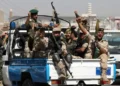
RIYADH, Saudi Arabia – Saudi Arabia issued emergency air-raid alerts across several parts of the kingdom late Friday and early Saturday, including the capital Riyadh, as attacks by Yemen’s Iran-aligned Houthi movement intensified.
Saudi Civil Defense warned residents of a “hostile aerial threat” and urged people in affected areas to follow official instructions. Alerts were subsequently lifted after authorities determined that the immediate danger had passed. No casualties or damage were reported from the Riyadh alerts.
The warning in Riyadh was the first such alert in the capital since the latest escalation involving the Houthis began. Explosions were heard in the city during the alert period, although Saudi authorities did not immediately identify what caused them or confirm that a Houthi projectile had reached the capital.

Alerts spread across several regions
The Riyadh warning followed a series of emergency alerts issued in other parts of Saudi Arabia.
Civil Defense issued warnings in areas including Jeddah, Taif, Yanbu, AlUla, Khamis Mushait, Jazan and Abha. The alerts did not initially specify the nature of the threat, and authorities later declared the danger had passed in the affected areas.
The alerts came after repeated attacks involving missiles and drones launched toward Saudi territory.
Saudi authorities said Thursday that falling debris from an intercepted Houthi drone killed one person and injured two others in Taif province. Earlier attacks had also caused injuries and property damage in southern Saudi Arabia, according to Saudi authorities.
The frequency and geographic spread of the warnings have increased pressure on Saudi air defenses.


Houthi attacks have expanded beyond the border
The latest escalation follows the Houthis’ announcement in July of what they described as a maritime blockade against Saudi Arabia.
The group has since claimed responsibility for attacks involving Saudi-linked shipping and targets inside the kingdom. Saudi authorities have also reported intercepting missiles and drones launched from Yemen.
The renewed fighting represents a significant deterioration from the relative calm that followed a U.N.-brokered truce in 2022.
The Houthis control much of northern Yemen, including the capital Sanaa and large parts of the country’s Red Sea coastline. Saudi Arabia has supported Yemen’s internationally recognized government and has previously led a military coalition against the Houthis.
Mecca has also been placed on alert
The escalation has reached areas beyond Saudi Arabia’s southern border.
On Sept. 15, Saudi authorities issued a security alert in Mecca, Jeddah and Taif. The warning in Mecca was the first of its kind there since the latest regional war began. The alerts were later lifted.
Saudi Arabia subsequently said its air defenses had intercepted and destroyed a Houthi drone south of Mecca before it entered restricted airspace over the holy city.
Saudi-led coalition spokesman Turki al-Malki described the security of Mecca and the country’s other holy sites as a “red line.” The Houthis denied targeting Mecca or other Islamic holy sites.
The incident added a particularly sensitive dimension to the escalating attacks because Mecca is Islam’s holiest city and a major destination for Muslim pilgrims.
Saudi air defenses face growing demands
The attacks are occurring while Saudi Arabia’s air-defense resources are under increasing pressure.
The Associated Press reported this week that Saudi Arabia is seeking assistance from France, Britain, Pakistan and Egypt as its stocks of missile interceptors decline. Two regional officials said the shortage was linked partly to the depletion of U.S. interceptor inventories during the separate U.S.-Iran war.
The Saudi government has not publicly confirmed all details of those requests.
The issue is significant because defending against drones and ballistic missiles requires expensive interceptors, while sustained attacks can rapidly consume available stocks.
Saudi Arabia is therefore confronting a different calculation from simply intercepting individual incoming weapons: the kingdom must maintain sufficient air defenses for repeated attacks while protecting military installations, cities and critical infrastructure.
Energy infrastructure is also under pressure
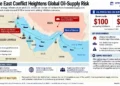
The attacks have coincided with threats to Saudi Arabia’s energy infrastructure and export routes.
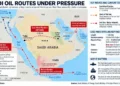
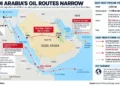
Saudi Arabia’s East-West oil pipeline, which carries crude from the kingdom’s eastern oil fields toward the Red Sea port of Yanbu, was shut down after a separate drone attack that Saudi authorities said originated from Iraq. No group immediately claimed responsibility for that attack.
The pipeline is strategically important because it allows Saudi oil exports to reach the Red Sea without passing through the Strait of Hormuz.
The combination of attacks on Saudi territory, shipping and energy infrastructure has therefore increased the potential regional and economic consequences of the escalation.
U.N. Security Council condemns Houthi escalation
The United Nations Security Council condemned the Houthis’ recent missile attacks and warned that continued military escalation could further widen the regional conflict.
The council said the attacks and threats also risked maritime security and international trade. Its members called for stronger enforcement of the U.N. arms embargo on the Houthis and urged practical cooperation to prevent the group from obtaining additional weapons, military training and financing.
The statement came as fighting in and around Yemen increasingly intersects with the wider regional conflict.
The Security Council also warned that continued escalation could worsen Yemen’s already severe humanitarian situation.
Riyadh faces a widening security challenge
The latest alerts do not establish that every warning was triggered by a confirmed Houthi missile or drone.
Saudi authorities have sometimes issued precautionary alerts without publicly identifying the incoming threat, and the latest Riyadh warning was followed by reports of explosions but no confirmed casualties or damage.
What is established is that the kingdom has experienced a sharp increase in security warnings and reported attacks since the Houthis intensified their campaign.
For Saudi Arabia, the challenge now extends across several fronts: protecting major population centers, maintaining missile-interceptor stocks, defending energy infrastructure and securing maritime trade routes.
The Riyadh alert brought that threat closer to the kingdom’s political center.
Reporting Credit: Saudi Civil Defense — emergency alerts and safety information; Saudi Ministry of Defense / Saudi-led coalition — reported interceptions and military assessments of Houthi attacks; United Nations Security Council — international response to the Houthi escalation and maritime-security concerns.