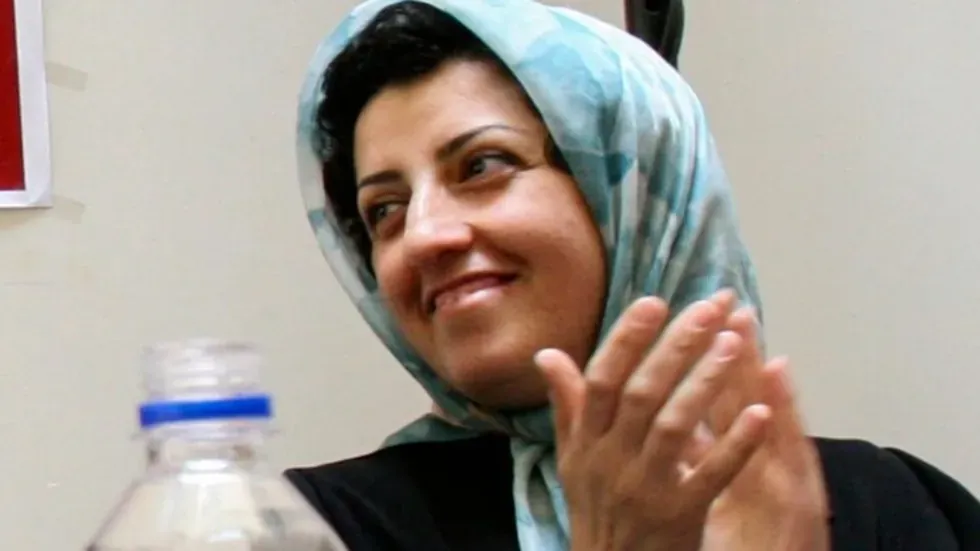
Authorities in Iran have detained Narges Mohammadi, the 2023 recipient of the Nobel Peace Prize, in a move that signals tightening pressure on domestic critics at a moment of political and economic sensitivity for the country.
According to reporting by the Los Angeles Times and statements from Mohammadi’s supporters, the activist was arrested Friday in Mashhad while attending a memorial ceremony for a lawyer whose recent death has stirred questions among rights advocates.
The detention places renewed international attention on the Iranian government’s handling of dissent, even as officials in Tehran continue to signal interest in restarting diplomatic talks with the United States over the country’s nuclear program.

Domestic Pressure Mounts as Authorities Tighten Control
Supporters say security forces detained Mohammadi during a gathering honoring human rights lawyer Khosrow Alikordi, who was found dead in his office earlier this month under circumstances that remain disputed.
Video circulated by activists showed Mohammadi addressing a crowd without wearing the mandatory headscarf, a gesture that has become emblematic of ongoing resistance to the country’s compulsory hijab rules.
Chants referencing Majidreza Rahnavard — a protester publicly executed during the government’s crackdown on the nationwide demonstrations of 2022 — were reportedly heard during the event.
Local officials acknowledged that arrests were made but stopped short of publicly confirming Mohammadi’s detention.
Hasan Hosseini, governor of Mashhad, told Iranian state television that prosecutors ordered the temporary detention of several attendees after what he described as “norm-breaking slogans” were shouted during the ceremony.
■ Related News


Authorities characterized the action as a preventive measure, though activists allege security forces used violence during the arrests.
Activist Network Warns of Expanding Crackdown
Human rights groups quickly condemned the detention.
In a statement, the foundation established in Mohammadi’s name called for the “immediate and unconditional release” of all individuals detained at the memorial.
Hadi Ghaemi, executive director of the Center for Human Rights in Iran, argued that the arrests highlight an increasingly restrictive environment for civil society.
“When peaceful citizens cannot mourn without being beaten and dragged away, it reveals a government terrified of truth and accountability,” Ghaemi said.
More than 80 lawyers in Iran have reportedly signed a statement calling for greater transparency surrounding Alikordi’s death.
A Return to Custody After Medical Furlough
Mohammadi, 53, had been outside prison since December 2024 after authorities granted her a temporary medical furlough.
She had previously been serving a sentence of more than 13 years on charges related to national security and propaganda against the state.
Supporters say the activist’s health has deteriorated after years of imprisonment. She has suffered multiple heart attacks in custody and underwent emergency surgery in 2022.
Doctors overseeing her care warned earlier this year that returning her to prison could seriously worsen her condition, particularly if access to specialized treatment is limited.
Symbol of Defiance in Iran’s Protest Movement
Trained as an engineer, Mohammadi has long been one of the most prominent figures in Iran’s human rights movement.
Her activism intensified during the wave of demonstrations triggered by the 2022 death of Mahsa Amini, a young woman who died after being detained by Iran’s morality police.
Those protests became one of the most significant challenges to Iran’s political establishment in decades.
Even while on medical leave from prison, Mohammadi continued to appear at protests and speak to international media outlets, including demonstrations outside Evin Prison, the facility where she had previously been held.
Diplomatic Calculations Enter a Sensitive Phase
The timing of Mohammadi’s detention carries potential diplomatic implications.
Iran has repeatedly signaled that it remains open to renewed negotiations with Washington regarding its nuclear program, though talks have yet to formally resume.
The arrest of a globally recognized human rights figure could complicate that diplomatic pathway, particularly as Western governments weigh the domestic political environment inside Iran.
For Tehran’s leadership, the episode reflects a broader tension: balancing internal security concerns while attempting to navigate economic pressures and international negotiations.
As the situation unfolds, Mohammadi’s detention may become another test of how Iran manages dissent during a period of geopolitical uncertainty.