The fragile ceasefire between Israel Defense Forces and Hamas faces renewed scrutiny after a mortar shell fired by Israeli troops landed in a residential area of the Gaza Strip, wounding at least 10 Palestinians and reigniting concerns that the truce may be drifting toward renewed confrontation.
According to reporting by Associated Press, Israeli officials said the mortar was fired during an operation near a demarcation zone established under the ceasefire agreement. The military stated that the shell deviated from its intended target and said the incident is under investigation.
The strike occurred near what Israeli authorities refer to as the “Yellow Line,” a ceasefire boundary separating Israeli-controlled portions of Gaza from the remainder of the territory. Palestinian medical officials reported that several of those injured in the blast were in critical condition.

The incident adds new pressure to a ceasefire already strained by mutual accusations of violations and delays in implementing the next phase of the agreement.
Ceasefire Boundaries Become Flashpoints
Tensions have increasingly centered on the poorly defined ceasefire boundary running through parts of Gaza. Israeli troops have been placing yellow markers intended to delineate the line, but Palestinian residents say large stretches remain unclear, increasing the risk of civilian exposure to military operations.
An Israeli military official, speaking on condition of anonymity in line with army protocol, acknowledged that some civilians have been killed during enforcement operations near the boundary. Israeli officials maintain that many of those targeted were militants linked to Hamas, though the military has also recognized cases in which noncombatants were caught in crossfire.
Since the truce took effect in October, Palestinian health authorities report that Israeli fire has killed more than 370 people in Gaza outside the designated line. Israeli officials dispute aspects of those figures and say their forces have responded to repeated Hamas violations of the ceasefire terms.
The conflicting accounts underscore the volatility surrounding the buffer zone, where enforcement actions, unclear markings and civilian movement intersect.




Diplomatic Path Forward Faces New Pressure
The mortar incident arrives at a critical moment for the ceasefire’s political roadmap. Negotiators had hoped to move the agreement into its second phase, which includes plans for an international stabilization force and a technocratic administrative authority to govern Gaza.
Progress has stalled, however, amid disputes over implementation conditions.
Israel has demanded the return of the remains of Israeli hostage Ran Gvili before advancing to the next stage. Hamas officials say they have struggled to locate the body and have instead called for greater international pressure on Israel to meet humanitarian provisions outlined in the ceasefire deal.
Those provisions include the reopening of border crossings and the delivery of significantly increased aid flows into Gaza.
Aid Access Emerges as Strategic Friction
Humanitarian access has become another major point of contention. According to figures recently cited by Israeli military sources, the volume of aid entering Gaza has fallen short of the 600 daily truck deliveries envisioned in the ceasefire agreement, though Israeli officials contest that interpretation.
Relief organizations warn that the shortfall continues to strain the territory’s fragile recovery after months of severe food shortages and widespread displacement.
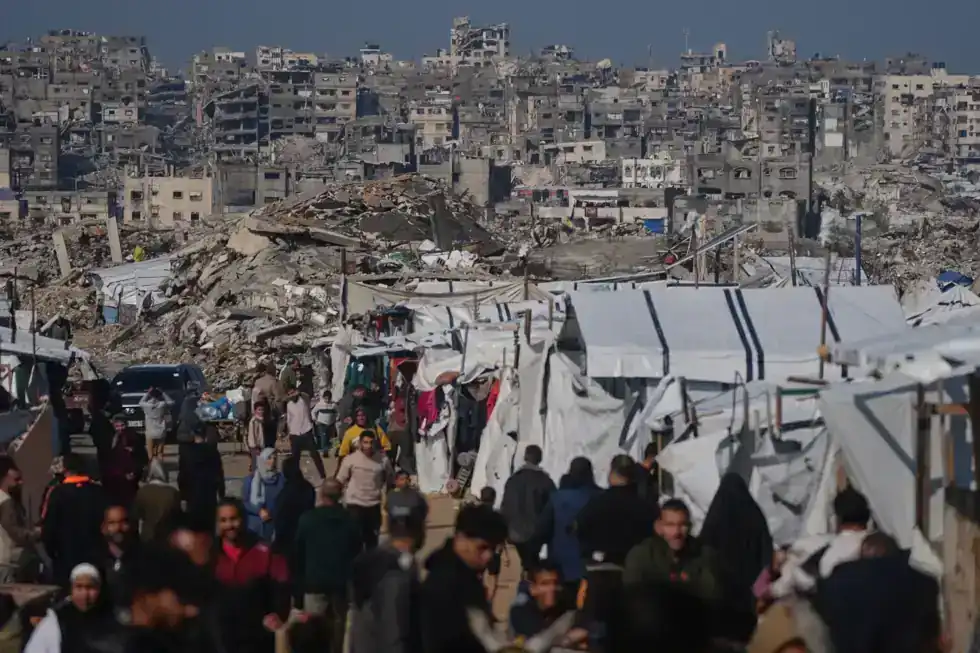
Aid groups say the majority of Gaza’s population remains dependent on external assistance, with many residents living in temporary shelters or amid the ruins of damaged neighborhoods.
The humanitarian situation is increasingly shaping international diplomatic pressure surrounding the ceasefire’s future.
Regional Stability Hinges on Truce Survival
The broader context of the war continues to loom over the ceasefire’s stability. The conflict began after Hamas-led militants launched an attack on southern Israel on Oct. 7, 2023, killing roughly 1,200 people and taking 251 hostages.
Israel’s subsequent military campaign in Gaza has killed more than 70,000 Palestinians, according to Gaza’s Health Ministry, which is administered under the Hamas-run government. International observers say the ministry’s data, though disputed by Israel, is widely referenced by humanitarian agencies.
Nearly all hostages captured during the attack have since been returned through negotiated exchanges or separate agreements.
Yet with Gaza’s infrastructure devastated and its population largely displaced, each new military incident along the ceasefire boundary risks unraveling the fragile diplomatic framework that has so far prevented a full return to war.
For regional mediators, the latest mortar strike illustrates how quickly operational miscalculations could escalate into a broader collapse of the truce.