Oil prices have risen to their highest level in roughly six weeks as escalating U.S.-Iran tensions increase risks to commercial shipping and raise concerns about energy supplies moving through the Strait of Hormuz.
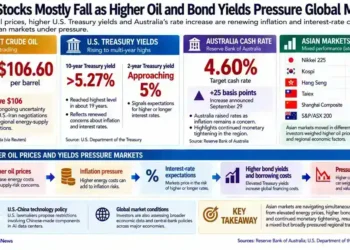
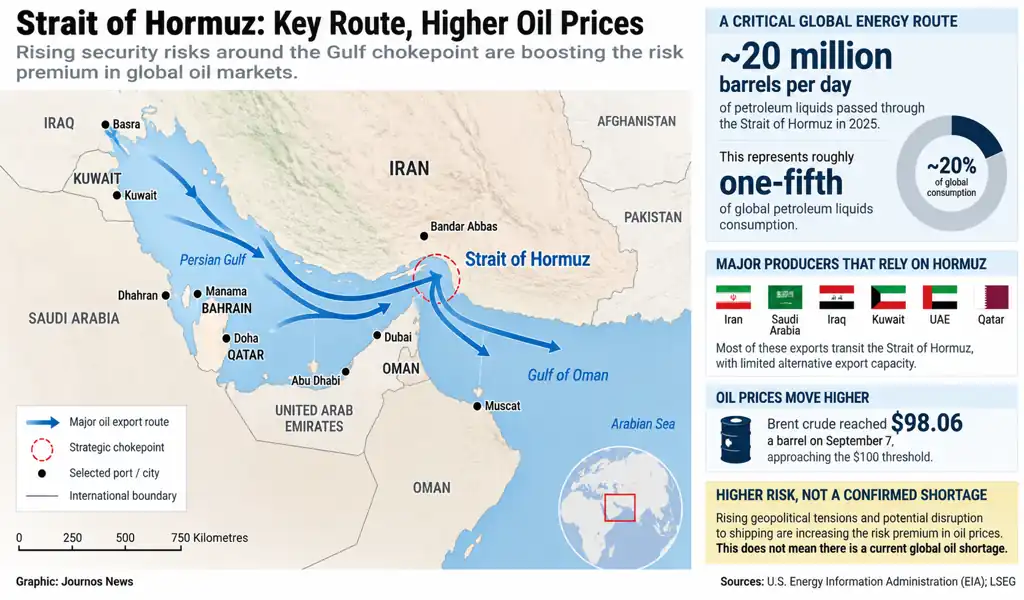
Brent crude climbed to $98.06 a barrel on September 7 before settling at $97.31, while West Texas Intermediate reached $92.65. Both benchmarks reached their highest levels since July 24, according to the supplied Reuters reporting, leaving Brent within a few dollars of the $100-a-barrel threshold.
The price move reflects growing concern over the security of a waterway that carries a substantial share of the world’s petroleum supplies. For energy markets, the immediate issue is not a confirmed loss of global oil supply but the increasing risk that commercial vessels may face difficulties moving through the Gulf.

Hormuz Becomes a Focus for Energy Markets
The Strait of Hormuz is a critical transit route for global energy trade.
The U.S. Energy Information Administration estimates that about 20 million barrels per day of petroleum liquids passed through the strait in 2025, equivalent to roughly one-fifth of global petroleum liquids consumption. The waterway is also an important route for liquefied natural gas shipments.
Saudi Arabia, Iraq, Kuwait, Qatar and the United Arab Emirates rely heavily on the route to reach international markets. Iran also depends on maritime routes in the Gulf for energy exports, according to EIA analysis.
That concentration of energy flows makes disruptions particularly significant for international oil markets.
Shipping Risk Adds to the Oil Price Premium
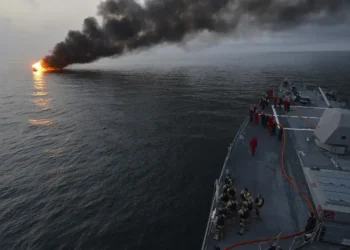
Attacks and threats involving tankers have increased the perceived risks facing commercial vessels operating in and around the Gulf.
■ Related News

For oil traders, the potential disruption can influence prices before a large physical shortage develops. Futures markets can incorporate expectations of tighter supply, creating a geopolitical risk premium even when substantial volumes of crude remain available.
That distinction is important for assessing the current price increase. The rise in crude benchmarks does not by itself establish that the full volume normally transported through Hormuz has been removed from global markets.
Instead, prices are responding to greater uncertainty over whether those supplies can continue reaching buyers reliably.
Brent Nears the $100 Threshold
Brent’s move toward $100 a barrel highlights the sensitivity of international oil markets to developments around the waterway.
EIA analysis identifies Hormuz as a major global petroleum chokepoint and notes that alternative export routes have limited capacity relative to the volumes normally transported through the strait.
Some Gulf producers can use pipelines to bypass Hormuz, but those routes cannot replace all of the oil normally shipped through the waterway. As a result, a prolonged disruption could put greater pressure on inventories and international crude prices.
Gulf Producers and Consumers Face Different Risks
The exposure created by Hormuz operates through several channels.
For Gulf producers, a sustained reduction in tanker traffic could constrain access to international markets. For buyers, disruption could tighten available supplies and increase crude acquisition costs.
Consumers could eventually face higher prices for gasoline, diesel, jet fuel and other petroleum products if elevated crude prices persist. The effect would vary by market because retail fuel prices also depend on refining margins, taxes, transportation costs, currency movements and local competition.
A prolonged increase in oil prices could nevertheless add to inflationary pressure in economies that depend heavily on imported energy.
Shipping Costs Could Increase Further
The economic impact extends beyond the crude benchmark itself.
If shipping companies view the Gulf as increasingly hazardous, operators could face higher insurance premiums, additional security expenses, delays or the need to use longer routes. Those costs can increase the delivered price of energy even when the underlying crude price rises by a smaller amount.
A sustained decline in tanker traffic could therefore create both a supply problem and a broader logistics challenge for energy markets.
Limited Alternatives Increase Market Sensitivity
The lack of sufficient alternative export capacity is one reason developments around Hormuz can have an outsized effect on global energy prices.
While some Gulf producers have pipelines capable of bypassing the strait, EIA analysis indicates that their capacity is insufficient to replace all of the volumes normally transported through Hormuz.
The market therefore has limited ability to redirect exports if shipping through the waterway becomes severely restricted. The duration and scale of any disruption would be critical to its effect on inventories, crude prices and downstream fuel markets.
Markets Await Further Developments
The next direction of oil prices will depend heavily on developments affecting maritime traffic and the broader U.S.-Iran confrontation.
If commercial vessels continue operating through the Gulf without sustained disruption, some of the risk premium embedded in crude prices could ease. Further attacks, vessel withdrawals or additional restrictions on maritime traffic could instead lead traders to price in a larger potential supply shortfall.
The Strait of Hormuz has consequently become a central variable for energy markets as traders assess the economic consequences of the conflict.
A Supply Risk, Not Yet a Global Shortage
Brent’s approach toward $100 a barrel demonstrates how quickly geopolitical risk can translate into higher energy prices.
The latest increase does not establish that a global oil shortage has already occurred. It indicates that traders are placing greater value on the possibility of disrupted supplies from a region connected to a critical global energy chokepoint.
For oil markets, the key question is therefore not only how much crude Gulf producers can produce, but whether that crude can continue reaching international buyers safely and consistently.
Reporting Credit: U.S. Energy Information Administration (EIA) — official analysis of the Strait of Hormuz as a global petroleum chokepoint, including petroleum volumes transported through the waterway, major exposed producers and the limited capacity of alternative export routes; U.S. Central Command (CENTCOM) — official military statements and operational information concerning U.S. activity involving Iranian forces and maritime security in the region; Islamic Republic of Iran / Iranian authorities — official statements and announcements concerning maritime restrictions and security measures affecting vessels operating in the Strait of Hormuz; OPEC — official petroleum-market and production information relevant to global crude supply and the ability of producers to respond to disruptions.