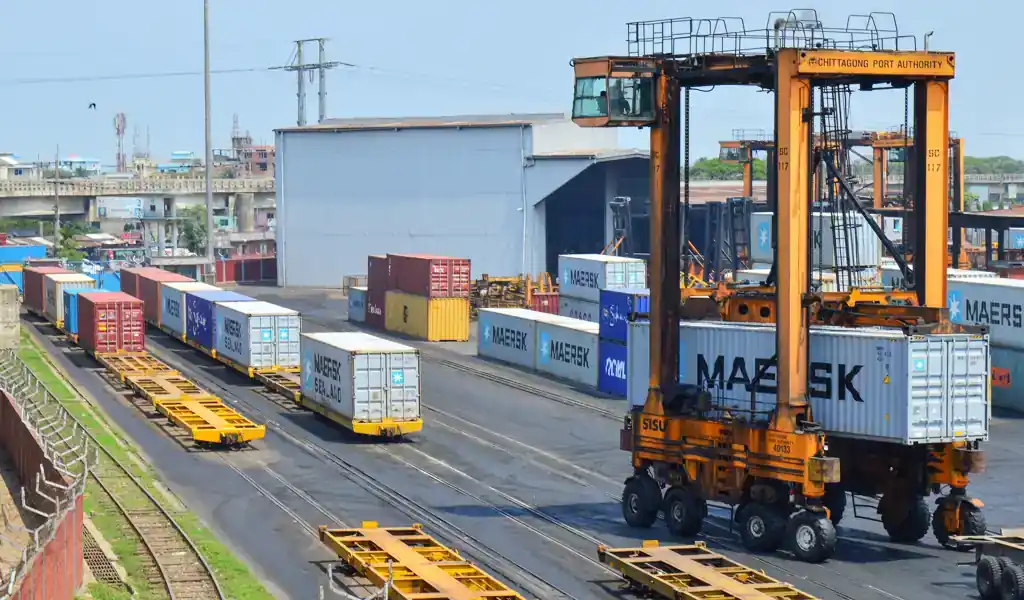
DHAKA, Bangladesh – Bangladesh has moved into the construction phase of a major new container terminal at Chattogram Port, as the government seeks to expand maritime capacity and attract international investment into the country’s logistics infrastructure.
The Laldia Container Terminal, being developed by Denmark-based APM Terminals under a public-private partnership, represents an investment of about $550 million and is one of the largest PPP investments in Bangladesh’s history. Construction officially began on August 30.
The project is expected to add more than 800,000 twenty-foot equivalent units (TEUs) of annual container-handling capacity and is scheduled for completion around 2030.

Chattogram at the center of Bangladesh’s trade
Chattogram Port is Bangladesh’s principal maritime gateway, handling roughly 92% of the country’s import and export trade.
The scale of that dependence makes expanding the port increasingly important as Bangladesh’s manufacturing and export economy grows.
The Laldia terminal is designed to reduce pressure on existing facilities while increasing the port’s ability to handle international container traffic more efficiently. Bangladesh’s government has described the investment as an important step toward turning Chattogram into a regional logistics hub.
Larger ships will be able to reach the port
One of the project’s most significant changes will be its ability to accommodate larger container vessels.
The terminal is being designed to handle ships carrying up to approximately 6,000 TEUs, compared with a current limit of around 2,800 TEUs at Chattogram.
■ Related News




That could reduce Bangladesh’s reliance on feeder vessels transporting containers between Chattogram and larger regional transshipment hubs such as Colombo and Singapore.
For exporters, direct access to larger ships could potentially reduce handling requirements and improve shipping efficiency.
International investment expands
APM Terminals’ project comes as international port operators increase their involvement in Bangladesh.
Saudi-backed Red Sea Gateway Terminal International has also expanded its presence at Chattogram’s Patenga Container Terminal following a $170 million investment in modernization and capacity expansion.
RSGT has indicated that it could invest substantially more in Bangladesh’s port and logistics sector.
The government has also removed restrictions that previously limited foreign ownership in privately operated inland container depots, part of a broader effort to attract international capital and expertise into the logistics industry.
Technology and greener operations
The Laldia project is intended to introduce modern container-terminal technology, including ship-to-shore cranes, remotely operated yard cranes and electric container-handling vehicles.
The planned facility will have about 600 meters of quay, seven ship-to-shore gantry cranes, 30 remotely operated gantry cranes and around 45 electric trucks.
Those systems are expected to improve handling efficiency while reducing the terminal’s dependence on conventional diesel-powered equipment.
Bangladesh seeks a larger logistics role
The investment comes as Bangladesh looks to strengthen its position in regional trade.
Better port infrastructure could become increasingly important as the country expands manufacturing and exports while preparing for changes associated with its transition from least-developed-country status.
The government has identified logistics, ports and trade infrastructure as important areas for attracting foreign investment and supporting longer-term economic growth.
The Laldia terminal is therefore more than a single port project. It forms part of a broader effort to modernize Bangladesh’s trade infrastructure and connect the country’s exporters more efficiently with international markets.
Competition for regional cargo
The expansion could also strengthen Chattogram’s position relative to other South Asian ports.
If the terminal can accommodate larger vessels and provide faster cargo handling, Bangladesh could reduce some of the additional costs associated with transshipment through foreign ports.
That could be particularly important for the country’s large garment-export industry, which depends heavily on reliable international shipping.
However, the benefits will depend on the terminal being supported by efficient customs procedures, road and rail connections, reliable access channels and broader port reforms.
What Happens Next
Construction of the Laldia Container Terminal will now proceed toward its planned operational phase around 2030.
The immediate focus will be on building the terminal and associated infrastructure, while Bangladesh continues developing other port and logistics projects around Chattogram.
If completed as planned, Laldia will add more than 800,000 TEUs of annual capacity and allow significantly larger container vessels to call at the port.
Key Facts
- Project: Laldia Container Terminal
- Location: Chattogram, Bangladesh
- Investment: About $550 million
- Developer: APM Terminals
- Model: Public-private partnership
- New capacity: More than 800,000 TEUs annually
- Vessel capacity: Up to about 6,000 TEUs
- Construction: Began August 30, 2026
- Expected completion: Around 2030
- Main objective: Expand Bangladesh’s container capacity and strengthen Chattogram as a regional logistics hub
- Status: DEVELOPING — BUSINESS & INFRASTRUCTURE
Reporting Credit: Bangladesh Ministry of Shipping — Laldia Container Terminal and Chattogram Port development; Chattogram Port Authority — port capacity and operations; APM Terminals — Laldia investment, construction and terminal development; Bangladesh Investment Development Authority — foreign investment and PPP framework.