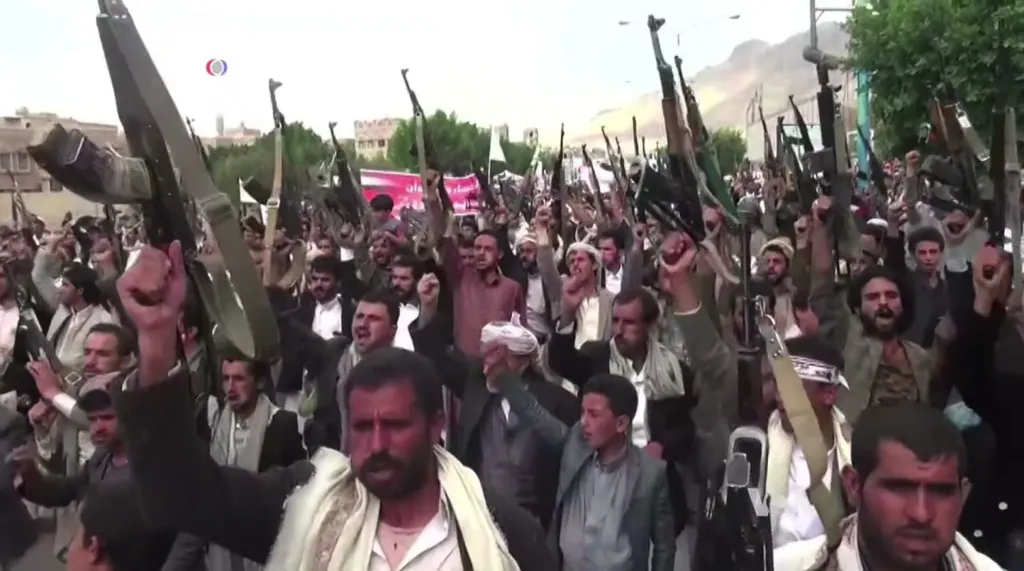
SANAA, Yemen – Yemen’s Houthis are opening a new military front in the wider Iran war by expanding along the country’s Red Sea coast, tightening their position near the Bab el-Mandeb Strait and increasing attacks against Saudi Arabia.
The escalation has transformed Yemen from a secondary theater into a more consequential part of the regional conflict.
The Iran-aligned group captured the strategic port city of Mocha earlier this month and subsequently took control of nearby islands at the southern entrance to the Red Sea. Saudi Arabia, which backs Yemen’s internationally recognized government, has responded with airstrikes and a renewed military campaign against Houthi positions.

The fighting is unfolding as Iran remains at war with the United States and as disruptions around the Strait of Hormuz have already strained global energy markets.
The geography of Yemen gives the Houthis an opportunity to exert pressure somewhere else along the region’s maritime trade network.
The fight has moved toward the Red Sea
The Houthi advance along Yemen’s western coast has been one of the most significant changes in the country’s military balance since the current phase of the civil war began.
The group captured Mocha, a strategically located port overlooking the Red Sea, before expanding toward islands near the Bab el-Mandeb Strait.
The waterway connects the Red Sea with the Gulf of Aden and is one of the world’s most important maritime passages. In peacetime, roughly 12% of global trade passes through the broader Red Sea route, making disruption there consequential for shipping and energy markets.




The Houthis’ territorial gains give them greater access to the coastline and positions from which they can threaten maritime traffic.
The development is also important because Saudi Arabia has increasingly relied on its Red Sea export infrastructure while other routes have been disrupted.
Saudi Arabia has become the Houthis’ immediate target
The escalation has rapidly expanded beyond Yemen’s internal battlefield.
The Houthis have launched drones and missiles toward Saudi Arabia, including attacks on energy-related sites in the country’s south.
Saudi authorities said attacks in September wounded dozens of people, while the Houthis claimed they had targeted Saudi energy infrastructure. The two sides have continued exchanging strikes as Saudi-backed Yemeni forces attempt to halt the Houthi advance.
On Sept. 19, Saudi Arabia said it intercepted a ballistic missile launched toward Riyadh. Residents reported explosions and smoke near the airport, but authorities said there were no casualties or damage. The Houthis also claimed attacks on targets in Yanbu, Taif, Baysh and Farasan, although some of those claims could not be independently verified.
The attacks have forced Saudi Arabia to devote additional air-defense resources to a threat emerging from its southern neighbor.
Saudi officials have also reported an interception of a Houthi drone south of Mecca, increasing the sensitivity of the confrontation because of the city’s religious significance.
The Bab el-Mandeb is the strategic prize
The Houthi advance is significant not simply because of territory captured inside Yemen.
It is also about geography.
The Bab el-Mandeb is the narrow maritime passage connecting the Red Sea and the Gulf of Aden. Ships using the Suez Canal route between Asia and Europe normally pass through this corridor.
Control or sustained military pressure around the waterway could give the Houthis an ability to threaten commercial shipping even without closing the strait completely.
The group has already demonstrated its willingness to attack ships during earlier phases of the regional conflict.
The current advance gives that maritime campaign a stronger territorial base.
Analysts cited by Al Jazeera said the land offensive and maritime campaign are closely connected, with control of more coastline potentially giving the Houthis greater depth for operations around the Red Sea.
Chatham House similarly assessed that the capture of Mocha and the advance toward Bab el-Mandeb represent a major change in Yemen’s strategic geography, potentially giving Iran and its allies greater ability to exert pressure around two major maritime chokepoints.
The Iran connection is central but complicated
The Houthis are closely aligned with Iran, but that does not mean every Houthi military decision is directly commanded from Tehran.
Iran has provided the group with weapons, technology and other forms of support, according to U.S., regional and international assessments.
Recent Reuters reporting, citing Yemeni government, Iranian and regional sources, said Iran’s Islamic Revolutionary Guard Corps provided direct guidance during the Houthi advance along the Red Sea coast. The sources said the objective was to open another front in the wider war involving Iran and the United States.
The claim about direct Iranian guidance is based on those sources and has not been independently established in every operational detail.
What is clearer is that the Houthi campaign serves an Iranian strategic interest by creating another pressure point around a critical maritime route while the Strait of Hormuz remains heavily disrupted.
That does not make Yemen simply an extension of the Iranian battlefield.
The Houthis have their own political and military objectives inside Yemen, including expanding territorial control and maintaining their position against the Saudi-backed government.
Yemen’s civil war is being reopened
The current fighting is also a revival of Yemen’s own conflict.
A United Nations-brokered truce in 2022 sharply reduced the level of large-scale fighting between the Houthis and Saudi-backed forces, although it did not produce a final peace agreement.
The latest Houthi offensive has broken that period of relative calm.
Government forces have launched counterattacks along the western coast and in other areas, while Saudi Arabia has carried out airstrikes against Houthi positions.
The fighting has displaced tens of thousands of Yemenis. Reuters reported that civilians have fled coastal areas as the conflict expanded, including people who crossed the Red Sea toward Djibouti.
The humanitarian consequences are significant because Yemen was already one of the world’s most severe humanitarian crises before the latest escalation.
A renewed nationwide war would place additional pressure on populations already affected by years of conflict, economic disruption and displacement.
Saudi Arabia’s oil routes are increasingly exposed
The military escalation has also created a direct energy-security concern for Saudi Arabia.
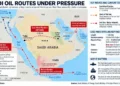
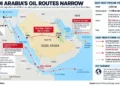
The kingdom has extensive oil infrastructure on both its eastern and western coasts. Its East-West pipeline can transport crude across the country to Red Sea terminals, allowing Saudi exports to reach international markets without passing through the Strait of Hormuz.
That route has become more important as the wider Iran war disrupts Gulf shipping.
But the pipeline itself has now come under attack.
Saudi Arabia said it shut down a major pipeline after drones struck it, while the escalation along the Red Sea coast has increased concerns about the security of Saudi energy infrastructure and exports.
The vulnerability is significant because the Houthis do not need to destroy Saudi Arabia’s entire oil infrastructure to create disruption.
Repeated attacks can force temporary shutdowns, require additional air-defense deployments and increase the risk premium attached to shipping and energy infrastructure.
The conflict is already affecting markets
Financial markets have responded to the widening confrontation.
Gulf stock markets fell on Sept. 20 after the Houthis claimed attacks near Riyadh. Saudi Arabia’s main index closed 0.3% lower, while Qatar’s benchmark declined 1.1%.
Oil and shipping markets are particularly sensitive to the situation because the conflict is developing around two major maritime chokepoints.
The Strait of Hormuz handles a much larger share of global oil flows, while Bab el-Mandeb is crucial to the Red Sea route connecting the Indian Ocean with the Mediterranean through the Suez Canal.
Disruption at both points would create a more complicated transportation problem than a single-route disruption.
Ships could be forced to take longer routes around Africa, increasing travel times, fuel consumption and insurance costs.
The United States faces a different calculation
Washington is also confronting a difficult strategic problem.
The United States is already heavily engaged in the wider Iran war, but a major new military campaign against the Houthis could expand the conflict further.
Recent reporting indicates that President Donald Trump has not committed direct U.S. military support to Saudi Arabia against the Houthis, even as attacks on the kingdom have intensified.
That leaves Saudi Arabia facing a growing threat while the United States weighs how much additional military involvement would be required.
The Houthis have also signaled that they do not currently intend to attack U.S. vessels in the Red Sea, according to a senior Houthi official who spoke to the Associated Press.
Whether that position holds as the fighting expands remains uncertain.
The next pressure point is the eastern advance
The Houthi territorial gains along the Red Sea coast may not be the end of the campaign.
The group appears to be facing the strategic question of whether to consolidate its western gains or continue pushing into other parts of Yemen.
The Washington Post reported that the Houthis were looking toward Yemen’s oil-rich east after their rapid advance along the coast. Saudi-backed government forces and other local formations remain obstacles to that expansion.
An eastern advance would fundamentally change the military and economic stakes.
Yemen’s oil-producing regions are important to the internationally recognized government, while control of additional territory could provide the Houthis with more resources and bargaining power.
But expanding too far could also stretch Houthi forces and create additional fronts against competing Yemeni factions.
For now, the group’s gains along the Red Sea already give it something it did not have before: a stronger geographic position around a major international shipping corridor.
Yemen has become part of the wider war
The latest escalation cannot be understood solely as another chapter of Yemen’s civil war.
It is both.
The Houthis are fighting for greater control inside Yemen while using their military position to exert pressure on Saudi Arabia and the Red Sea.
Iran benefits strategically from the additional pressure placed on Saudi Arabia and on maritime routes, while the Houthis retain their own interests and decision-making.
For the United States and its allies, the problem is now broader than protecting ships.
They must also consider Saudi energy infrastructure, air defenses, humanitarian displacement and the possibility that another major theater could develop while the Iran war is already stretching regional military resources.
The immediate question is whether the Houthis consolidate their new positions or push farther.
The larger question is whether Yemen becomes a sustained secondary battlefield of the Iran war.
The answer will depend on the pace of Saudi counterattacks, Houthi military decisions, Iranian support and whether Washington and regional governments choose to expand or contain their involvement.
For now, the map of the conflict has changed.
The Houthis hold new territory along the Red Sea, Saudi Arabia is under direct attack, and the Bab el-Mandeb has become an increasingly important pressure point in a war that began far beyond Yemen’s borders.
Reporting Credit: Saudi Ministry of Defense / Saudi-led coalition — official statements concerning Houthi attacks, missile and drone interceptions and Saudi military responses; internationally recognized Yemeni government — battlefield and counteroffensive statements; Houthi movement / Ansar Allah — statements and claims concerning attacks and territorial operations; United Nations — Yemen humanitarian and conflict information; U.S. Department of Defense — publicly documented regional military posture and operations.