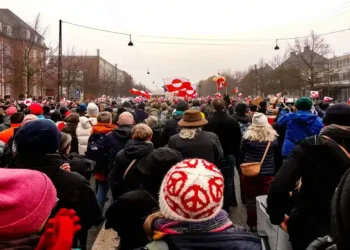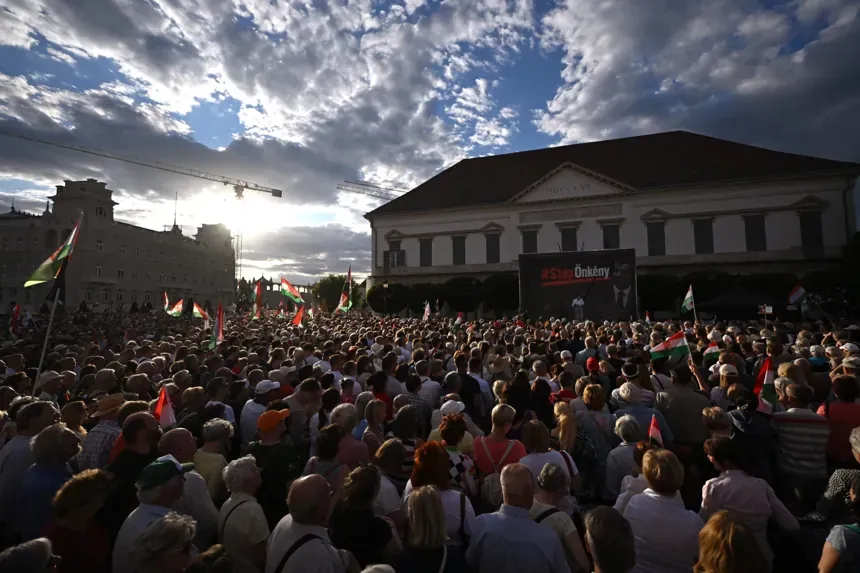
BUDAPEST, Hungary – Thousands of demonstrators gathered in Budapest on Thursday to protest the Hungarian government’s plan to remove President Tamás Sulyok from office, highlighting the country’s deepening political divisions just months after Prime Minister Péter Magyar ended Viktor Orbán’s 16-year rule.
The demonstration, held outside the presidential offices at Budapest’s Sándor Palace in the Castle District, was organized by Orbán’s far-right Fidesz party after the former prime minister urged supporters to take part through social media.
Although Orbán promoted the protest, he did not attend.

Constitutional amendment targets presidency
The protest comes ahead of a parliamentary vote next week on a constitutional amendment that would terminate Sulyok’s presidency.
The proposal would also introduce term limits for members of parliament, implement judicial reforms and establish a new authority to investigate alleged financial abuses committed during Orbán’s administration.
Since taking office after a landslide election victory in April, Magyar has moved rapidly to dismantle institutions he says helped sustain Orbán’s authoritarian-style rule.
His government has removed numerous political appointees and senior officials while pledging to restore democratic checks and strengthen Hungary’s ties with the European Union.
Protesters defend the presidency
Demonstrators argued that removing the president before the end of his term would undermine democratic institutions regardless of Sulyok’s personal popularity.
■ Related News



“The point is not whether Tamás Sulyok is popular or not, but that this is simply unacceptable in a democracy,” protester Krisztina Nemerkényi said.
Orbán and Fidesz have portrayed the government’s effort as an attack on the rule of law and warned it could mark the beginning of authoritarian governance under the new administration.
Government says voters gave it a mandate
Magyar has defended the proposal, arguing that Sulyok failed to fulfill his constitutional responsibilities by not challenging what he describes as anti-democratic actions taken during Orbán’s years in office.
The prime minister repeatedly pledged during the election campaign to replace Sulyok and has argued that his party’s two-thirds parliamentary majority gives the government a clear democratic mandate to do so.
Although Hungary’s presidency is largely ceremonial, the officeholder signs legislation into law and may refer bills to the Constitutional Court for review, powers that government supporters fear could be used to delay or obstruct reforms.
Fidesz rejects accusations
Speaking at the protest, Fidesz lawmaker János Pócs defended his party’s record after criticism over numerous constitutional amendments enacted while Orbán was in power.
Fidesz rewrote Hungary’s constitution in 2011 and later amended it 15 times.
Pócs said those changes were made “always in the interest of the country, in order to protect the country, but not for the sake of dictatorship.”
Orbán’s government faced years of criticism from the European Union and international watchdogs over judicial independence, media freedom and democratic governance.
Reform agenda continues
Since taking office in May, Magyar’s administration has implemented several campaign pledges, including suspending the news service of Hungary’s public broadcaster, which the government says functioned as a political propaganda outlet under Orbán.
The government has also introduced an eight-year term limit for future prime ministers and replaced the leadership of Hungary’s national security and intelligence agencies.
In addition, Budapest secured the release of approximately €16.4 billion ($19 billion) in previously frozen European Union funding after introducing reforms aimed at reversing democratic backsliding identified during Orbán’s tenure.
The outcome of next week’s constitutional vote is expected to shape the next phase of Hungary’s political transition as the new government continues efforts to overhaul institutions established during Orbán’s years in power.
This report is based on reporting by The Associated Press.
Article Topics: Hungary | Viktor Orbán | Péter Magyar | Tamás Sulyok | Budapest Protest | Constitutional Reform | European Union | Politics