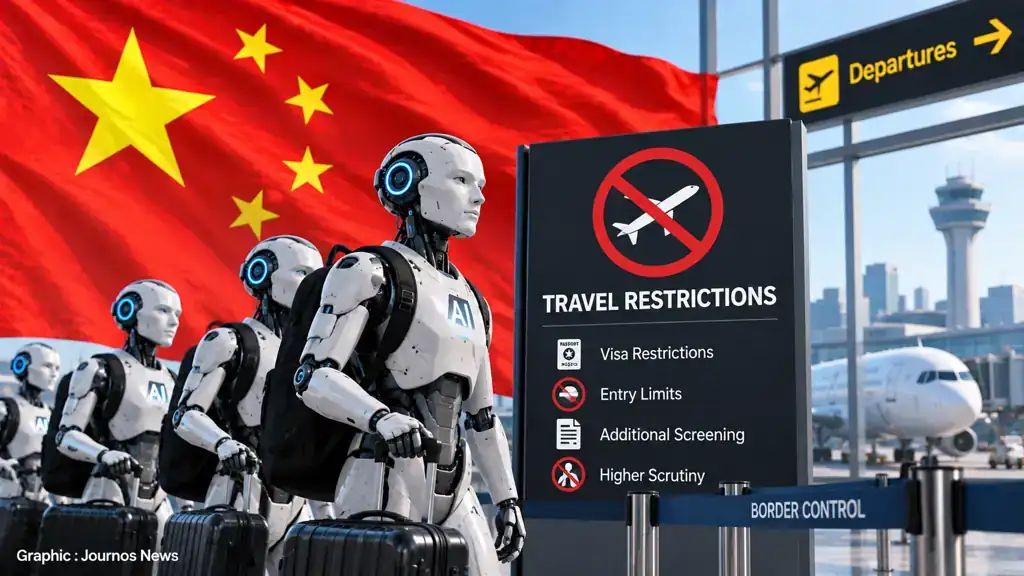
BEIJING, China – China has expanded the legal circumstances under which authorities can prevent citizens from leaving the country, including cases involving national security and technology-related interests, according to changes to the country’s exit-control framework.
The changes give authorities broader grounds to restrict international travel when a person’s departure is considered capable of threatening national security or causing significant harm to national interests. The measures add to a growing body of Chinese laws that give the state greater authority over cross-border movement.
The issue has drawn particular attention because exit restrictions can affect people connected to sensitive industries, scientific research, technology and commercial disputes.

China’s government maintains that exit controls are necessary to protect national security and enforce the law. Critics and rights advocates have argued that the rules can be applied with limited transparency and leave individuals uncertain about when they may be prevented from traveling.
National security becomes a broader basis for travel restrictions
China’s exit-control system already allows authorities to prevent certain individuals from leaving the country under specified legal circumstances.
The expanded provisions reinforce national-security considerations as a basis for restricting departure. That is significant because China’s definition of national security extends beyond traditional military and intelligence concerns to areas including economic security, technology, data and supply chains.
Under China’s National Security Law and related legislation, national security is treated as a broad concept encompassing political, economic, technological and other interests.
The government has increasingly linked technological capabilities and information security to national security. That has resulted in tighter controls surrounding sensitive data, advanced technologies and research.
■ Related News




For people working in those fields, the practical consequences can extend beyond restrictions on information itself.
An individual involved in a regulatory investigation, commercial dispute or sensitive research project may face restrictions on leaving the country while authorities determine whether the person possesses information or responsibilities considered relevant to national interests.
Technology workers face greater uncertainty
The expansion comes as Beijing continues to strengthen controls over technologies it considers strategically important.
China has tightened rules surrounding data transfers, cybersecurity and the protection of sensitive information. Authorities have also increased scrutiny of companies and individuals involved in areas considered important to national development and security.
That environment has complicated international travel for some executives, researchers and employees of technology companies.
The restrictions do not mean that all Chinese citizens working in technology or other sensitive sectors will automatically be prevented from traveling. Rather, they provide legal mechanisms that authorities can use in particular cases.
The distinction matters because the rules operate through individual decisions and legal circumstances rather than creating a blanket travel ban for an entire profession.
Business implications
Travel restrictions can create risks for multinational companies operating in China.
Executives and employees who are subject to an exit restriction may be unable to attend overseas meetings, return to another country where they normally live or work, or participate in international business activities.
The uncertainty can also affect companies deciding how to structure operations and protect employees who may become involved in investigations or disputes.
Foreign businesses have previously raised concerns about exit bans in China, particularly when executives become involved in commercial or regulatory cases.
For Chinese companies, restrictions can create similar problems by limiting the ability of employees and managers to travel while they are involved in sensitive proceedings.
Beijing says national security is the priority
Chinese authorities have defended stronger national-security controls as necessary to protect the country’s interests.
The government has increasingly emphasized that national security must be integrated into economic and technological policy. Beijing argues that countries have the right to prevent sensitive information and strategic technologies from being transferred abroad.
That approach differs from systems in which restrictions on international travel generally require more narrowly defined legal grounds.
The practical effect of China’s broader framework will depend on how authorities apply the rules and how courts and government agencies interpret the relevant provisions.
For individuals affected by an exit restriction, that distinction can be consequential.
A restriction can prevent a person from leaving even without a criminal conviction, depending on the legal basis cited by authorities. The lack of advance notice can also make the restrictions difficult for individuals and companies to anticipate.
A wider shift in China’s security policy
The changes form part of a broader evolution in China’s approach to national security.
Beijing has expanded the concept of security across economic activity, technology, data and foreign relations. Laws covering counterespionage, state secrets, data security and national security have increasingly intersected with ordinary commercial and professional activity.
That has created a more complicated operating environment for people whose work involves sensitive information or international connections.
The latest exit-control changes do not establish that China intends to routinely prevent citizens from traveling abroad. Their significance lies instead in the additional authority available to the state when officials determine that national-security or other legally defined interests are at stake.
How frequently those powers are used, and how clearly affected individuals can challenge them, will determine their practical impact.
Reporting Credit: National People’s Congress of the People’s Republic of China — legislative framework and legal provisions; Chinese government authorities — national-security and exit-control policy; relevant Chinese regulatory authorities — technology, data and national-security requirements.