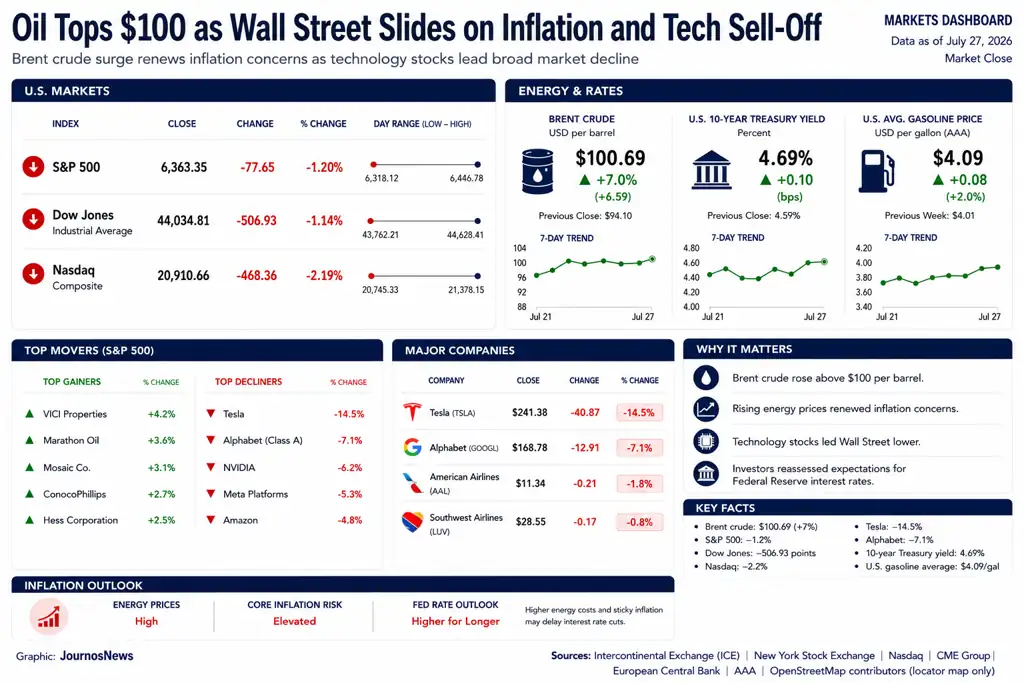
NEW YORK – Wall Street posted its steepest daily decline in a month on Thursday as Brent crude oil climbed above $100 per barrel amid escalating tensions in the Middle East, while sharp losses in Tesla and Alphabet pushed major U.S. stock indexes lower.
The S&P 500 fell 1.2% to close at 7,408.30, putting the benchmark on track for its first consecutive weekly declines since March. The Dow Jones Industrial Average dropped 506.93 points, or 1%, to 51,711.65, while the Nasdaq Composite slid 2.2% to 25,137.69.
Brent crude, the international oil benchmark, surged 7% to settle at $100.69 per barrel after briefly reaching $102 during trading, its highest level since May.

Oil Rally Renews Inflation Concerns
According to AP reporting, the latest surge in oil prices followed attacks on two Saudi oil tankers in the Red Sea, raising fresh concerns over the security of another critical shipping route for Middle Eastern crude exports.
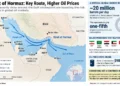
The attacks added to existing market concerns over disruptions to the Strait of Hormuz, one of the world’s most important energy transit corridors.
President Donald Trump warned of “major military punishment” against Yemen’s Iran-backed Houthi rebels if attacks on commercial shipping continue, underscoring the growing geopolitical risks facing global energy markets.
Only weeks earlier, Brent crude had traded below $72 per barrel as investors anticipated that easing regional tensions could restore normal shipping through the Strait of Hormuz.
Markets Reassess Interest Rate Outlook
The renewed increase in energy prices has intensified concerns that inflation could accelerate after showing signs of moderating.
■ Related News



Persistently higher inflation could prompt central banks to maintain tighter monetary policy, increasing borrowing costs and weighing on economic growth and equity valuations.
The European Central Bank left its benchmark interest rates unchanged at Thursday’s policy meeting. Meanwhile, CME Group data showed traders assigning a 36% probability that the Federal Reserve will raise its benchmark interest rate at next week’s meeting, up from nearly 12% a week earlier.
If implemented, it would mark the Fed’s first interest rate increase since 2023.
Treasury Yields and Fuel Prices Rise
Higher oil prices also pushed Treasury yields higher. The yield on the benchmark 10-year U.S. Treasury note rose to 4.69% from 4.67% on Wednesday and has climbed from 3.97% before the conflict involving Iran intensified.
The increase has contributed to U.S. mortgage rates reaching their highest levels in nearly a year.
Consumers are also facing higher fuel costs. According to AAA, the national average price for a gallon of regular gasoline rose to $4.09, up from $3.93 a month earlier, although it remained below the roughly $4.56 peak recorded in May.
Airline Stocks Fall Despite Strong Earnings
Airline shares declined as investors focused on the prospect of higher fuel costs despite stronger-than-expected quarterly results.
American Airlines fell 8.4% after reporting quarterly profit that exceeded analysts’ expectations, saying stronger ticket prices helped offset rising fuel expenses.
Southwest Airlines dropped 6.2% despite also reporting quarterly profit and revenue above Wall Street forecasts.
Tesla and Alphabet Lead Technology Losses
Technology stocks added further pressure to the broader market.
Tesla plunged 14.5% after reporting quarterly profit below analysts’ expectations, making it one of the largest drags on the S&P 500.
Alphabet fell 7.1% despite posting stronger-than-expected revenue and earnings.
Investors instead focused on the company’s expanding artificial intelligence investment plans after Alphabet raised its full-year capital expenditure forecast and nearly doubled AI-related investment to about $45 billion from a year earlier.
Chief Executive Officer Sundar Pichai said artificial intelligence helped accelerate Google Cloud revenue growth to 82% during the latest quarter. Even so, investors continued to question whether the industry’s heavy AI spending will generate returns sufficient to justify elevated market valuations.
Global Markets Deliver Mixed Performance
European markets broadly declined as higher oil prices increased concerns over inflation and corporate costs. France’s CAC 40 fell 1.6%, one of the region’s largest declines.
Earlier in the day, Asian markets finished mostly higher, led by South Korea’s Kospi, which gained 4.4%.
This report is based on reporting by The Associated Press.