BUENOS AIRES, Argentina – Argentina’s Peronist opposition is struggling to resolve its leadership dispute and build a common strategy for the 2027 presidential election.
Former President Cristina Fernández de Kirchner remains an influential figure within the movement. At the same time, Buenos Aires Governor Axel Kicillof is seeking to build a broader coalition that could reach voters beyond Peronism’s traditional base.
The divisions have become more visible as Peronist leaders discuss how to choose a presidential candidate and whether they can build a wider opposition alliance against President Javier Milei.

After a large Peronist gathering in Avellaneda this month, Kicillof said the movement needed to build a national alternative and reach Argentines who had not previously worked with Peronism. He also said the current period should focus on building that alternative rather than formally launching presidential campaigns.
The leadership question is complicated by Fernández, whose political influence remains strong despite her conviction and current ban from holding public office.
Cristina Fernández remains central to the dispute
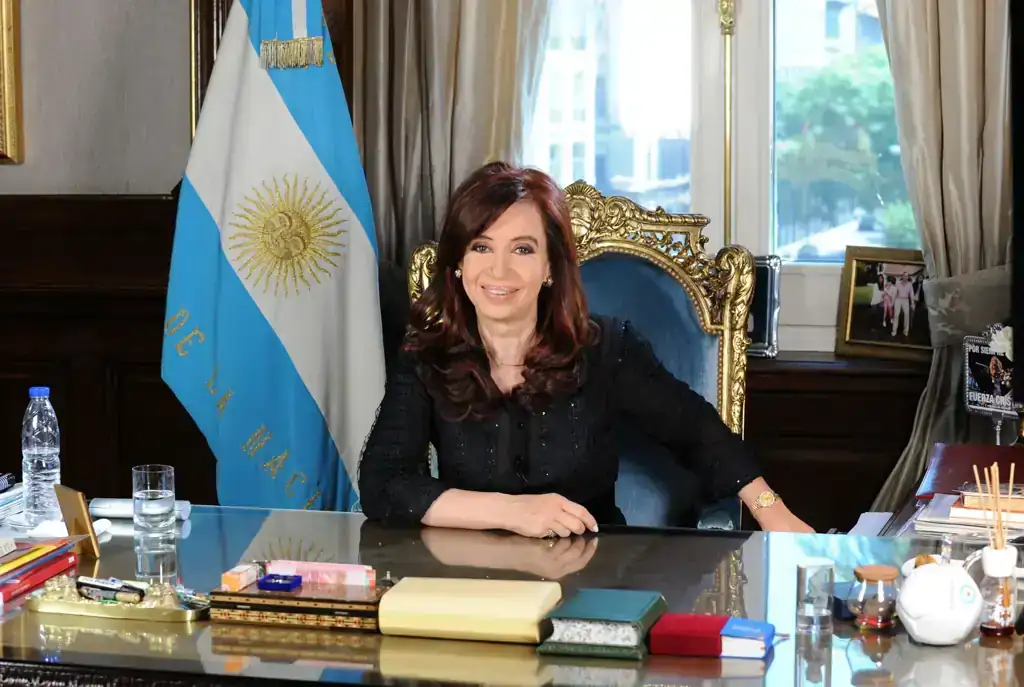
Fernández was president from 2007 to 2015 and vice president from 2019 to 2023. She remains one of the most influential figures in Peronism.
She is serving a six-year sentence under house arrest after Argentina’s Supreme Court upheld her corruption conviction and imposed a lifetime ban from holding public office. Fernández has challenged the conviction before the United Nations Human Rights Committee, arguing that the case was politically motivated.
A favorable finding by the committee would not automatically restore her eligibility to run for office. Argentine authorities and courts would still have to address the disqualification.
■ Related News



Her political influence, however, has continued.
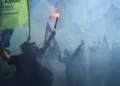
Supporters regularly gather outside her Buenos Aires residence, where she has sometimes appeared from the balcony. Some Peronist activists continue to call for her return to electoral politics.
That creates a challenge for politicians seeking to establish a new generation of leadership.
Kicillof served as Fernández’s economy minister from 2013 to 2015 and was once viewed as a potential successor within the movement. Their political relationship later deteriorated as both sides developed competing views about Peronism’s future leadership.
Kicillof now faces the task of building his own political organization while maintaining support among voters and activists loyal to Fernández.
Kicillof seeks a broader opposition
Kicillof governs Buenos Aires province, Argentina’s most populous province and a longstanding Peronist stronghold.
His recent political message has focused on expanding the movement beyond its traditional coalition.
At the Avellaneda gathering, he argued that opposing Milei was not enough. Peronists, he said, needed to build a broader national alternative capable of attracting voters outside the movement’s established political network.
Kicillof has not formally declared a presidential candidacy.
His position nevertheless matters because the leadership dispute is increasingly tied to the 2027 presidential race.
Juan Grabois, an opposition lawmaker involved in efforts to reconcile different Peronist factions, has said the movement needs to address its internal dispute while Fernández continues to command substantial support within Peronism.
The disagreement is therefore about more than policy.
It is also about who should define the movement’s direction and how its next presidential candidate should be chosen.
Peronists debate how to choose candidates
Party leaders are considering different ways to select candidates.
One unresolved issue is whether Argentina will continue using the PASO primary system for the 2027 election. National primary elections remain part of the country’s electoral framework, but the government has pursued changes to the system, and the 2025 PASO elections were suspended by legislation.
That uncertainty has encouraged Peronist leaders to consider other mechanisms.
Recent discussions involving figures such as Máximo Kirchner, former governors Jorge Capitanich and Sergio Uñac, and La Rioja Governor Ricardo Quintela have focused on maintaining unity if the PASO system is changed or suspended.
One possibility is an internal party election to choose candidates.
Uñac has proposed an open internal election divided geographically across Argentina. That remains a proposal and has not become an adopted party mechanism.
The broader aim is to prevent competing Peronist factions from running separately and dividing the movement’s vote.
But agreeing on a selection process would not necessarily settle the deeper dispute over leadership.
The 2025 election exposed divisions
Peronism enters the 2027 race after a difficult 2025 legislative election.
Official results showed La Libertad Avanza won the largest share of seats in the Chamber of Deputies and Senate races contested in October 2025. The Peronist Fuerza Patria coalition won 47 of the 127 Chamber seats being renewed and nine of the 24 Senate seats at stake.
The results exposed divisions between Kicillof and Fernández and prompted questions about how Peronism would reorganize for the next presidential election.
The election also showed that Peronism remains a major national political force, while no longer setting the national political agenda.
The movement therefore faces two tasks: retaining its existing supporters and expanding its appeal to voters who backed Milei or other political forces.
The economy remains central to the opposition’s case
Argentina’s economic situation is likely to remain a major issue in the political debate.
Milei’s government has pursued fiscal adjustment, deregulation and spending cuts since taking office in late 2023. The government says those policies have restored fiscal balance and reduced inflation.
According to Argentina’s national statistics agency, consumer prices rose 1.7% in August 2026 from the previous month. The unemployment rate was 7.9% in the second quarter.
The government has also presented a 2027 budget based on continued fiscal discipline and economic growth. Economy Minister Luis Caputo said the administration expected a fourth consecutive year of financial surplus.
Peronist leaders have criticized the effects of spending cuts on public services, workers and households.
For Kicillof and other opposition figures, the challenge is to turn that criticism into a broader political program rather than simply oppose Milei’s existing policies.
That distinction will become more important as the election approaches.
Peronism has a unity problem
The Partido Justicialista, the formal political organization associated with Peronism, maintains a large national network.
Its organization includes governors, provincial party leaders and congressional blocs. The party’s stated principles include political sovereignty, economic independence, social justice, workers’ rights and federalism.
But Peronism contains several political currents.
Fernández and her allies retain a strong organizational base. Kicillof is developing an independent political identity in Buenos Aires province. Other governors and lawmakers are also seeking influence over the eventual coalition and candidate-selection process.
These groups can cooperate in opposing Milei while disagreeing over economic policy, political strategy and leadership.
That makes unity possible but difficult to formalize.
The 2027 election is already shaping the debate
Argentina’s next presidential election is scheduled for October 2027. The exact primary process will depend on the electoral rules in force at the time.
That leaves Peronist factions time to negotiate, but the internal contest has already begun.
Kicillof has said the current period should focus on building a national alternative rather than formally launching presidential campaigns. Other Peronist figures are already discussing internal elections and possible presidential bids.
Fernández’s continued influence adds another variable.
She cannot currently appear on the presidential ballot under her existing disqualification. Her political endorsement and relationship with the Peronist base, however, remain important factors in the movement’s internal calculations.
The movement has not settled its next identity
The debate inside Peronism goes beyond choosing a candidate.
The movement must also decide what it wants to represent after years of different Peronist governments and competing factions.
Kicillof is seeking to combine opposition to Milei’s economic policies with a broader appeal to voters outside the traditional Peronist coalition.
Fernández’s supporters continue to emphasize her political legacy and social programs.
Other leaders are looking for a coalition that can bring together different parts of the opposition.
So far, those approaches have not produced a single political platform.
For now, the main point of agreement is opposition to Milei and concern about the direction of the country under his government.
Whether that can produce a unified presidential ticket remains unresolved.
The next stage will depend partly on whether Peronist leaders can agree on rules for selecting candidates and partly on whether they can reconcile Fernández’s influence with the ambitions of Kicillof and other potential leaders.
Argentina’s 2027 presidential election remains more than a year away.
But the internal contest over who will speak for Peronism has already begun.
Reporting Credit: Argentina’s National Electoral Chamber — national electoral framework and election rules; Argentina’s National Electoral Directorate — official 2025 election results; Partido Justicialista — party structure and stated political principles; INDEC — August 2026 inflation and second-quarter 2026 employment data; Argentine Ministry of Economy — 2027 budget and fiscal-policy information.