HONG KONG, China – Asian stock markets moved in different directions Thursday after Wall Street ended lower following the Federal Reserve’s first interest-rate increase in three years, as investors assessed the impact of tighter U.S. monetary policy on global markets.
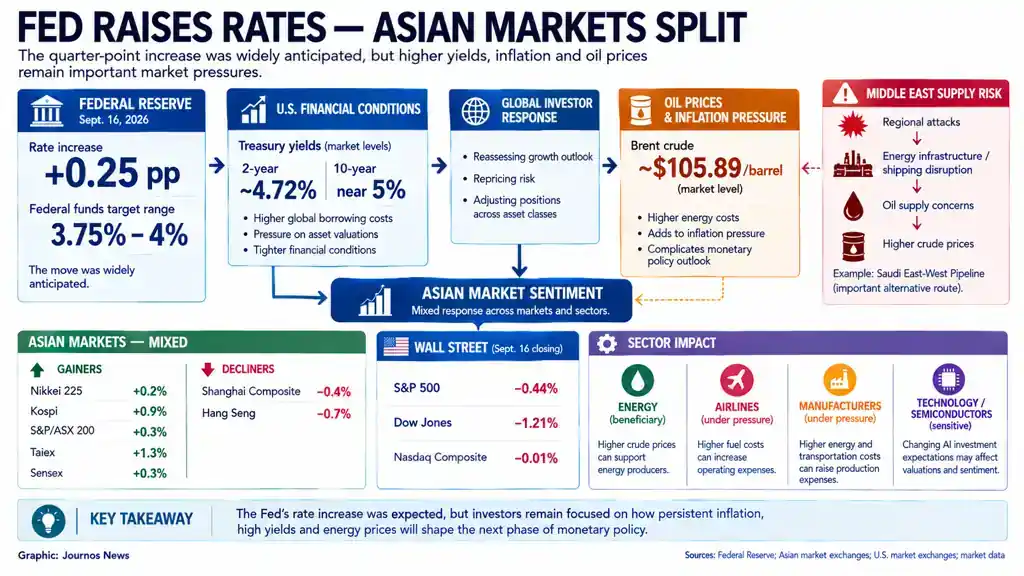
The Fed raised its benchmark interest rate by a quarter percentage point Wednesday, bringing the federal funds target range to 3.75%–4%. The decision was aimed at containing inflation that remains above the central bank’s 2% target.
The move was widely anticipated by financial markets, but the Fed’s updated outlook pointed to continued concern about inflation and the possibility of further tightening.

Asian markets split
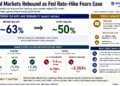
Japan’s Nikkei 225 rose 0.2% to 64,067.53, while South Korea’s Kospi gained 0.9% to 6,778.49.
Australia’s S&P/ASX 200 advanced 0.3%, Taiwan’s Taiex climbed 1.3% and India’s Sensex was up 0.3%.
The gains contrasted with declines in mainland China and Hong Kong. The Shanghai Composite fell 0.4% to 3,877.46, while Hong Kong’s Hang Seng Index dropped 0.7% to 24,533.46.
U.S. stock futures were higher during Asian trading, suggesting some stabilization following the previous session’s decline.
Wall Street retreats after Fed decision
U.S. stocks initially reacted sharply to the Fed announcement before closing lower.


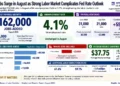

The S&P 500 fell 0.44% to 7,551.81, while the Dow Jones Industrial Average declined 1.21% to 51,461.90. The technology-heavy Nasdaq Composite slipped just 0.01% to 25,978.42.
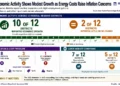
The Fed’s decision came as inflation remained elevated and economic activity showed signs of strength. Fed Chair Kevin Warsh said the economy had strengthened, while identifying inflation as an ongoing problem for policymakers.
The combination of stronger economic activity and persistent inflation has increased attention on how long borrowing costs may remain high.
Treasury yields rise
Bond markets also reacted to the policy shift.
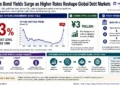
The U.S. two-year Treasury yield climbed to about 4.72%, from roughly 4.67% before the Fed announcement. The 10-year Treasury yield remained near 5%, a level that has become an important reference point for global investors.
Higher U.S. yields can influence financial conditions worldwide by changing the relative attractiveness of dollar-denominated assets and increasing borrowing costs for companies and governments.
The dollar, meanwhile, weakened slightly against the Japanese yen during early Asian trading, with the dollar at about 156.04 yen compared with 156.26 yen late Wednesday.
Oil remains a market concern
Energy prices added another layer of uncertainty.
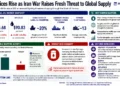
Brent crude was trading around $105.89 a barrel, slightly higher in early Asian trading. Oil prices have remained elevated amid continuing disruption to energy supplies linked to the conflict in the Middle East, including reduced flows through the Strait of Hormuz.
Higher energy prices can complicate the inflation outlook because they raise costs for households and businesses while potentially limiting the ability of central banks to ease monetary policy.
For Asian economies that import substantial amounts of energy, sustained oil-price pressure can also affect trade balances, currencies and domestic inflation.
Investors weigh the next phase of Fed policy
The immediate market reaction was relatively uneven rather than a uniform regional selloff.
The quarter-point increase had largely been anticipated, reducing the element of surprise for investors. Morningstar’s Lorraine Tan described the regional reaction as broadly expected, while noting that continuing geopolitical tensions could maintain pressure on inflation.
Attention now turns to how quickly inflation responds to tighter monetary policy and whether the Federal Reserve follows the September increase with additional moves.
For Asian markets, the path of U.S. interest rates will remain important because it can affect global bond yields, currency markets, capital flows and the valuation of riskier assets.
The mixed performance Thursday showed that investors were responding not simply to the rate increase itself, but to the wider combination of U.S. inflation, Treasury yields, energy prices and regional economic conditions.
Reporting Credit: Federal Reserve — Sept. 16, 2026 monetary-policy decision and economic projections; Asian market exchanges — regional index trading data; U.S. market exchanges — Sept. 16 closing index data.