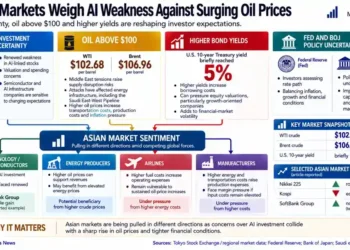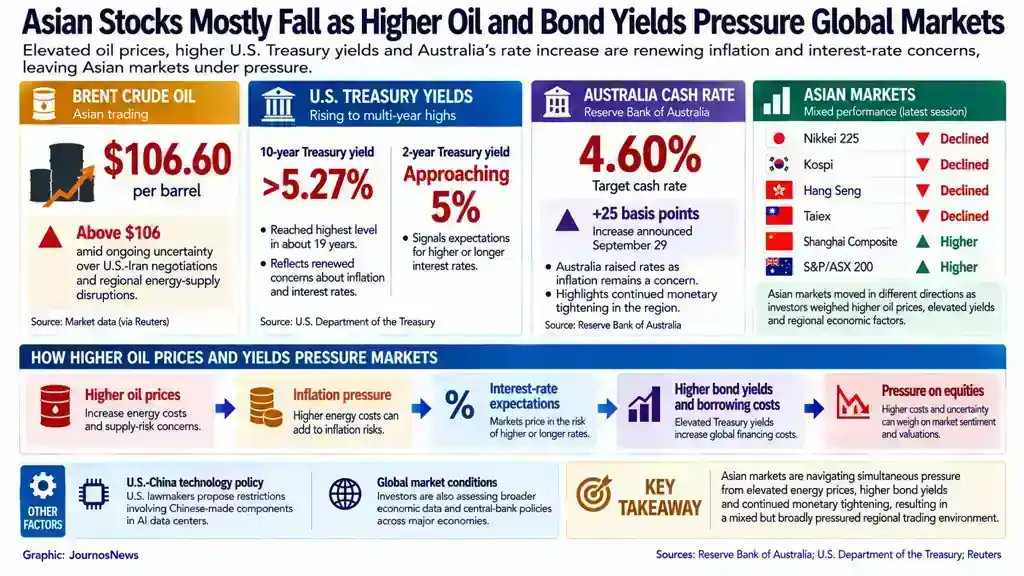
SINGAPORE — Asian stocks mostly fell on Tuesday as higher oil prices and rising bond yields pressured global markets, reinforcing concerns that persistent inflation could keep interest rates elevated for longer.
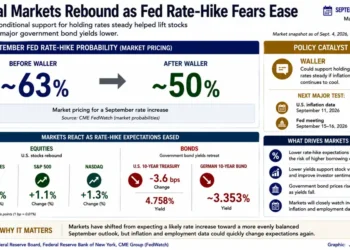
The regional decline followed losses on Wall Street, where the S&P 500 fell 0.8%, the Dow Jones Industrial Average lost 0.7% and the Nasdaq Composite declined 0.9% on Monday. Asian markets also faced pressure from a rise in U.S. Treasury yields, with the 10-year yield briefly moving above 5.27%, its highest level in about 19 years.
Japan’s Nikkei 225, South Korea’s Kospi, Hong Kong’s Hang Seng and Taiwan’s Taiex were among the major regional indexes to decline. China’s Shanghai Composite and Australia’s ASX 200 were among the markets that moved higher.

Oil prices add to inflation concerns
Brent crude climbed above $106 a barrel as uncertainty surrounding U.S.-Iran negotiations continued to weigh on expectations for an easing of disruptions affecting regional energy supplies. Reuters reported Brent at about $106.60 a barrel during Asian trading, with prices continuing to rise.
Higher energy costs create a difficult backdrop for central banks because they can feed directly into inflation while also increasing costs for businesses and households. Markets have consequently been reassessing how quickly interest rates can come down, particularly if elevated oil prices persist.
The rise in oil prices has also contributed to higher government bond yields. Higher yields increase borrowing costs and can reduce the relative attractiveness of equities, particularly companies whose valuations depend heavily on expectations of future growth.
Treasury yields reach a new high
The benchmark U.S. 10-year Treasury yield rose above 5.27% overnight, extending a sharp increase during September. The two-year yield approached 5%, reflecting increased expectations that U.S. monetary policy could remain restrictive.
The move in longer-term yields has broader implications for global financial markets because U.S. Treasury securities provide a reference point for borrowing costs and asset valuations internationally.
■ Related News




The U.S. Treasury’s official yield data show how elevated long-term rates have become in September, with the Treasury publishing daily yield-curve data for government securities.
Australia raises interest rate
The Reserve Bank of Australia added another signal of tighter monetary conditions on Tuesday, raising its cash rate target by 25 basis points to 4.60%. The decision was announced on September 29 and was the latest move in the central bank’s effort to contain inflation.
The RBA’s decision came as markets were already preparing for higher borrowing costs. The central bank said inflation remained a concern and raised the cash rate despite the broader pressure that higher interest rates place on households and businesses.
Australia’s move matters for regional markets because it reinforces the broader shift toward higher interest rates at a time when energy prices are adding another source of inflationary pressure.
China technology stocks remain under pressure
Chinese technology shares faced additional pressure after U.S. plans to restrict the use of Chinese components in American data centers weighed on sentiment. Reuters reported that the CSI300 blue-chip index was around a one-year low during Tuesday’s trading.
The weakness added a separate source of pressure to Asian markets, beyond the global rise in oil prices and bond yields.
Markets face competing pressures
The combination of expensive energy and higher borrowing costs leaves investors assessing two related risks: renewed inflation and weaker economic activity.
Higher oil prices can increase inflation while reducing purchasing power, whereas higher interest rates raise financing costs for governments, companies and households. The result can be a more difficult environment for risk assets if both pressures persist.
For now, the latest market moves reflect a reassessment of the interest-rate environment rather than a single factor. Oil prices remain closely tied to developments involving the Middle East, while bond yields are responding to changing expectations for inflation, economic growth and central-bank policy.
Reporting Credit: Reserve Bank of Australia; U.S. Department of the Treasury.