Journos News - Breaking News, World News, Top Stories, Todays Headlines and Flash Reports
Monday, September 28, 2026
  • Login
  • Home
  • World
    • Africa
    • Americas
    • Asia
    • Europe
    • Middle East
    • Oceania
  • Politics
  • Business
  • Technology
  • Health
  • Science
  • Sports
  • Entertainment
  • Culture
No Result
View All Result
  • Home
  • World
    • Africa
    • Americas
    • Asia
    • Europe
    • Middle East
    • Oceania
  • Politics
  • Business
  • Technology
  • Health
  • Science
  • Sports
  • Entertainment
  • Culture
No Result
View All Result
Journos News - Breaking News, World News, Top Stories, Todays Headlines and Flash Reports
No Result
View All Result
Home Government and Politics

U.S. and China Release $30 Billion Product Lists for Tariff Cuts

The lists cover agricultural goods, household products and other nonsensitive imports as Washington and Beijing extend their trade truce.

The Daily Desk by The Daily Desk
September 28, 2026
in Government and Politics, Government Policy & Economy
0
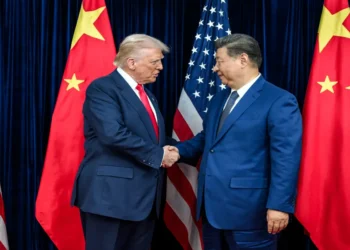
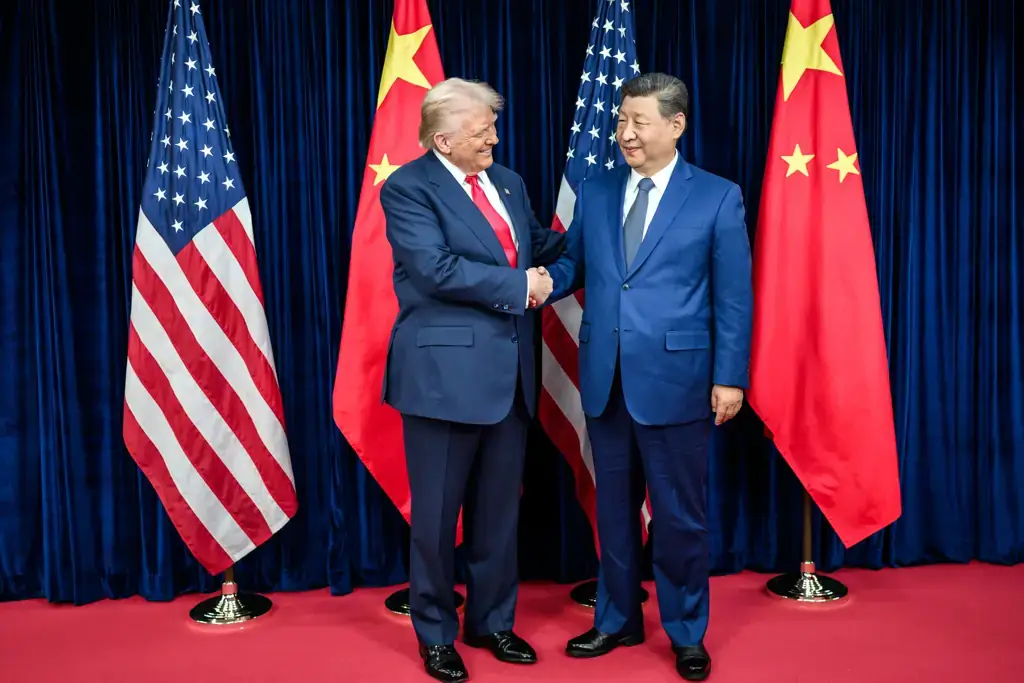
U.S. and Chinese leaders greet before a bilateral meeting at Gimhae International Airport in Busan, South Korea, on October 30, 2025.

U.S. President Donald Trump greets Chinese President Xi Jinping before a bilateral meeting at Gimhae International Airport in Busan on October 30, 2025. Official White House Photo by Daniel Torok.

WASHINGTON, United States – The United States and China have released reciprocal lists of about $30 billion in goods from each country that could receive more favorable tariff treatment, putting specific products behind a broader effort to ease trade tensions between the world’s two largest economies.

The lists were released after U.S. President Donald Trump and Chinese President Xi Jinping met in Washington last week during Xi’s state visit. The agreement was developed through the newly established U.S.-China Board of Trade, which was created to address trade in nonsensitive products.

The United States Trade Representative said the two sides had reached consensus on recommendations covering $30 billion of trade in each direction. The White House described the products as nonsensitive goods that could receive more favorable treatment.

The arrangement covers a broad range of ordinary commercial products rather than some of the industries at the center of the countries’ strategic competition.

What China will consider for lower tariffs

The U.S. list includes more than 1,600 categories of American goods entering China, according to the published details.

They include agricultural commodities, fish and seafood, logs and wood products, cosmetics and medical devices. Coal is also included among the U.S. goods covered by the arrangement.

Agricultural products form an important part of the list.

China is set to reduce tariffs on a range of American farm products including corn, wheat, sorghum, meat and dairy products. Vegetable oils and meals are also included.

■ Related News

IMF 2026 global growth forecast of 3 percent, with technology investment, resilient economies, energy disruption and geopolitical risks highlighted.

IMF Keeps 2026 Global Growth Forecast at 3% Despite War Risks

September 11, 2026
Huawei Canada office building photographed in July 2018, showing the company’s Canadian corporate presence.

Huawei Faces U.S. Racketeering Trial Over Alleged Technology Transfers

September 10, 2026
President Donald Trump and Canadian Prime Minister Mark Carney meet during a bilateral engagement on October 7, 2025.

U.S. Bans Canadian Dairy, Alcohol and Motorcycles as Trade War Escalates

September 9, 2026
Israeli settlements are visible on hills southwest of Dheisheh refugee camp in the West Bank, Palestine, photographed in March 2018.

Dozen Countries Move Toward Trade Restrictions on Goods From Israeli Settlements

September 9, 2026

Soybeans, however, were excluded from the tariff-reduction list, despite their importance in U.S.-China agricultural trade.

That exclusion leaves one of the most commercially significant agricultural commodities outside the latest tariff arrangement.

What Washington will cut

The U.S. list covers 77 categories of Chinese products.

Among them are small household appliances, tableware, glass products, wooden Christmas ornaments, toys, sporting goods, holiday decorations and children’s products. Children’s car seats are also included.

The composition of the U.S. list means the immediate effects are concentrated largely in consumer goods rather than the advanced technologies that have become central to the wider U.S.-China economic rivalry.

Semiconductors, electric vehicles and batteries were not included in the arrangement.

That distinction limits the scope of the tariff agreement even as the total value of the affected trade reaches roughly $60 billion.

Most covered goods would move toward normal tariff treatment

China’s Commerce Ministry said tariffs on more than 90% of the products covered by the arrangement would be subject to most-favored-nation tariff rates, meaning the additional country-specific tariffs would effectively be removed for those products.

The U.S. side has described the arrangement as recommendations for more favorable treatment rather than announcing a single tariff rate applying to every product.

U.S. Trade Representative Jamieson Greer said the framework could improve market access for American farmers, manufacturers, businesses and workers while providing U.S. consumers with greater access to Chinese household goods and toys.

The precise effect will therefore vary by product and by the tariff treatment already in place.

The agreement follows a broader trade truce

The product lists are part of a larger effort to prevent the trade relationship from returning to the sharp escalation seen during the previous year.

U.S. tariffs on Chinese imports had at one point reached as high as 145% during the escalation, before the two countries subsequently reduced some of those measures.

Washington and Beijing have now also extended their broader trade truce by two months, giving negotiators additional time to work on unresolved economic issues. The extension runs through Jan. 10, 2027.

The two governments also agreed to establish an agricultural working group under the Board of Trade to address market-access and regulatory issues affecting agricultural commerce.

Strategic industries remain outside the deal

The latest arrangement does not resolve some of the most difficult economic disputes between Washington and Beijing.

Advanced semiconductors and other strategic technologies remain subject to separate U.S. export controls and Chinese industrial policies.

Electric vehicles and batteries were also excluded from the product lists. Rare-earth supply issues likewise remain under discussion rather than being resolved through the tariff package.

That leaves the two countries’ broader industrial and technology competition largely intact.

The agreement instead concentrates on goods where both governments have identified opportunities for increased trade without directly addressing their most sensitive strategic disputes.

Trade flows remain heavily imbalanced

The $30 billion figure has different significance for each side because the two countries trade at very different overall volumes.

U.S. exports to China totaled roughly $68 billion during the first seven months of 2026, while Chinese exports to the United States were around $270 billion during the first eight months, according to data cited in current reporting.

That means the $30 billion framework represents a considerably larger share of U.S. exports to China than of Chinese exports to the United States.

The difference does not by itself determine the eventual economic effect, because the value of goods covered by the lists does not necessarily equal the value of additional trade that will result.

Actual effects will depend on tariff rates, demand, exchange rates, production capacity and whether businesses take advantage of the improved access.

Companies get more predictable conditions, but uncertainty remains

The agreement gives businesses a clearer list of products that may receive more favorable treatment, but it does not end the broader uncertainty surrounding U.S.-China trade.

Both governments have retained significant economic and national-security tools that can affect bilateral commerce.

The U.S. is continuing a Section 301 investigation into Chinese industrial capacity involving China and other trading partners. The investigation could potentially lead to additional trade measures after its conclusion.

At the same time, Washington and Beijing are continuing discussions over artificial intelligence, critical minerals and other areas where economic and national-security concerns overlap.

The tariff lists therefore represent one part of a much larger relationship.

For exporters, however, the immediate significance is more concrete.

U.S. farmers and manufacturers may gain improved access to Chinese buyers for products included on Beijing’s list, while Chinese producers of consumer goods covered by the U.S. list may face lower tariff barriers when selling into the American market.

Whether those changes produce a substantial increase in two-way trade will depend on how the recommendations are implemented and how companies respond.

For now, the lists mark a shift from broad tariff confrontation toward targeted reductions on selected goods.

They do not resolve the deeper economic competition between Washington and Beijing, but they create a defined area in which the two governments are attempting to expand trade while leaving their most sensitive industries outside the agreement.

Reporting Credit: U.S. Trade Representative — U.S.-China Board of Trade recommendations and U.S. product list; The White House — September 25, 2026 U.S.-China trade framework and product categories; China’s Ministry of Commerce — reciprocal tariff-reduction arrangement and Chinese product list; U.S. Census Bureau/Chinese customs authorities — bilateral trade data where applicable.

Tags: #ChinaTrade#GlobalEconomy#InternationalTrade#Tariffs#TradeWar#USChinaRelations#USTrade
The Daily Desk

The Daily Desk

The Daily Desk is the editorial byline of Journos News, representing reporting produced by the newsroom across world news, politics, business, technology, disasters, and other areas of public interest. Stories published under this byline are independently researched, verified, and edited in accordance with Journos News’ editorial standards, with an emphasis on accuracy, transparent sourcing, attribution, context, and editorial independence.

Related Posts

Business graphic showing rising Brent and WTI crude prices, Strait of Hormuz shipping activity, oil supply risks and global economic impacts.

Oil Prices Rise as Iran War Raises Fresh Threat to Global Supply

by The Daily Desk
September 2, 2026
0

LONDON - Oil prices climbed Wednesday as renewed fighting between the United States and Iran increased...

Graphic explaining Iran war economic impacts, showing costs for consumers and farmers, beneficiaries, oil prices, markets, and global trade pressures.

Investors Prosper as Consumers Pay the Price of Six Months of Iran War

by The Daily Desk
August 31, 2026
0

NEW YORK — Six months after the United States and Israel launched their war against...

Asian stock markets rise as oil prices fall, with market indexes, crude prices, Nvidia shares and key investor risks highlighted. - Journos News, File

Asian Shares Rise as Lower Oil Prices and AI Optimism Support Markets

by The Daily Desk
August 26, 2026
0

TOKYO, Japan - Asian stocks mostly advanced in early Wednesday trading as lower oil prices...

U.S. President Donald Trump greets Chinese leader Xi Jinping before a bilateral meeting in Busan, South Korea.

Trump’s Iran Economic Campaign Faces a Test in China

by The Daily Desk
August 26, 2026
0

Washington — The Trump administration is stepping up efforts to isolate Iran economically, but China’s...

Journos News explainer graphic showing how tariffs work, who pays them, supply-chain effects, government purposes, quotas and consumer impacts.

What Are Tariffs and How Do They Work?

by The Daily Desk
August 26, 2026
0

Tariffs are government charges on imported goods and one of the oldest instruments of trade...

Canada’s innovation minister speaks during a frontier artificial intelligence safety roundtable at Bletchley Park in the United Kingdom.

Canada Escalates Trade Confrontation With U.S. With New Tariffs

by The Daily Desk
August 26, 2026
0

Canada is escalating its trade confrontation with the United States with new counter-tariffs on about...

Editorial map showing the Strait of Hormuz, Iran and Oman, with shipping routes and key locations amid Iran-Oman ceasefire diplomacy.

Iran Ceasefire Talks Put the Strait of Hormuz at the Center of a Fragile Middle East De-Escalation

by The Daily Desk
August 8, 2026
0

Iran and Oman are moving closer to an arrangement intended to restore commercial shipping through...

U.S. Navy guided-missile destroyers conduct mine clearance operations in the Strait of Hormuz as U.S. Central Command begins a maritime security mission in April 2026.

Oil Prices Fall After Trump Pauses New Iran Strikes Amid Ceasefire Push

by The Daily Desk
August 3, 2026
0

NEW YORK - Oil prices fell sharply Sunday after U.S. President Donald Trump said he...

Exterior view of the Sichuan Jinxing Compressor Manufacturing Co., Ltd. factory in Chengdu, China, showing industrial buildings and manufacturing facilities.

China Rejects Overcapacity Claims Ahead of Expected U.S. Tariff Decision

by The Daily Desk
July 29, 2026
0

HONG KONG - China on Tuesday rejected accusations that its manufacturing sector suffers from excessive...

Market dashboard showing declining oil prices, energy market indicators, maritime chokepoints, and the impact of easing Gulf tensions on global energy markets.

Oil Prices Retreat as U.S.-Iran Pause Eases Immediate Fears Over Gulf Supply Disruptions

by The Daily Desk
July 27, 2026
0

NEW YORK - Oil prices fell sharply in early trading Sunday after the United States...

Load More
JournosNews logo

Journos News delivers globally neutral, fact-based journalism that meets international media standards — clear, credible, and made for a connected world.

  • Categories
  • World News
  • Politics
  • Business & Markets
  • Technology
  • Health
  • Science
  • Sports
  • Arts & Culture
  • Resources
  • Editorial Standards
  • Submit a Story
  • Advertise with Us
  • Syndication & Partnerships
  • Site Map
  • Press & Media Kit
  • Editorial Team
  • Careers

Join thousands of readers receiving the latest updates, tips, and exclusive insights straight to their inbox. Never miss an important story again.

  • About Us
  • Editorial & Trust Center
  • Contact Us
  • Privacy Policy
  • Terms of Use & Copyright Notice

© JournosNews.com All rights reserved.

Welcome Back!

Login to your account below

Forgotten Password?

Retrieve your password

Please enter your username or email address to reset your password.

Log In
JournosNews

Independent Journalism.
Verified Facts.

You're about to read a professionally edited article from JournosNews.com.

Every article is produced in accordance with our editorial standards, emphasizing factual accuracy, transparent attribution, fairness, editorial independence, and meaningful context.

Editorial Standards
No Result
View All Result
  • Home
  • World
    • Africa
    • Americas
    • Asia
    • Europe
    • Middle East
    • Oceania
  • Politics
  • Business
  • Technology
  • Health
  • Science
  • Sports
  • Entertainment
  • Culture

© JournosNews.com All rights reserved.

This website uses cookies. By continuing to use this website you are giving consent to cookies being used. Visit our Privacy and Cookie Policy.