TOKYO, Japan – Asian markets were mixed on Tuesday as investors weighed renewed weakness in artificial-intelligence stocks against a sharp rise in oil prices, with upcoming interest-rate decisions in the United States and Japan adding to market uncertainty.
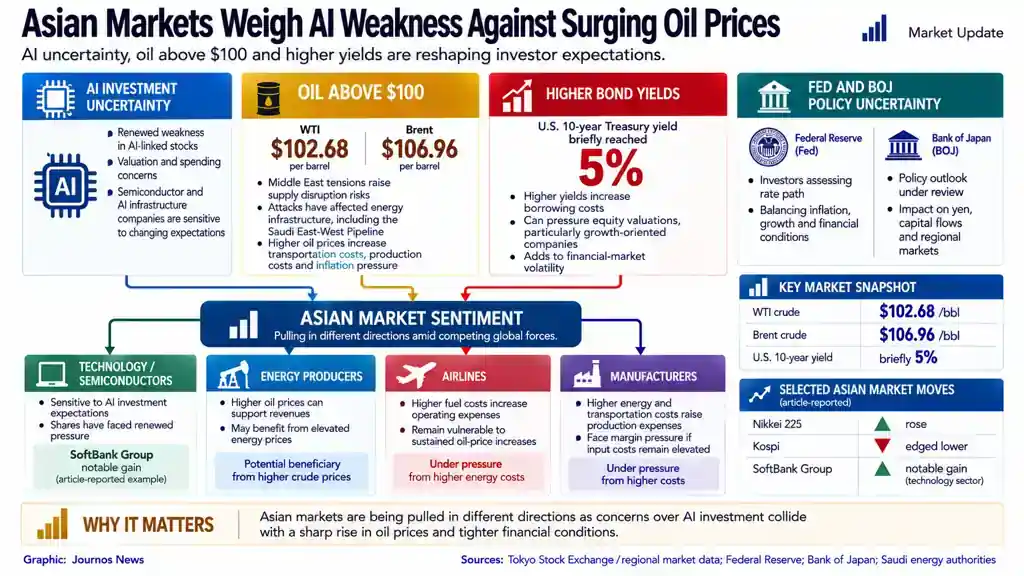
Japan’s Nikkei 225 rose while South Korea’s Kospi edged lower. Other major regional markets also moved unevenly as investors assessed the effect of higher energy prices and renewed concerns about the pace and profitability of AI investment.
Oil prices remained above $100 a barrel after fresh attacks involving Saudi Arabia increased concerns about disruptions to Middle Eastern energy supplies. U.S. West Texas Intermediate crude was recently up about 1.3% at $102.68 a barrel, while Brent crude rose about 1.2% to $106.96.

AI concerns weigh on technology shares
The pressure on technology stocks follows growing debate among prominent AI executives about the pace of development and the risks associated with the industry’s rapid expansion.
Anthropic CEO Dario Amodei has called for a slowdown in AI development, while other technology leaders have expressed related concerns. The comments have contributed to a sell-off in some AI-linked companies, particularly semiconductor and technology shares that had benefited strongly from expectations of continued AI investment.
The retreat has not been uniform across Asia.
Japan’s SoftBank Group was among the notable gainers after reports that OpenAI was delaying a planned stock offering. The move helped support the Nikkei even as other technology shares remained under pressure.
That divergence illustrates the uncertainty surrounding the AI trade. Investors are not abandoning the sector as a whole, but are reassessing which companies are most exposed to changing expectations about AI spending and future returns.




Oil adds another market pressure
Energy prices are creating a separate source of concern for investors.
The latest increase followed renewed Houthi attacks involving Saudi Arabia and continuing disruption around key Middle Eastern energy routes. Saudi Arabia’s East-West oil pipeline, which provides an alternative route to the Strait of Hormuz, has also been damaged and remains shut.
The pipeline disruption is particularly important because Saudi Arabia has relied more heavily on the route while shipping through the Strait of Hormuz has been severely restricted.
Higher crude prices can raise transportation and production costs and add to inflation, particularly in economies that rely heavily on imported energy. That creates an additional complication for central banks already assessing whether inflation remains strong enough to require tighter monetary policy.
Fed and BOJ decisions in focus
Investors are also looking ahead to monetary-policy decisions in Washington and Tokyo.
The Federal Reserve is due to meet this week, while the Bank of Japan is also preparing for its policy meeting. Market participants are assessing how persistent inflation and higher energy costs could affect the policy outlook.
U.S. Treasury yields have also risen sharply, with the 10-year yield briefly reaching 5% on Tuesday, according to market reporting. Higher yields can increase borrowing costs and put pressure on equity valuations, particularly growth stocks whose expected earnings lie further in the future.
For Asian investors, the combination of expensive oil, elevated bond yields and uncertainty over AI spending creates competing forces across sectors and markets.
Energy producers can benefit from higher crude prices, while airlines, manufacturers and other major fuel consumers face higher costs. Technology companies, meanwhile, remain sensitive to changing expectations for investment in data centers, semiconductors and AI infrastructure.
The immediate direction of Asian markets is likely to remain tied to developments in energy security and monetary policy as investors reassess the balance between economic growth, inflation and the valuation of technology stocks.
Reporting Credit: Tokyo Stock Exchange and regional exchange-market data — Asian equity movements; Federal Reserve — U.S. monetary-policy schedule and information; Bank of Japan — Japanese monetary-policy schedule and information; Saudi Arabian energy authorities — pipeline and energy-infrastructure developments.