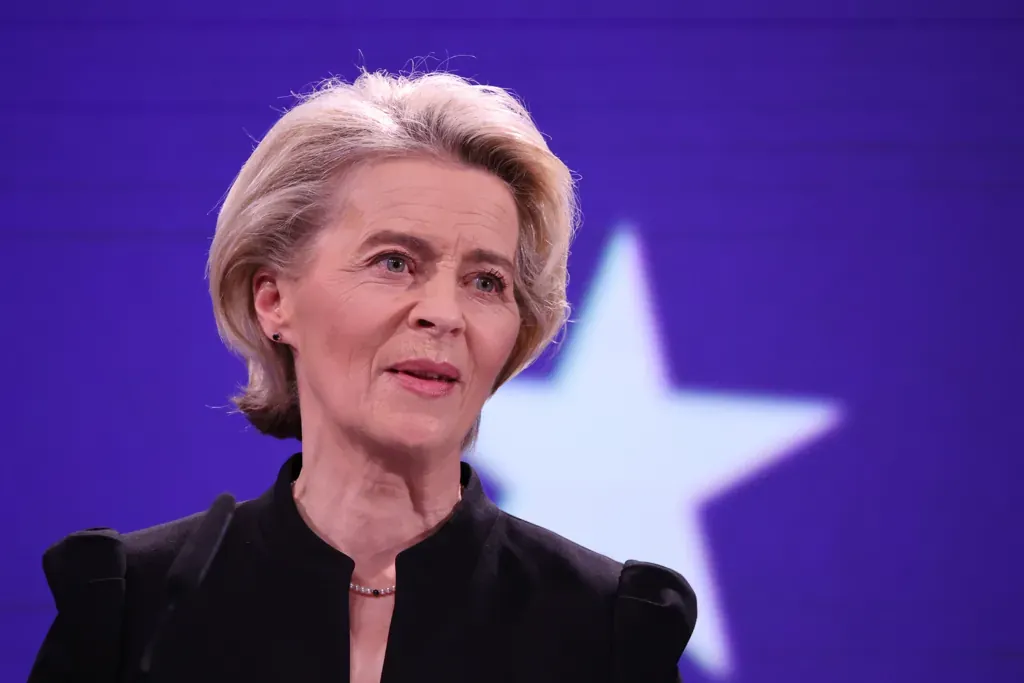
STRASBOURG, France – European Commission President Ursula von der Leyen has proposed opening the European Union to Canada as its first “associate member,” signaling a possible new form of partnership between the bloc and a country outside Europe.
Von der Leyen made the proposal Wednesday during her State of the Union address to the European Parliament, with Canadian Prime Minister Mark Carney attending in Strasbourg. She said she wanted to work with Canada on creating the new relationship as Europe seeks to deepen cooperation with partners in an increasingly uncertain international environment.
The proposal does not make Canada an EU member. It opens the possibility of creating a new category of association whose precise legal and institutional terms have yet to be negotiated.

Canada seeks a deeper relationship with Europe
Carney has spent recent months advocating what he has called a “unique alliance” with the EU, as Canada seeks to diversify its economic and strategic relationships.
The initiative follows worsening trade relations between Canada and the United States and comes as Ottawa looks for additional markets and partnerships in Europe.
Carney has said Canada is not seeking full EU membership. Instead, Ottawa has been exploring closer cooperation in areas including trade, investment, defense, technology, energy and the movement of people.
The proposed associate-member framework could provide a structure for that cooperation without requiring Canada to join the EU’s political and institutional system as a full member.
The EU already has extensive ties with Canada
The proposal would build on an existing network of agreements rather than create relations from scratch.
■ Related News




The EU and Canada have operated under the Comprehensive Economic and Trade Agreement, or CETA, since most of the agreement began provisional application in 2017. The agreement covers a broad range of trade and economic relations, although some provisions still require ratification by individual EU member states.
The two sides have also expanded cooperation in research. Canadian organizations participate in Pillar II of the EU’s Horizon Europe program, allowing eligible Canadian researchers and institutions to participate in collaborative projects and receive direct funding under the program.
Defense cooperation has also advanced. In February, the EU and Canada signed an agreement allowing Canadian companies and products to participate in procurement under the bloc’s Security Action for Europe, or SAFE, program. Canada became the first non-European country to participate in the instrument.
Associate membership would be something new
The EU does not currently have a general “associate member” category comparable to full membership.
That means the proposal would require the two sides to determine what rights and obligations such a relationship would actually involve.
Possible areas for negotiation include market access, regulatory cooperation, research, defense procurement, energy, critical minerals, technology and mobility. But the exact scope of the proposed status has not been established.
European Commission officials had declined before the State of the Union address to provide details about the possible arrangement, saying the relationship with Canada was being developed at a high level and that Carney’s appearance at the speech would precede further discussions.
The next EU-Canada summit is scheduled for Oct. 29-30, providing a potential forum for the two sides to discuss the proposal in greater detail.
Security and economic cooperation are expanding
The proposal comes as Canada and the EU are already moving closer on strategic issues.
Canada’s participation in SAFE gives Canadian defense companies access to procurement opportunities connected to the EU’s effort to strengthen European defense capabilities. The bloc’s broader defense initiative has a loan envelope of €150 billion.
The two sides have also been working on energy security and business cooperation. In June, the European Commission and Canada held an energy-security business roundtable in Montreal focused on strengthening transatlantic energy relations.
Those existing agreements give the proposed associate-member concept a practical foundation, although they do not by themselves establish a new membership category.
A shift in how the EU approaches partnerships
For the EU, the Canadian proposal comes as Brussels seeks to strengthen relationships with countries it regards as important partners on trade, security, technology and economic resilience.
For Canada, closer European ties could provide additional options as it confronts a more difficult relationship with its largest trading partner, the United States.
The proposal therefore has both institutional and geopolitical dimensions. The institutional question is how an associate relationship could fit within the EU’s existing legal framework. The geopolitical question is how far Canada and Europe are prepared to deepen their cooperation without moving toward full political integration.
Neither question has been settled by von der Leyen’s announcement.
What has changed is that the European Commission has publicly endorsed exploring a relationship that would give Canada a status the EU has not previously offered to another country.
The next stage will depend on negotiations between Ottawa and Brussels, with the October summit expected to provide an early opportunity to define what the proposed partnership could look like.
Reporting Credit: European Commission — State of the Union address and EU-Canada relations; Council of the European Union — Canada’s participation in the SAFE defense instrument; European Commission Directorate-General for Trade — CETA and EU-Canada trade relations; European Commission Directorate-General for Research and Innovation — Canada’s Horizon Europe association; Government of Canada — Canada’s relationship and cooperation with the EU.