Journos News - Breaking News, World News, Top Stories, Todays Headlines and Flash Reports
Tuesday, August 4, 2026
  • Login
  • Home
  • World
    • Africa
    • Americas
    • Asia
    • Europe
    • Middle East
    • Oceania
  • Politics
  • Business
  • Technology
  • Health
  • Science
  • Sports
  • Entertainment
  • Culture
No Result
View All Result
  • Home
  • World
    • Africa
    • Americas
    • Asia
    • Europe
    • Middle East
    • Oceania
  • Politics
  • Business
  • Technology
  • Health
  • Science
  • Sports
  • Entertainment
  • Culture
No Result
View All Result
Journos News - Breaking News, World News, Top Stories, Todays Headlines and Flash Reports
No Result
View All Result
Home World News Europe

Record Low Danube Water Levels Push Eastern Europe Toward Energy Emergency

Hungary, Romania and Serbia introduce emergency power-saving measures as drought threatens nuclear and hydropower generation.

The Daily Desk by The Daily Desk
August 4, 2026
in Europe, World News
0
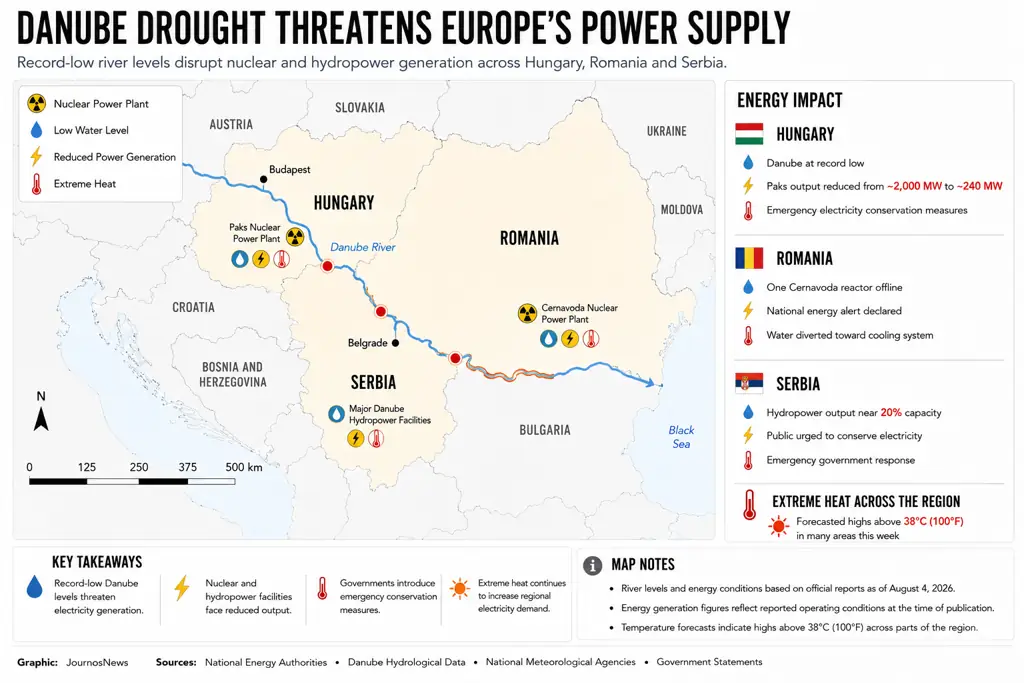
Locator map showing record-low Danube River water levels affecting nuclear and hydropower generation in Hungary, Romania, and Serbia, with key energy infrastructure and impacted areas.

Editorial map illustrating record-low Danube River water levels affecting nuclear and hydropower generation across Hungary, Romania, and Serbia, highlighting major energy facilities and reported regional impacts. — Graphic: JournosNews, File

BUDAPEST, Hungary – A prolonged drought and record-low water levels on the Danube River are straining electricity supplies across Central and Eastern Europe, prompting governments to introduce emergency conservation measures as extreme summer heat drives up power demand.

Hungary, Romania and Serbia have all warned that falling river levels are affecting nuclear and hydroelectric generation. Officials say continued hot and dry weather could further reduce electricity production in the coming days.

The Danube, one of Europe’s most important waterways, fell to about 10 centimeters (4 inches) in Budapest on Monday—well below the previous record low of 33 centimeters (13 inches) set in 2018.

Forecasters expect temperatures to exceed 38 degrees Celsius (100 degrees Fahrenheit) this week, increasing electricity demand for cooling while limiting power generation.

Hungary’s Nuclear Plant Faces Possible Shutdown

Hungary’s Paks Nuclear Power Plant has sharply reduced electricity production because low Danube water levels have restricted the amount of cooling water available for its reactors.

The facility generated about 240 megawatts on Monday, compared with its normal output of roughly 2,000 megawatts.

Prime Minister Péter Magyar said engineers had managed to keep the plant’s final operating turbine running, temporarily avoiding a complete shutdown that had been expected over the weekend.

He cautioned, however, that the plant could still suspend operations later this week if river levels continue to fall.


■ Related News

Darkened streets in Cuba following a nationwide power outage. - AP Photo/Ramon Espinosa

Cuba Suffers Second Nationwide Blackout in a Week as Power Grid Crisis Deepens

July 11, 2026
Solar-powered electric tricycles travel through the streets of Havana, Cuba. - AP Photo/Ramon Espinosa

Solar-Powered Tricycles Keep Cuba Moving as Fuel Shortages and Blackouts Persist

July 11, 2026
Protesters gather outside Sándor Palace in Budapest over plans to remove Hungary's president. - Tibor lilyes/MTI via AP

Orbán Allies Rally in Budapest Against Hungarian Government’s Plan to Remove President

July 10, 2026
Darkened streets in Havana after a nationwide power outage in Cuba. - AP Photo/Ramon Espinosa

Cuba Suffers Nationwide Blackout as Fuel Shortages and Aging Power Grid Deepen Crisis

July 8, 2026

Located about 90 kilometers (55 miles) south of Budapest, the Paks facility produces nearly half of Hungary’s electricity and accounts for about one-third of the country’s total power consumption.

To offset lower production, Hungary has increased electricity imports from neighboring countries and expanded its use of renewable energy sources.

Governments Introduce Power Conservation Measures

Hungary has asked major industrial users to reduce electricity consumption and urged households to conserve energy during peak demand between 5 p.m. and 10 p.m.

Beginning Monday, authorities also prohibited electric freight trains from operating during peak hours. Officials estimate the measure will save between 70 and 90 megawatt-hours of electricity each day.

After initially relying on voluntary reductions, the government approved emergency powers allowing mandatory electricity limits for large industrial and commercial consumers if conditions worsen.

According to Magyar, conservation efforts reduced electricity demand by about 700 megawatts on Sunday.

Romania and Serbia Also Face Growing Pressure

The drought has also disrupted electricity production elsewhere along the Danube.

In Romania, military engineers used explosives near the Bala Canal on Monday to redirect more water toward the Danube’s main channel and help maintain cooling operations at the state-owned Cernavoda Nuclear Power Plant.

Officials said river flow had dropped to about 1,500 cubic meters per second—less than one-third of the average July level.

One reactor at the plant has already been shut down, leaving the facility operating at about half of its normal capacity.

Acting Prime Minister Ilie Bolojan declared a nationwide energy alert on Friday and warned that the remaining reactor could also be forced offline if water levels continue to decline.

Several major manufacturers have also reduced operations. Automakers Dacia and Ford suspended vehicle production and began scheduled maintenance until Aug. 19, while other industrial companies agreed to lower electricity use during evening peak hours.

Hydropower Output Falls in Serbia

Serbia is facing similar challenges as historically low Danube levels reduce hydropower generation.

Officials said the country’s main hydroelectric plant is operating at only about 20% of its normal capacity.

Prime Minister Djuro Macut convened an emergency meeting on Monday and appealed to residents to reduce electricity consumption, particularly by limiting the use of air conditioners and other high-energy household appliances.

Macut described the situation as “serious and demanding,” warning that continued drought could place additional pressure on Serbia’s electricity system.

The ongoing drought highlights the growing vulnerability of Europe’s energy infrastructure to prolonged periods of extreme heat, with governments across the region balancing rising electricity demand against declining water supplies needed to sustain power generation.

This report is based on reporting by The Associated Press.

Tags: #DanubeRiver#Drought#EnergyCrisis#Hungary#Hydropower#NuclearPower#Romania#Serbia
The Daily Desk

The Daily Desk

The Daily Desk is a contributor at JournosNews.com covering politics, media, governance, and the evolving dynamics of public discourse. Stories published under this byline are produced in accordance with JournosNews' editorial standards, with an emphasis on verified reporting, accuracy, context, and impartiality.

Related Posts

Medical staff work inside a Cuban hospital amid healthcare shortages. - AP Photo/Ramon Espinosa

Cuba’s Healthcare System Faces Deepening Strain as Energy Shortages Disrupt Medical Care

July 3, 2026
Residents collect water as delayed monsoon affects Indian cities and farms - AP Photo/Rafiq Maqbool

Delayed Monsoon Deepens Water Crisis and Raises Farming Concerns Across India

June 27, 2026
Gas station price boards showing falling fuel prices - AP Photo/Nam Y. Huh

US Gas Prices Fall Below $4 as Oil Markets Ease After Iran Peace Deal

June 19, 2026
Hospital staff treating patients amid shortages in Cuba - AP Photo/Ramon Espinosa

US Energy Restrictions Deepen Healthcare Strain in Cuba, State Media Reports

June 16, 2026
Load More
JournosNews logo

Journos News delivers globally neutral, fact-based journalism that meets international media standards — clear, credible, and made for a connected world.

  • Categories
  • World News
  • Politics
  • Business & Markets
  • Technology
  • Health
  • Science
  • Sports
  • Arts & Culture
  • Resources
  • Editorial Standards
  • Submit a Story
  • Advertise with Us
  • Syndication & Partnerships
  • Site Map
  • Press & Media Kit
  • Editorial Team
  • Careers

Join thousands of readers receiving the latest updates, tips, and exclusive insights straight to their inbox. Never miss an important story again.

  • About Us
  • Editorial & Trust Center
  • Contact Us
  • Privacy Policy
  • Terms of Use & Copyright Notice

© JournosNews.com All rights reserved.

Welcome Back!

Login to your account below

Forgotten Password?

Retrieve your password

Please enter your username or email address to reset your password.

Log In
JournosNews

Independent Journalism.
Verified Facts.

You're about to read a professionally edited article from JournosNews.com.

Every article is produced in accordance with our editorial standards, emphasizing factual accuracy, transparent attribution, fairness, editorial independence, and meaningful context.

Editorial Standards
No Result
View All Result
  • Home
  • World
    • Africa
    • Americas
    • Asia
    • Europe
    • Middle East
    • Oceania
  • Politics
  • Business
  • Technology
  • Health
  • Science
  • Sports
  • Entertainment
  • Culture

© JournosNews.com All rights reserved.

This website uses cookies. By continuing to use this website you are giving consent to cookies being used. Visit our Privacy and Cookie Policy.