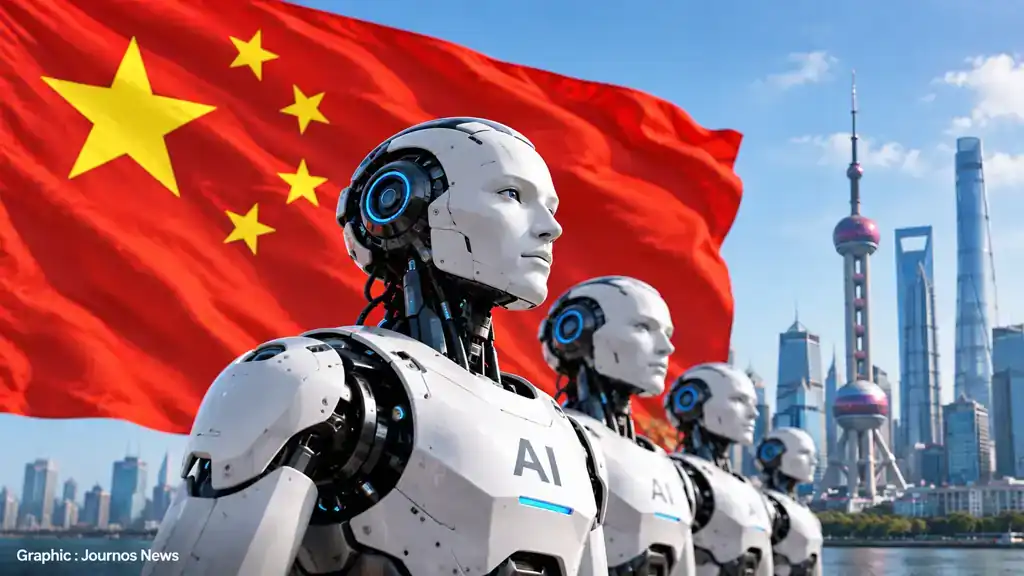
BEIJING, China – China has pushed back against a call by Anthropic CEO Dario Amodei for the United States to maintain restrictions on China’s access to advanced artificial-intelligence technology, rejecting the argument that limiting Beijing’s AI development is necessary for global security.
China’s Foreign Ministry said Monday that countries should cooperate on AI rather than pursue confrontation. Spokesperson Guo Jiakun criticized what he described as fearmongering and competition that could interfere with international efforts to establish AI governance.
The response followed an essay published by Amodei over the weekend in which he argued that the rapid development of frontier AI should be slowed and that the United States should preserve restrictions on China’s access to the most advanced chips and chipmaking equipment.

Amodei warned that a Chinese lead in AI could pose what he described as a serious danger to the United States and the wider world. At the same time, he argued that meaningful efforts to manage advanced AI would ultimately require cooperation with China.
Beijing rejects the containment argument
China’s response reflects a broader disagreement over whether restrictions on advanced technology should be treated primarily as national-security measures or as part of a wider effort to contain China’s technological development.
China’s state-run Global Times described Amodei’s proposal as a form of containment and characterized it as a “Cold War” approach to AI. Beijing has separately rejected recent U.S. accusations that Chinese AI developers have aggressively extracted capabilities from leading American AI models.
Chinese officials have instead called for international cooperation on AI governance.
President Xi Jinping has promoted the development of a global AI governance framework and has presented China as an advocate of broader international participation in the technology’s development. Chinese officials have also acknowledged that AI presents security risks, including the potential use of the technology by foreign actors.




That position creates a complicated divide. Beijing objects to restrictions designed to limit its access to advanced computing technology while also acknowledging that increasingly capable AI systems create security and governance challenges.
The AI debate is becoming part of U.S.-China competition
Amodei’s argument comes as Washington and Beijing are already disputing access to advanced semiconductors, AI models and computing infrastructure.
A joint advisory issued last week by the FBI, National Security Agency and Cybersecurity and Infrastructure Security Agency accused Chinese AI developers of efforts to extract capabilities from leading U.S. AI systems, including Anthropic’s Claude and OpenAI’s GPT. China rejected those allegations as groundless. Its Commerce Ministry argued that AI model distillation is used more broadly across the industry and accused Washington of seeking an AI monopoly.
The competing claims are adding another layer to an already sensitive technology relationship.
For U.S. policymakers, maintaining an advantage in advanced AI is increasingly linked to national security and technological leadership. For Beijing, restrictions on chips and AI infrastructure are viewed as barriers to its ability to develop its own technology industry.
President Donald Trump has also rejected calls to slow U.S. AI development, arguing that Washington needs to maintain its lead over China.
AI governance could become a larger diplomatic issue
Trump and Xi are expected to discuss AI governance during a planned meeting on Sept. 24. The talks could bring together two competing approaches: Washington’s emphasis on maintaining a technological advantage and Beijing’s call for broader international cooperation while resisting restrictions aimed specifically at China.
The disagreement also exposes a tension within the global AI debate.
Amodei is calling for slower development because of concerns about the risks posed by increasingly capable systems, but his proposal also includes maintaining restrictions that would make it harder for China’s AI industry to access leading-edge technology. Beijing argues that such restrictions undermine the cooperation needed to establish international AI rules.
The immediate dispute therefore extends beyond the pace of AI development. It is also about who controls the computing resources, technologies and standards that will shape the next phase of artificial intelligence.
Reporting Credit: China Ministry of Foreign Affairs — official response to calls for restrictions on China’s AI development; China Ministry of Commerce — response to U.S. allegations concerning AI model distillation; Anthropic — Dario Amodei’s proposal on frontier AI development and technology restrictions; FBI, National Security Agency and Cybersecurity and Infrastructure Security Agency — U.S. cybersecurity assessment concerning alleged Chinese AI-model capability extraction.