Journos News - Breaking News, World News, Top Stories, Todays Headlines and Flash Reports
Saturday, September 5, 2026
  • Login
  • Home
  • World
    • Africa
    • Americas
    • Asia
    • Europe
    • Middle East
    • Oceania
  • Politics
  • Business
  • Technology
  • Health
  • Science
  • Sports
  • Entertainment
  • Culture
No Result
View All Result
  • Home
  • World
    • Africa
    • Americas
    • Asia
    • Europe
    • Middle East
    • Oceania
  • Politics
  • Business
  • Technology
  • Health
  • Science
  • Sports
  • Entertainment
  • Culture
No Result
View All Result
Journos News - Breaking News, World News, Top Stories, Todays Headlines and Flash Reports
No Result
View All Result
Home Business

U.S. Hiring Rebounds in August, Adding Complexity to Federal Reserve Rate Outlook

Stronger payroll growth and upward revisions reinforced labor-market resilience as policymakers continue to assess inflation risks.

The Daily Desk by The Daily Desk
September 5, 2026
in Business, Jobs & Labor
0
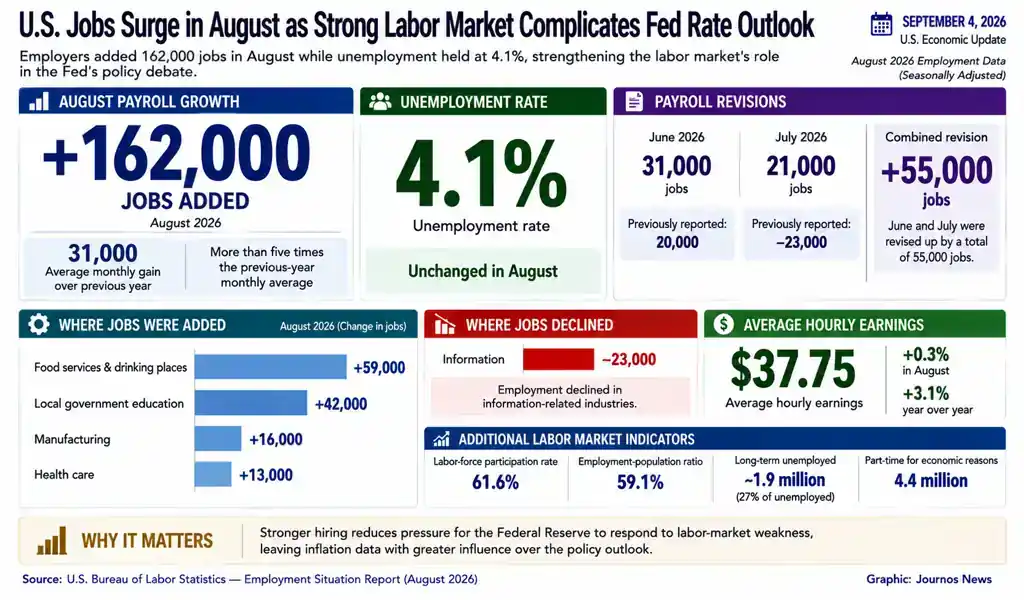
U.S. jobs graphic showing 162,000 August payroll gains, 4.1 percent unemployment, revised payroll data and changes across major industries.

JournosNews graphic showing August U.S. payroll growth, unemployment, payroll revisions, wage gains and employment changes across major industries. - Journos News, File.

U.S. employers added 162,000 jobs in August, while the unemployment rate held at 4.1%, according to the U.S. Bureau of Labor Statistics, signaling a stronger labor market after weaker employment gains earlier in the summer.

The August increase was more than five times the average monthly payroll gain of 31,000 recorded over the previous year. The stronger reading, combined with upward revisions to the previous two months, adds another factor for Federal Reserve policymakers as they weigh the outlook for interest rates against continuing inflation concerns.

Earlier employment figures revised higher

The Bureau of Labor Statistics also revised its estimates for June and July, strengthening the picture of employment growth before August.

June payroll gains were revised to 31,000 from 20,000, while July was revised to an increase of 21,000 after an earlier estimate showed a decline of 23,000. Combined employment for the two months was therefore 55,000 higher than previously reported.

The revisions mean the August increase followed a somewhat firmer labor-market backdrop than the initial employment reports had indicated.

Restaurants and education drive August gains

Food services and drinking places recorded the largest employment increase, adding 59,000 jobs during August. That was well above the sector’s average monthly gain of 12,000 over the previous year.

Local government education added 42,000 jobs, largely reversing losses reported in the previous month as the new school year began.

Manufacturing employment increased by 16,000 jobs, while health care added 13,000 positions, according to the BLS.


■ Related News

Business graphic showing U.S. job openings, hiring, layoffs, hiring rates, labor-market trends and Federal Reserve implications for July 2026.

U.S. Job Openings Rise Slightly to 7.3 Million as Labor Market Holds Up

September 1, 2026
Business graphic showing higher Treasury yields, rising Brent crude prices, inflation concerns, market impacts, Federal Reserve policy and Strait of Hormuz risks.

U.S. Bonds Sell Off as Rising Oil Prices Fuel Inflation Anxiety

September 1, 2026
Social Security Administration offices at 3971 South Research Park Drive in Ann Arbor, Michigan.

How to Avoid a Social Security Cut? Lawmakers Are Floating Ideas

August 27, 2026
New York Stock Exchange building on Wall Street in Lower Manhattan, New York City.

U.S. Stocks Retreat From Records as 5% Oil Surge Revives Inflation Concerns

August 11, 2026

Information sector continues to shed jobs

Employment gains were not spread evenly across the economy.

The information industry lost 23,000 jobs in August, with declines among computing infrastructure providers, data processing and web-hosting services, as well as publishing and broadcasting.

The sector had already been losing an average of 8,000 jobs per month over the previous year.

Construction employment changed little overall, although nonresidential specialty trade contractors continued to add workers.

Wage growth remains moderate

Average hourly earnings for private-sector employees rose 0.3%, or 10 cents, in August to $37.75, the Bureau of Labor Statistics reported.

Over the previous 12 months, average hourly earnings increased 3.1%.

The combination of stronger hiring and moderate wage growth presents a mixed signal for monetary policymakers. Continued job creation may point to sustained economic demand, while the wage figures provide less evidence that labor costs are accelerating sharply.

Labor force participation rises modestly

The labor force participation rate increased to 61.6% in August, though it remained 0.5 percentage point below its January level.

The employment-population ratio was unchanged at 59.1%, while the number of unemployed people remained around 7 million.

The figures indicate that the stronger payroll reading coincided with a modest expansion in the labor force rather than simply a reduction in the number of people available for work.

Long-term unemployment remains a concern

Some indicators continued to show areas of weakness within the labor market.

About 1.9 million people had been unemployed for at least 27 weeks in August, accounting for 27% of all unemployed workers.

The number of people working part time for economic reasons declined by 414,000 to 4.4 million.

The data suggest that while overall hiring strengthened, challenges persisted for some workers, particularly those experiencing prolonged unemployment.

Stronger employment changes the policy balance

The August employment report gives the Federal Reserve a more resilient labor market to consider as it evaluates its next monetary policy decisions.

A stronger pace of job creation can reduce pressure to respond to a weakening employment market, allowing policymakers to place greater attention on inflation and other economic indicators. At the same time, the moderate pace of annual wage growth does not, by itself, establish that labor-market conditions are generating a renewed acceleration in inflationary pressures.

The employment data alone do not determine whether the Federal Reserve will raise, hold or eventually lower interest rates. The central bank will continue to weigh labor-market conditions alongside incoming inflation and broader economic data.

Consumer-facing industries receive support

Employment growth and rising wages can support household spending, particularly across service industries.

The August increase in restaurant and food-service employment was one sign of continued activity in consumer-facing businesses, although the broader data showed uneven conditions across sectors.

Stronger demand can also complicate efforts to bring inflation down if other pressures, including supply constraints or higher energy costs, continue to affect prices.

Inflation data become increasingly important

The August report shifted the immediate picture of the U.S. labor market away from the weakness suggested by earlier employment estimates.

Payroll growth strengthened, June and July figures were revised higher and unemployment remained at 4.1%. However, the gains were not universal, while long-term unemployment remained significant.

For the Federal Reserve, the next major question is whether continued labor-market strength can coexist with progress toward price stability. The August employment figures provide evidence of renewed hiring momentum but leave the direction of future monetary policy dependent on inflation and other incoming economic data.

Reporting Credit: This report is based on data from the U.S. Bureau of Labor Statistics.

Tags: #Employment#FederalReserve#InterestRates#jobcreation#LaborMarket#Unemployment#USEconomy#USJobs
The Daily Desk

The Daily Desk

The Daily Desk is a contributor at JournosNews.com covering politics, media, governance, and the evolving dynamics of public discourse. Stories published under this byline are produced in accordance with JournosNews' editorial standards, with an emphasis on verified reporting, accuracy, context, and impartiality.

Related Posts

JournosNews market graphic showing mixed Asian indexes, rising oil prices, U.S. economic indicators and geopolitical energy risks.

Asian Markets Mixed as Oil Rises After Wall Street Extends Weekly Gains

August 10, 2026
Business market dashboard showing Wall Street indexes, oil prices, Treasury yields, market movers and investor sentiment at the close of trading on August 7, 2026.

Wall Street Ends Lower as Rising Oil Prices and Mixed Earnings Cool Market Rally

August 7, 2026
JournosNews market dashboard showing Wall Street stock indexes, corporate movers, Treasury yields, oil prices and key market drivers following the August 6, 2026 market close.

Wall Street Ends Mixed as Strong Earnings Offset Iran Uncertainty

August 6, 2026
Business dashboard showing U.S. stock market gains, declining oil prices, major market movers, and key economic indicators on August 4, 2026.

US Stocks Rally as Falling Oil Prices Ease Inflation Fears and Lift Wall Street

August 4, 2026
Business dashboard showing U.S. mortgage rates, Treasury yields, housing market indicators, affordability data, and mortgage rate trends as of July 31, 2025.

US 30-Year Mortgage Rate Climbs to One-Year High as Borrowing Costs Continue Rising

July 31, 2026
Business dashboard showing Asian stock market performance, oil prices, U.S. market close, AI semiconductor stocks, currency movements, and key market drivers on July 29, 2026.

Oil Prices Retreat as Asian Markets Weaken Amid AI Chip Sell-Off and Middle East Tensions

July 30, 2026
Exterior view of the New York Stock Exchange building on Wall Street in New York City's Financial District, displaying its neoclassical façade and American flags.

Oil Prices Surge as AI Selloff and Fed Uncertainty Weigh on Wall Street

July 30, 2026
Market dashboard showing mixed U.S. stock performance, falling oil prices, Treasury yields, sector performance, and market indicators ahead of the Federal Reserve's interest rate decision.

Wall Street Ends Mixed as Oil Retreat Eases Market Jitters Ahead of Fed Decision

July 28, 2026
Load More
JournosNews logo

Journos News delivers globally neutral, fact-based journalism that meets international media standards — clear, credible, and made for a connected world.

  • Categories
  • World News
  • Politics
  • Business & Markets
  • Technology
  • Health
  • Science
  • Sports
  • Arts & Culture
  • Resources
  • Editorial Standards
  • Submit a Story
  • Advertise with Us
  • Syndication & Partnerships
  • Site Map
  • Press & Media Kit
  • Editorial Team
  • Careers

Join thousands of readers receiving the latest updates, tips, and exclusive insights straight to their inbox. Never miss an important story again.

  • About Us
  • Editorial & Trust Center
  • Contact Us
  • Privacy Policy
  • Terms of Use & Copyright Notice

© JournosNews.com All rights reserved.

Welcome Back!

Login to your account below

Forgotten Password?

Retrieve your password

Please enter your username or email address to reset your password.

Log In
JournosNews

Independent Journalism.
Verified Facts.

You're about to read a professionally edited article from JournosNews.com.

Every article is produced in accordance with our editorial standards, emphasizing factual accuracy, transparent attribution, fairness, editorial independence, and meaningful context.

Editorial Standards
No Result
View All Result
  • Home
  • World
    • Africa
    • Americas
    • Asia
    • Europe
    • Middle East
    • Oceania
  • Politics
  • Business
  • Technology
  • Health
  • Science
  • Sports
  • Entertainment
  • Culture

© JournosNews.com All rights reserved.

This website uses cookies. By continuing to use this website you are giving consent to cookies being used. Visit our Privacy and Cookie Policy.