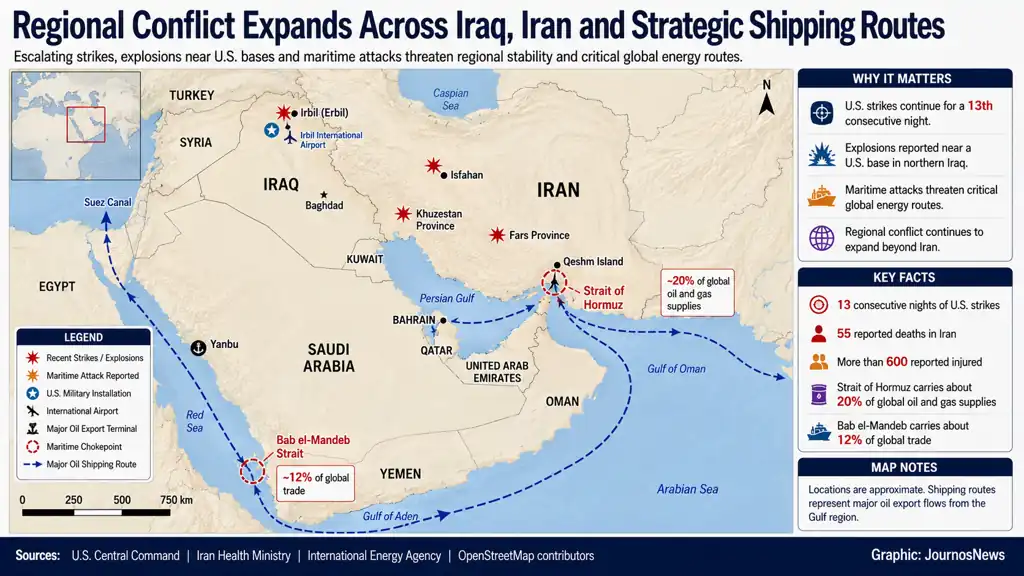
IRBIL, Iraq – Explosions were reported near a military base hosting U.S. forces in northern Iraq on Friday, while air raid sirens sounded in Bahrain, as the United States continued its military campaign against Iran for a 13th consecutive night.
The latest developments highlight the widening regional impact of the conflict, which has increasingly spread beyond Iran’s borders to threaten U.S. military installations, commercial shipping routes and global energy supplies. Fighting has intensified over the past week as Washington targets Iranian military infrastructure while Tehran responds with actions affecting maritime traffic and U.S. interests across the Middle East.
An Associated Press journalist in Irbil, the capital of Iraq’s semi-autonomous Kurdistan Region, reported hearing at least seven explosions and seeing multiple plumes of black smoke rising from areas near or within the military base at Irbil International Airport. Iraqi authorities did not immediately provide details on the cause of the explosions or report casualties or damage.

Bahrain also activated air raid sirens twice on Friday. Authorities there likewise did not immediately report casualties or damage.
U.S. Campaign Targets Iranian Military Infrastructure
Iranian semi-official news agencies Fars and ISNA reported that U.S. strikes targeted a naval base belonging to Iran’s Islamic Revolutionary Guard Corps in northern Iran.
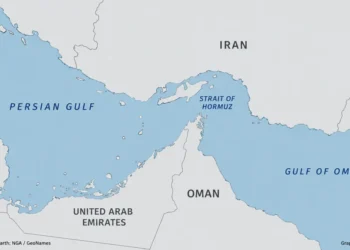
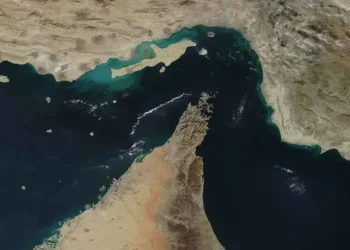
Additional overnight strikes were reported on Qeshm Island, which hosts Iranian naval assets, including drone boats capable of operating in the Strait of Hormuz.
Other reported strike locations included Isfahan Province, home to a major Iranian air base and one of the country’s nuclear facilities, as well as Khuzestan Province in southwestern Iran and Fars Province in southern Iran.
U.S. Central Command said the latest operations were intended to “further degrade Iran’s ability to threaten civilian mariners and commercial vessels transiting regional waters.”


According to Iran’s Health Ministry, at least 55 people have been killed and more than 600 injured in recent weeks as the fighting has intensified.
Maritime Attacks Raise Energy Security Concerns
The Strait of Hormuz remains central to the conflict because it serves as one of the world’s most important energy transit routes, carrying roughly one-fifth of global oil and natural gas supplies during normal conditions.
Iran has targeted vessels operating within a shipping corridor overseen by U.S. forces and has asserted that it has the right to regulate traffic through the waterway, including the possibility of charging transit fees. Before the current conflict, commercial passage through the strait was generally toll-free.
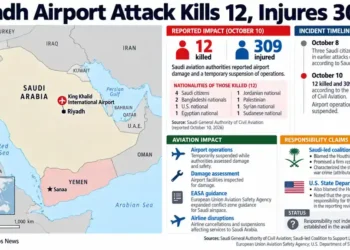
Pressure on regional shipping increased further after Iran-aligned Houthi rebels attacked two Saudi oil tankers in the Red Sea on Thursday, following earlier threats to disrupt Saudi-linked shipping through the Bab el-Mandeb Strait.
The Bab el-Mandeb, which connects the Red Sea with the Gulf of Aden, carries about 12% of global trade, including roughly one-quarter of the world’s container traffic. Saudi Arabia has increasingly relied on its Red Sea export terminal at Yanbu to maintain oil exports while reducing dependence on the Strait of Hormuz.
Brent crude oil briefly rose above $100 per barrel following the attacks before retreating.
Trump Warns Iran and Houthi Rebels
President Donald Trump warned that the Houthi movement would face “major military punishment” if attacks on commercial shipping continue.
Trump also said on social media that Iranian assets held under U.S. control would be used to compensate for damage caused to ships and cargo during the conflict.
“Please let this statement serve to represent, until further notice, that from this point forth, any and all damages done to Ships, Cargo, or anything related thereto, will be paid for by Iranian Money that the United States has in its possession, and controls.”
The source material did not indicate what legal authority would permit the U.S. government to use those assets for compensation.
Iranian Foreign Minister Abbas Araghchi criticized the proposal in a post on X, writing that once governments normalize confiscating foreign assets, “no one’s assets are safe,” and warning that such actions would have serious consequences.
With attacks continuing on land and at sea, neither Washington nor Tehran has indicated that de-escalation is imminent, leaving regional security, global shipping and international energy markets under sustained pressure.
This report is based on reporting by The Associated Press.