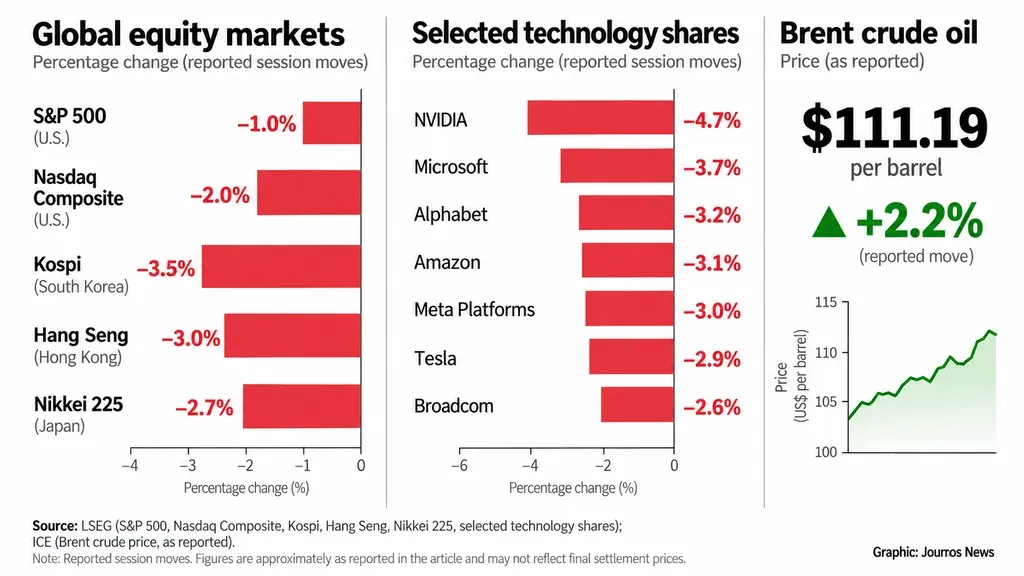
Global stock markets fell on Thursday, October 22, as technology shares came under pressure and oil prices climbed to their highest level since May. Investors faced growing questions about the cost of artificial intelligence (AI) infrastructure and the returns companies may earn from their spending.
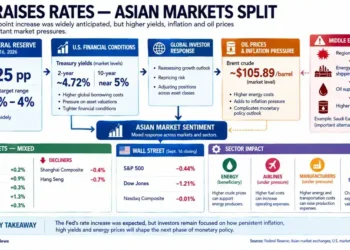
In the United States, the S&P 500 fell about 1%, while the Nasdaq Composite dropped around 2%. Technology shares led much of the decline. In Asia, South Korea’s Kospi lost 3.5%, Hong Kong’s Hang Seng fell 3%, and Japan’s Nikkei 225 dropped 2.7%. European shares also declined as investors assessed company results, rising oil prices and concerns about government borrowing costs.
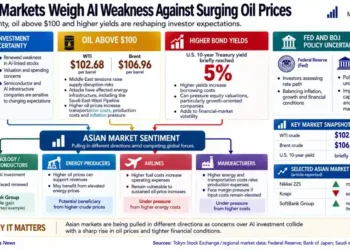
Brent crude, the global oil benchmark, rose about 2.2% to $111.19 a barrel, reaching its highest level since May. Renewed security threats in the Middle East added to concerns about possible disruptions to oil supplies.

The declines reflected several pressures rather than a single cause. Investors were reassessing expensive AI investments, while higher oil prices raised concerns about business costs and inflation.
AI spending concerns weigh on technology shares
Investors have poured money into data centers, advanced chips and other infrastructure needed to develop and run AI systems. The spending has created new revenue opportunities for technology companies, but it has also raised questions about how quickly those investments will generate enough profit to justify their cost.
Shares of chipmaking equipment supplier Lam Research fell about 10%. Meta Platforms dropped 5.4%, while Nvidia lost 3.7%. CoreWeave, a cloud computing company with substantial investment in Nvidia hardware, fell 7.8%.
The declines came despite continued investment in AI infrastructure. Nvidia announced new capacity agreements with manufacturing and supply-chain partners on October 21, including plans to expand advanced packaging and other production capabilities. The announcement points to continued industry investment, although it does not establish how profitable that investment will be.
Investors are increasingly examining whether companies can turn large AI budgets into sustainable earnings. Building data centers requires expensive chips, electricity, cooling systems, land and network connections. Companies may also need to spend heavily before demand produces enough revenue to cover those costs.


That uncertainty can affect share prices even when a company reports strong sales. Investors are weighing not only current performance but also future spending, financing needs and expected returns.
Oil climbs as Middle East risks intensify
Oil prices rose as renewed security concerns heightened fears of disruptions to energy supplies.
Attacks involving Houthi forces in Saudi Arabia and wider tensions connected to the conflict with Iran added to market concerns. The United States also warned of security risks to its personnel in Saudi Arabia. These developments increased uncertainty about regional stability and the movement of oil through important shipping routes.
The price increase reflected the risk of future disruption, not proof that all feared supply losses had already occurred. Oil traders often adjust prices when they believe conflict could restrict production, damage infrastructure or make shipping more difficult.
Brent’s rise above $111 a barrel also added pressure to an energy market already affected by geopolitical uncertainty. If prices remain elevated, transport, manufacturing and other fuel-intensive businesses could face higher operating costs.
However, the effect on individual companies will vary. Energy producers may benefit from higher prices, while airlines, logistics operators and manufacturers may face greater expenses.
European markets face separate financial pressures
European shares also moved lower as investors reacted to mixed company results and higher government borrowing costs.
The STOXX Europe 600 fell nearly 1%. France’s CAC 40 lost about 1.4%, while technology companies including Infineon, STMicroelectronics and ASML came under pressure. Hermes also fell sharply after reporting disappointing revenue.
France’s political and fiscal outlook added another source of uncertainty. The difference between French and German 10-year government bond yields widened to its largest level since 2011, reflecting increased concern about the relative risk of French government debt.
These European pressures were distinct from the debate over AI spending in the United States. Although global investors respond to developments across markets, not every decline can be attributed to technology valuations or rising oil prices.
Higher oil prices could complicate the inflation outlook
A sustained rise in oil prices can feed into inflation by increasing the cost of fuel, transport and goods production. Businesses may absorb some of those costs, while others may pass them on to consumers.
Higher inflation could make it harder for central banks to reduce interest rates. If borrowing costs remain high, companies may face more expensive financing for new projects, including AI data centers and other large infrastructure investments.
But these outcomes are not certain. The effect will depend on how long oil prices remain elevated, whether supply disruptions materialize, and how inflation and economic activity develop.
For technology companies, higher financing costs could increase scrutiny of investments that require years of spending before they deliver expected returns. For the wider economy, rising energy costs could weaken consumer purchasing power if wages do not keep pace.
Investors await clearer evidence of returns
The market declines highlight the tension between continued investment in AI and growing demands for evidence that the spending will produce lasting profits.
AI infrastructure remains a major area of corporate investment, and some companies continue to expand capacity. At the same time, investors are becoming more sensitive to financing costs, earnings forecasts and the time needed to recover those investments.
Oil prices add another variable. A prolonged increase could put pressure on inflation and company margins, while any easing of geopolitical tensions could reduce some of that pressure.
The direction of markets will depend on new evidence: company earnings, capital-spending plans, energy supply developments and the path of inflation and interest rates. Thursday’s declines show that investors are reassessing several risks at once, rather than responding to a single market driver.
Reporting Credit: Intercontinental Exchange (ICE) — Brent Crude Futures. Official futures-market data. The page retrieved for this review did not independently confirm the October 22 settlement price. NVIDIA — NVIDIA and Supply Chain Partners Expand Capacity to Accelerate AI Infrastructure Buildout. Official company announcement dated October 21, 2026, describing plans to expand AI-related manufacturing capacity. U.S. Department of State — Saudi Arabia Travel Advisory. Official security guidance documenting regional risks. It does not by itself confirm the specific market impact of the latest attacks.