ASTANA, Kazakhstan – Governments are seeking access to artificial intelligence technology from both the United States and China as competition over chips, data centers, AI models and digital standards intensifies.
Two initiatives have become important channels for that competition. The US-led Pax Silica initiative focuses on trusted technology supply chains, advanced manufacturing, critical minerals and AI infrastructure. China’s World Artificial Intelligence Cooperation Organization (WAICO) aims to expand international AI cooperation, promote shared governance and make AI technologies more accessible.
For many countries, the goal is not simply to align with Washington or Beijing. They want investment, computing power, skilled workers and influence over the rules governing AI. They also want to avoid becoming dependent on a single foreign supplier.

Kazakhstan offers a striking example. It joined Pax Silica in June 2026 and became a founding member of WAICO the following month. Indonesia has also joined WAICO, while Singapore is considering an invitation to participate. These decisions show that countries can pursue different diplomatic relationships at the same time. They do not, however, guarantee unrestricted access to every technology or service offered by either side.
Two initiatives with different priorities
Pax Silica emerged as a US-led effort to strengthen supply chains that support the AI economy. Its focus extends beyond software to the physical systems needed to develop and operate AI: semiconductors, critical minerals, electricity, data centres, manufacturing and technical expertise.
The initiative also seeks closer cooperation among countries that Washington considers trusted technology partners. Its June 2026 expansion brought its reported membership to 24 signatories, including countries in Europe, the Middle East and the Indo-Pacific. Kazakhstan became the first country from its region to join.
Pax Silica began with a non-binding declaration. That matters because a declaration of shared objectives is not the same as a treaty requiring members to buy specific products, exclude particular suppliers or follow a common procurement policy.
Singapore’s government described the initiative’s initial declaration as non-binding and said its inaugural summit explored opportunities in advanced manufacturing and AI infrastructure.
■ Related News




WAICO took a different institutional path. On July 16, 2026, representatives of 29 countries signed the agreement establishing the organization in Shanghai. China’s Foreign Ministry described it as an independent intergovernmental organization, headquartered in Shanghai, intended to promote international AI cooperation and global governance.
The founding agreement identifies goals that include expanding access to AI, building national capacity, coordinating governance and technical standards, encouraging an open-source ecosystem and addressing AI-related risks. Its stated functions are limited to civilian AI.
The agreement provides a formal membership process. States that signed during the founding period became founding members, while other states may apply for membership subject to approval by the organization’s council. It also provides for observers without voting rights.
The two initiatives therefore offer different forms of engagement. Pax Silica emphasizes cooperation across the physical supply chain and the security of technology networks. WAICO places greater emphasis on international cooperation, AI capacity building and governance.
Neither initiative, by membership alone, gives a country complete control over the technologies it uses.
Kazakhstan is pursuing both partnerships
Kazakhstan’s participation in both initiatives reflects a practical economic strategy. The country wants to attract advanced technology investment, develop domestic computing capacity and move beyond exporting raw materials.
Its geography and resources help explain the interest. Kazakhstan sits between Europe and China, has substantial energy and mineral resources, and is seeking to expand its digital infrastructure. Its government has identified critical-mineral processing, data centers, engineering skills and high-tech manufacturing as potential areas for development.
Joining Pax Silica provides a framework for cooperation with the United States and other participating economies. Kazakhstan’s accession documents include a joint statement on the AI Opportunity Partnership, which identifies cooperation in research, computing infrastructure, energy, talent development and private-sector investment.
But Kazakhstan’s simultaneous membership of WAICO also matters. It gives the country a place in a Chinese-led forum that aims to shape international AI cooperation and governance.
That combination suggests Kazakhstan is trying to widen its options rather than commit its entire AI strategy to a single political or commercial network. It may seek Western computing hardware and investment while also pursuing Chinese capital, technology and commercial partnerships.
The arrangement does not eliminate trade-offs. Advanced chips may be subject to export controls. Some cloud services may not be available in every market. Security requirements can affect procurement, while technical choices made today can influence future costs.
Kazakhstan’s challenge is to turn diplomatic access into working infrastructure, domestic skills and bargaining power.
The $10 billion announcement is not $10 billion already invested
A major part of Kazakhstan’s AI ambitions is a package of agreements announced on June 15 involving the government, US-based AI infrastructure company Firebird and Nvidia-related technology.
Kazakhstan’s prime minister said the package was worth $10 billion and linked it to the development of a project called Data Center Valley. Firebird works on data-center development and high-performance computing, while Nvidia supplies chips and computing technology used in many AI systems.
The announcement signals the scale of Kazakhstan’s ambition. It does not, by itself, establish that the entire amount has been transferred, that every agreement is binding and fully financed, or that the planned infrastructure is already operating.
Those distinctions are important in assessing AI investment. A memorandum of understanding, a framework agreement, a signed contract, a financial close, a disbursement and an operating data centre are different stages of a project.
The public announcement describes a package of agreements. A full assessment would require project-level details, including the amount of committed financing, the source of funds, the construction timetable, procurement contracts, the computing capacity to be installed and the share of infrastructure that will be available to Kazakhstan-based users.
Without those records, the $10 billion figure should be treated as the announced value of the package, not as verified investment already delivered.
Chinese investment gives Kazakhstan another source of capital
Kazakhstan’s economic relationship with China provides a second important part of the picture.
Kazakhstan’s investment promotion agency reported that Chinese foreign direct investment reached a record $2.8 billion in 2025. It also reported bilateral trade of $48.7 billion that year. The investment figure covers the wider economy, including sectors such as industry, transport, energy and manufacturing. It is not a measure of Chinese investment in AI alone.
The distinction prevents a misleading comparison. The $10 billion Kazakhstan announced in June is a package of AI-related agreements, while the $2.8 billion figure measures Chinese foreign direct investment across sectors during 2025. They cover different periods and types of economic activity.
Both figures show why Kazakhstan has an incentive to maintain multiple partnerships. US-linked technology investment could support advanced computing and data-center development. Chinese investment can contribute capital, equipment, industrial capacity and access to a major commercial market.
The question is how much value remains in Kazakhstan. A project can attract substantial foreign investment while relying on imported chips, overseas engineering teams, foreign cloud platforms and external maintenance. Domestic ownership of a data center does not necessarily mean domestic control of its technology.
To measure progress, Kazakhstan would need to disclose not only investment totals but also operating capacity, local employment and training, technology transfer, domestic supplier participation and the ability to run critical systems without continuous foreign support.
Indonesia wants access without giving up strategic flexibility
Indonesia has also pursued a strategy that allows it to work with different international partners.
On July 16, 2026, Indonesia signed the agreement establishing WAICO, becoming one of its 29 founding members. Coordinating Minister for Economic Affairs Airlangga Hartarto said the decision supported international cooperation in AI development and governance.
Indonesia’s participation gives it a formal role in a forum that aims to expand AI access, encourage cooperation and develop shared approaches to governance. It does not mean the country has abandoned cooperation with US companies or other technology providers.
A policy brief published by Indonesia’s economic policy research unit in September argued that the country should pursue a calibrated dual-track strategy. It recommended using WAICO to expand international cooperation while strengthening bilateral partnerships with the United States and other partners.
The approach reflects a broader national interest. Indonesia needs affordable computing, reliable energy, data infrastructure, local technical expertise and AI systems that can serve its language and economic needs. It also needs rules for personal data, cybersecurity and government use of AI.
Membership in an international organization can open doors, but the practical value depends on what follows: investment contracts, training, research partnerships, access to computing resources and measurable improvements in domestic capacity.
Singapore is keeping its options open
Singapore has taken a different position. It is a signatory to Pax Silica and has received an invitation to participate in WAICO. As of its parliamentary responses on September 9 and 10, the government said it would consider the invitation alongside its broader engagement with China and other international AI initiatives.
Singapore also stated that there was no ASEAN-wide position on joining either Pax Silica or WAICO.
That position reflects Singapore’s established practice of working through multiple international platforms. Its role as a regional financial, technology and data-center hub gives it an interest in maintaining links with different markets and suppliers.
The government’s public position does not establish that Singapore has joined WAICO. It has confirmed an invitation and a decision to consider it.
That distinction also matters for other countries watching the two initiatives. An invitation, an expression of interest, observer status, a signature and full membership are not interchangeable. Governments should identify the exact status of each relationship before drawing conclusions about its obligations.
Membership does not automatically require countries to choose sides
One of the most consequential questions is whether Pax Silica or WAICO formally restricts members from cooperating with the other initiative.
The available documents do not establish a blanket rule that membership in one automatically bars participation in the other. Kazakhstan’s participation in both is direct evidence that the two memberships can coexist at least at the level of formal participation.
However, formal membership rules are only part of the picture. Governments may face pressure from partners over the equipment they buy, the companies they trust, the data they share and the infrastructure they use for sensitive work.
US concerns about technology security and access to advanced semiconductors can affect the availability of particular chips and computing systems. Chinese export controls and commercial policies can also affect supply chains. These restrictions may apply independently of whether a country belongs to Pax Silica or WAICO.
A public warning from a government is not the same as a binding membership condition. Likewise, a supply restriction imposed under export-control law is not necessarily a rule written into an international AI initiative.
To establish whether a country is required to exclude the other side, researchers must examine the initiative’s founding documents, accession terms, supplementary agreements, procurement contracts and any applicable export-control rules. They must also distinguish official policy from diplomatic pressure reported by media.
That distinction is essential to understanding the real choices governments face.
US and Chinese AI ecosystems offer different options
The practical comparison between US and Chinese AI systems cannot be reduced to the claim that one side is always more capable or the other always cheaper.
The United States has a large ecosystem of advanced AI chip designers, cloud providers, frontier-model developers and software companies. Nvidia’s accelerators are widely used in AI training and inference, while US cloud providers offer managed computing, development tools and integrated enterprise services.
China has its own major AI developers, cloud providers, chip companies and open-weight model ecosystem. Some Chinese models can be downloaded and deployed on infrastructure controlled by the user, depending on the model’s license and technical requirements. That can give organizations more control over where data is processed and how a system is customized.
But an open-weight model is not necessarily fully open source. Its license may restrict certain uses, and its weights alone do not provide all the training data, computing resources or expertise needed to reproduce the original model.
Likewise, access to a US commercial model through an API does not automatically give a customer control over the underlying system. The provider may determine where the model runs, how data is handled and which functions are available.
Price comparisons require the same care. API prices are only one cost. Organizations must also account for hardware, electricity, staffing, integration, security, support and the performance of a model on their actual tasks.
For example, DeepSeek’s published API pricing lists different rates for its Flash and Pro models and varies charges by input, output, cached requests and time of use. Those prices are useful for comparing specified services, but they do not establish that all Chinese AI systems are cheaper than all US alternatives.
A fair comparison should test named models on the same tasks, in the same languages and under comparable conditions. It should measure accuracy, reliability, latency, cost per completed task, data handling and performance on local-language material.
For governments, the best system may differ by use case. A research laboratory, a public hospital, a national security agency and a small business do not have the same requirements.
AI sovereignty requires more than owning a data center
Governments often describe their AI ambitions in terms of sovereignty. The term can mean several different things: control over national data, the ability to run models locally, domestic computing capacity, local technical expertise or freedom to change suppliers.
These capabilities are related, but they are not identical.
A country may own a data centre but depend on foreign chips, software updates and specialist maintenance. It may run an open-weight model locally but lack the staff to secure it, adapt it to local needs or maintain it over time. It may have strong data-protection laws while relying on cloud services whose technical and contractual terms limit practical control.
A useful assessment of AI sovereignty should measure at least five areas.
First, governments should record how much computing capacity is installed and operational, who controls it and how much is available to domestic researchers and companies.
Second, they should measure local expertise, including the number of trained engineers, researchers, security specialists and technicians able to maintain the infrastructure.
Third, they should examine data arrangements. These include where data is stored and processed, who can access it, how long providers retain it and what happens when a contract ends.
Fourth, they should assess the ability to operate systems independently. Can a public agency keep a service running if a foreign API becomes unavailable, a chip supply is interrupted or a cloud contract is terminated?
Finally, governments should measure how easily they can move to another provider. That requires looking at data portability, software compatibility, hardware dependence, staff retraining and the cost of rebuilding applications.
No country needs to produce every chip or develop every model to have meaningful control. But governments need to understand which dependencies are manageable and which could interrupt essential services.
The wider contest reaches beyond Asia
The US-China AI competition also affects countries that are seeking infrastructure investment, development assistance and greater access to digital services.
In Africa, Washington has backed telecommunications and digital infrastructure as part of its effort to expand trusted networks and support US technology companies. In September, the US International Development Finance Corporation announced an investment of up to $155 million in African digital infrastructure provider WIOCC. The agency has also supported other communications and infrastructure projects on the continent.
That is an announced investment ceiling, not proof that the full amount has already been disbursed. It also concerns digital infrastructure rather than a dedicated AI model or computing project. Still, fibre networks and data centers are part of the foundation needed to deliver AI services.
For governments in Africa and the Middle East, the challenge is to evaluate the terms of infrastructure partnerships rather than judge them solely by the nationality of a supplier. Important questions include who finances the project, who owns the equipment, where data is processed, how contracts can be terminated and whether local workers and firms gain lasting skills.
The same principles apply to Southeast Asia. Governments may seek a mix of cloud services, locally operated models, imported accelerators and domestic research. They need to know whether those systems can work together and whether the contracts preserve the option to change suppliers.
Development assistance can expand access to AI, but it does not automatically build technological independence. That depends on the terms of the assistance and the capabilities that remain when the project ends.
Diversification can reduce risk, but it is not free
Using multiple AI providers can improve resilience. If one service becomes unavailable, a government or company may be able to shift some work to another provider. Different models may also perform better on different languages, tasks or types of data.
Yet diversification can create additional costs. Applications may need to be rewritten for different interfaces. Data may require new formats or security checks. Staff may need retraining. Hardware and software may not be interchangeable, and a model that performs well in one language may not match another on a critical task.
Security requirements can also complicate switching. A government may approve one provider for public information but not for sensitive records. A system may be suitable for general research but unsuitable for defense or critical infrastructure.
Governments therefore need procurement rules that preserve flexibility where possible. These may include portable data formats, documented interfaces, clear exit clauses, independent security testing and regular reviews of supplier concentration.
They should also distinguish between diversification and duplication. Buying several systems without a plan can increase costs without reducing the most serious risks. The objective is to ensure that essential functions can continue if a supplier, product or supply route becomes unavailable.
What Washington and Beijing still need to clarify
The two initiatives make broad claims about secure supply chains, international cooperation and the responsible development of AI. The next test is whether those goals translate into transparent and measurable commitments.
Washington needs to explain how Pax Silica participation affects access to technology, what security standards members are expected to follow and whether any restrictions apply to cooperation with non-member countries or Chinese suppliers.
Beijing needs to clarify how WAICO will put its stated goals into practice, including how projects are selected, how funding is allocated, how members influence decisions and what safeguards govern cross-border data and technology cooperation.
Both governments should publish clear information about the practical benefits available to participating countries. That includes investment terms, research access, computing capacity, training programmes, licensing conditions and any restrictions on transferring or using technology.
Officials from Kazakhstan, Indonesia and Singapore also need to explain how they will assess the results of their partnerships. Their success should not be measured by the number of summits attended or declarations signed. It should be measured by the computing resources available, the skills developed, the investment delivered and the control their institutions retain over critical systems.
The available public record establishes the broad objectives of both initiatives and confirms several countries’ participation decisions. It does not yet provide a complete picture of all practical obligations, commercial arrangements or the extent to which members can use competing suppliers without restrictions.
The measure of success is real national capacity
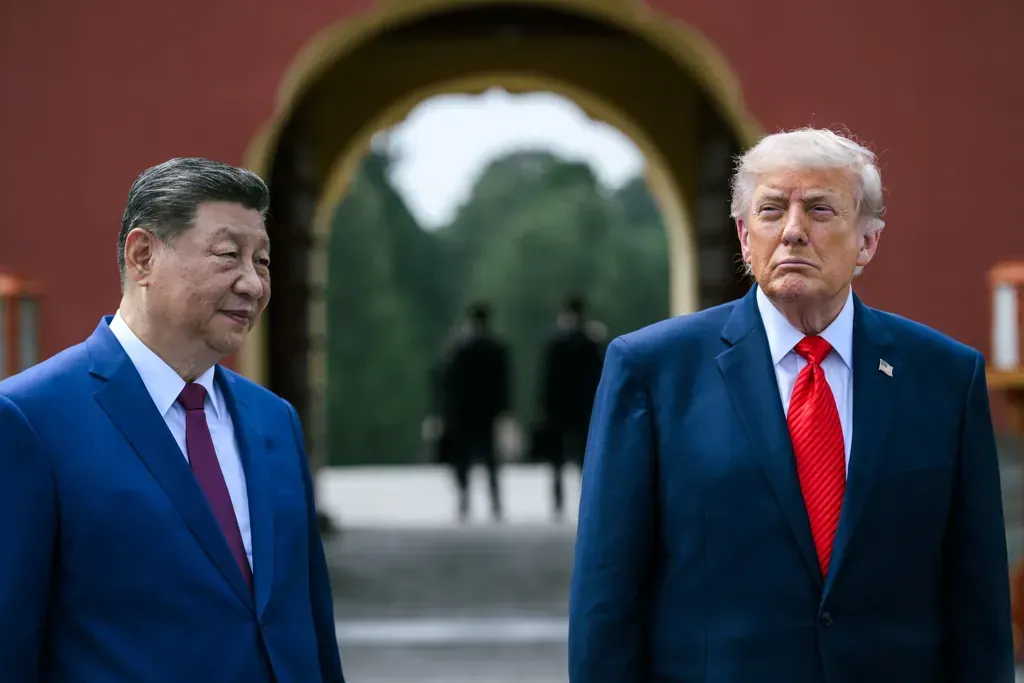
The rivalry between Washington and Beijing gives governments opportunities to seek investment, expand technical cooperation and negotiate better terms. It also creates risks when access to essential technology depends on political decisions made elsewhere.
Kazakhstan’s participation in both initiatives demonstrates that formal engagement with the two ecosystems is possible. Indonesia’s role in WAICO and Singapore’s consideration of an invitation show that countries are making different choices based on their own interests.
But membership is only the beginning. The real question is whether these partnerships help countries build infrastructure they can operate, develop people who can maintain it, protect their data and move between suppliers when necessary.
AI sovereignty does not require complete technological self-sufficiency. It requires a credible ability to manage dependencies, protect essential systems and make decisions without losing access to critical services.
For governments navigating the US-China rivalry, that is the standard against which the competing initiatives should be judged.
Reporting Credit: Based on official government announcements, initiative documents and published reporting on Pax Silica, WAICO, AI infrastructure investment and national technology strategies.