KINSHASA, Democratic Republic of the Congo – The Democratic Republic of the Congo is facing a growing shortage of health workers as the country’s largest recorded Bundibugyo virus outbreak continues to expand, putting additional pressure on treatment centers and teams trying to contain transmission.
The World Health Organization said more than 4,000 additional health professionals had already been deployed to reinforce Ebola care teams. But the need remains substantially greater: more than 6,200 additional staff members will be required over the next three months, alongside thousands of pieces of resuscitation equipment and capacity for more than 2,000 additional operational beds.
The staffing requirement comes as the outbreak continues to spread geographically.

As of September 20, the outbreak had reached 63 health zones across six provinces, with 7,733 confirmed cases and 3,732 deaths, according to the latest WHO regional situation report. Transmission has declined in some areas but remains active in others, particularly North Kivu and Haut-Uélé.
Treatment capacity has expanded but remains under pressure
The response has expanded considerably since the outbreak was declared in May.
By September 1, 59 health facilities in affected provinces had been identified for Ebola care, with a combined capacity of 1,346 beds. In Ituri Province alone, 25 facilities included 15 Ebola treatment centers and 10 transit centers, providing 974 beds across 19 health zones.
That expansion has not eliminated pressure on individual facilities.
WHO said overall bed occupancy in Ituri was about 62%, but some treatment centers in Bunia were operating at between 90% and full capacity. Maintaining those facilities requires enough trained staff, biomedical equipment and supplies to provide care safely as patient numbers change.




The staffing problem is therefore not simply about adding doctors or nurses to a national health workforce.
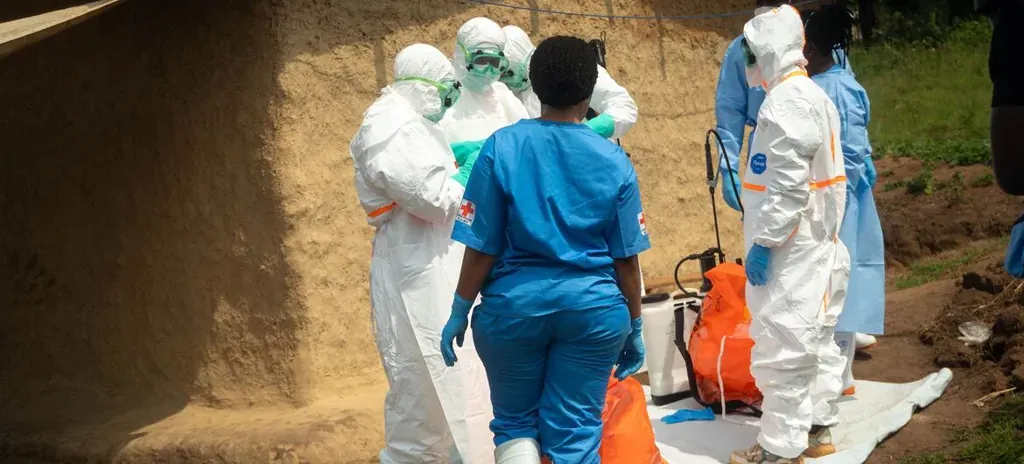
Ebola treatment requires personnel trained in infection prevention and control, clinical management, laboratory procedures, patient transport and other specialized functions. Staff also face the risk of exposure while working in affected facilities.
WHO reported in August that 158 health workers had been infected during the outbreak and 45 had died as of August 20. The agency said affected and high-risk facilities need trained personnel, protective equipment, water, sanitation and functioning infection-prevention systems.
The outbreak continues to expand
The latest WHO figures show that the epidemic remains geographically uneven.
Ituri remains the principal center of transmission, but its share of total cases has declined as other provinces have recorded more infections. North Kivu experienced a significant increase in cases during September, while Haut-Uélé has maintained sustained transmission. Dungu Health Zone in Haut-Uélé became the latest affected area, bringing the total to 63 health zones.
The expansion complicates the staffing problem.
Health workers and response teams cannot simply be concentrated in the largest treatment center. New transmission areas require surveillance, case investigation, laboratory testing, contact monitoring and treatment capacity closer to affected communities.
WHO previously said that insecurity, population displacement and poor road access were limiting the ability of response teams to reach some communities and were impeding surveillance, contact tracing and healthcare access.
WHO says the response needs more people and resources
The shortage of personnel is occurring alongside broader funding and operational constraints.
WHO’s emergency recommendations call for a major expansion of human resources and specifically urge authorities to ensure health workers are protected, equipped and paid on time. The recommendations also call for trained teams capable of rapidly scaling operations as transmission changes.
Earlier in the outbreak, WHO and Africa CDC said response operations in parts of eastern Congo were being outpaced by transmission.
At that point, contact follow-up was 75%, below the operational target of at least 95%, while treatment-center occupancy in North Kivu had reached 139%. The agencies called for more laboratory, treatment, ambulance and burial capacity as well as stronger support for frontline workers.
The response has since expanded substantially, but the continuing need for additional personnel shows how quickly requirements can grow when an outbreak spreads into new areas.
A difficult outbreak to detect and contain
The outbreak is caused by Bundibugyo virus, one of the species of virus that causes Ebola disease.
The disease can be difficult to distinguish from other illnesses, particularly in the early stages. WHO says laboratory confirmation is important because symptoms can overlap with endemic febrile illnesses such as malaria. Effective control depends on rapid identification, isolation and treatment, contact tracing, safe burials and community engagement.
The response is also taking place in a difficult humanitarian environment.
WHO says insecurity and population displacement are limiting access to healthcare in affected areas. More than 26 million people in the country are experiencing acute food insecurity, while about one million internally displaced people are in Ituri Province alone, according to the agency’s September assessment.
Overcrowding and limited water and sanitation services can further complicate infection prevention.
Those conditions make the availability of trained health workers even more important because the response must operate simultaneously across clinical care, surveillance, infection control and community outreach.
Uganda’s experience offers a contrasting example
The regional situation is not uniformly deteriorating.
Uganda, which recorded imported Bundibugyo virus cases connected to the wider outbreak, declared an end to its transmission in July after reporting 20 confirmed cases and two deaths. WHO and Africa CDC credited early detection, rapid contact tracing, coordinated national action and cross-border surveillance with helping contain the outbreak there.
The contrast illustrates why response speed matters.
Where cases are detected quickly and contacts can be identified and monitored, authorities have more opportunities to interrupt transmission before it expands.
In Congo, the scale and geography of the outbreak make that task considerably more difficult.
The shortage extends beyond hospitals
Health workers are needed throughout the response, not only inside Ebola treatment centers.
Community health workers and other local personnel help identify suspected cases, encourage people to seek care, support contact tracing and communicate with communities.
WHO’s emergency recommendations specifically call for local networks, including community health workers, Red Cross volunteers and trusted community representatives, to be trained and activated to support early detection and referral.
That approach is particularly important in areas where insecurity or poor roads make it difficult for specialized response teams to reach every community quickly.
It also reflects a broader lesson from previous Ebola outbreaks: public-health measures are harder to implement when communities do not trust the people delivering them.
The immediate challenge is keeping pace with transmission
Africa CDC’s latest scientific review, released September 17, said declines in cases and deaths in some hotspots were encouraging but that the epidemic remained heterogeneous and had not yet clearly peaked.
The organization recommended maintaining the continental public-health emergency designation, increasing response intensity, strengthening contact identification and restoring essential health services.
The WHO situation report published four days later recorded continued geographic expansion despite declines in some major transmission areas.
That leaves the response facing a moving target.
Treatment capacity has increased. Thousands of additional health professionals have been deployed. Surveillance and laboratory testing have expanded.
But the number of locations requiring those services has also grown.
The immediate question is whether enough trained personnel, equipment and financing can reach those locations quickly enough to keep the response ahead of transmission.
For WHO, the staffing requirement is already clear: the response needs thousands more people over the coming months.
The epidemic will determine how quickly they are needed.
Reporting Credit: World Health Organization — outbreak surveillance, case and death figures, health-worker requirements, treatment capacity, operational assessments and emergency recommendations; Africa Centres for Disease Control and Prevention — continental outbreak assessment and response recommendations; Ministry of Health of the Democratic Republic of the Congo — national outbreak response and health-system coordination.