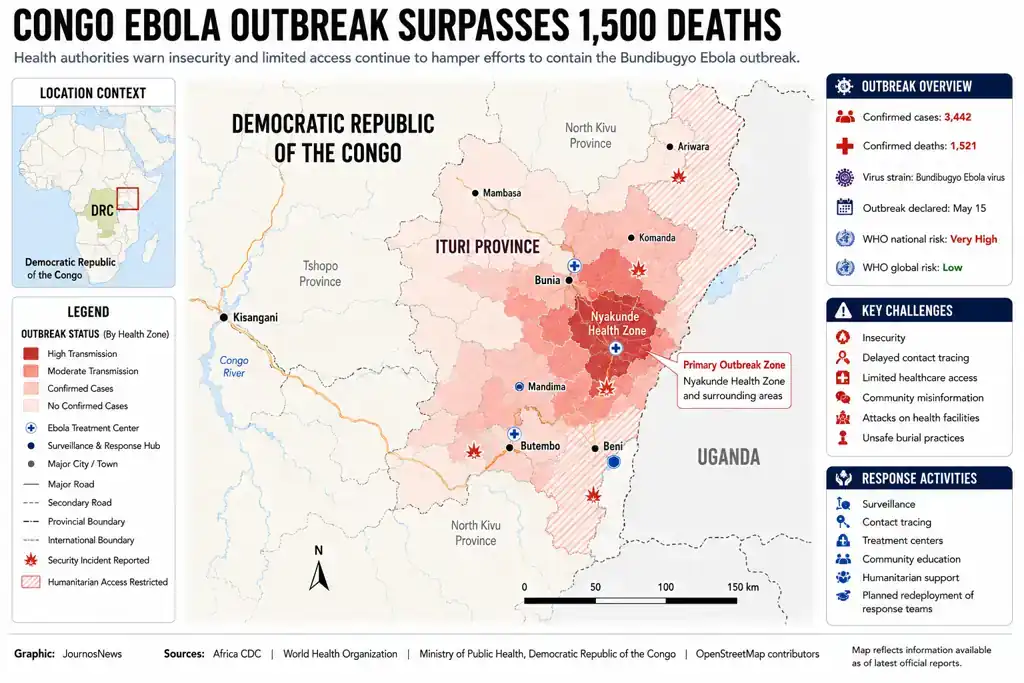
BUNIA, Congo – The death toll from the Democratic Republic of the Congo’s rapidly expanding Ebola outbreak has surpassed 1,500, according to government data released Thursday, as health officials warned that the emergency continues to outpace efforts to contain the virus.
The latest figures show 3,442 confirmed cases and 1,521 deaths as of Tuesday. The Africa Centres for Disease Control and Prevention (Africa CDC) said part of the increase reflects a backlog of cases and deaths that had not previously been confirmed or recorded. Officials stressed, however, that the outbreak remains a severe public health emergency.
Insecurity Hampers Response Efforts
The outbreak, declared on May 15, has been linked to the Bundibugyo strain of the Ebola virus, for which there are currently no approved vaccines or treatments.

According to Africa CDC, response efforts have been hindered by delayed contact tracing, limited access to affected communities, public mistrust and ongoing violence involving armed groups and some local populations.
Nearly 90% of confirmed infections have been reported in the eastern province of Ituri, although cases have also been identified in five provinces, including the city of Kisangani.
While neighboring Uganda declared its Ebola outbreak over on Tuesday after its last patient was discharged in mid-June, health authorities continue to classify the risk of transmission within the Democratic Republic of the Congo as extremely high.
Community Transmission Drives Rising Death Toll
Africa CDC Director-General Dr. Jean Kaseya said 63% of confirmed Ebola deaths recorded during the past two weeks occurred outside treatment centers.
He said unsafe handling of infected bodies remains a major driver of transmission, as traditional burial practices involving direct physical contact continue in some communities.
■ Related News
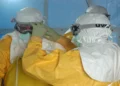



Health officials also said restrictions on burial practices, combined with misinformation denying the existence of Ebola, have fueled community resistance and contributed to attacks on health facilities.
In the Nyakunde health zone of Ituri Province, international organizations temporarily relocated staff after a July 15 attack on a hospital and an Ebola treatment center following the death of a patient.
Officials said the withdrawal of partners, including Africa CDC and Mercy Corps, disrupted surveillance, contact tracing and the delivery of medical supplies.
Dr. Désiré Duabo, chief medical officer for the Nyakunde health zone, warned that stocks of essential medical supplies were nearly exhausted because international organizations had been providing much of the equipment, logistics and operational support.
Pierre Akilimali, the Democratic Republic of the Congo’s Ebola response incident manager at the National Public Health Institute, said attacks on health facilities have increased risks faced by frontline medical workers.
“They are working amidst risks of infection as well as risks to their personal safety,” Akilimali said.
Local authorities said security conditions have improved and urged international partners to resume operations.
Africa CDC said response teams could redeploy to the area as early as next week.
WHO Assesses Global Risk as Low
The World Health Organization (WHO) said the global risk posed by the outbreak remains low because Ebola spreads through direct contact with bodily fluids rather than through the air.
The agency said cases detected outside the affected region have been rapidly identified and contained without resulting in sustained transmission.
Within the Democratic Republic of the Congo, however, WHO continues to assess the risk of further spread as “very high.”
Health officials also noted that the current outbreak reached 1,500 deaths more quickly than any previous Ebola epidemic.
During the 2014–2016 West Africa Ebola outbreak, which infected about 28,000 people and killed more than 11,000, it took approximately eight months for the death toll to exceed 1,000.
The latest figures underscore the growing challenge facing health authorities as they work to contain an outbreak complicated by insecurity, misinformation and limited access to affected communities.
This report is based on reporting by The Associated Press.