CAIRO, Egypt – Yemen’s Houthi rebels have declared a blockade targeting Saudi-linked shipping through the Bab el-Mandeb Strait, raising concerns that the conflict involving Iran could expand further while threatening one of the world’s most important maritime trade routes.
The Houthis said they were closing the strategic waterway to vessels connected to Saudi Arabia or traveling to and from Saudi Red Sea ports, describing the move as retaliation for what they called the kingdom’s blockade of Yemen and an alleged Saudi strike on the international airport in the Houthi-controlled capital of Sanaa. The group claimed six ships changed course on Tuesday, although there was no independent confirmation.
The announcement comes as the Bab el-Mandeb Strait has become increasingly important to global shipping because disruptions in the Strait of Hormuz linked to the Iran conflict have reduced maritime traffic through the Persian Gulf.

Strategic Shipping Corridor Faces Renewed Security Concerns
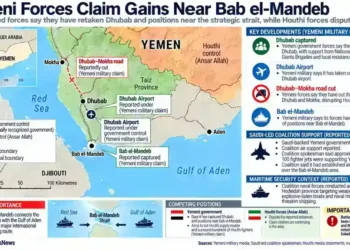
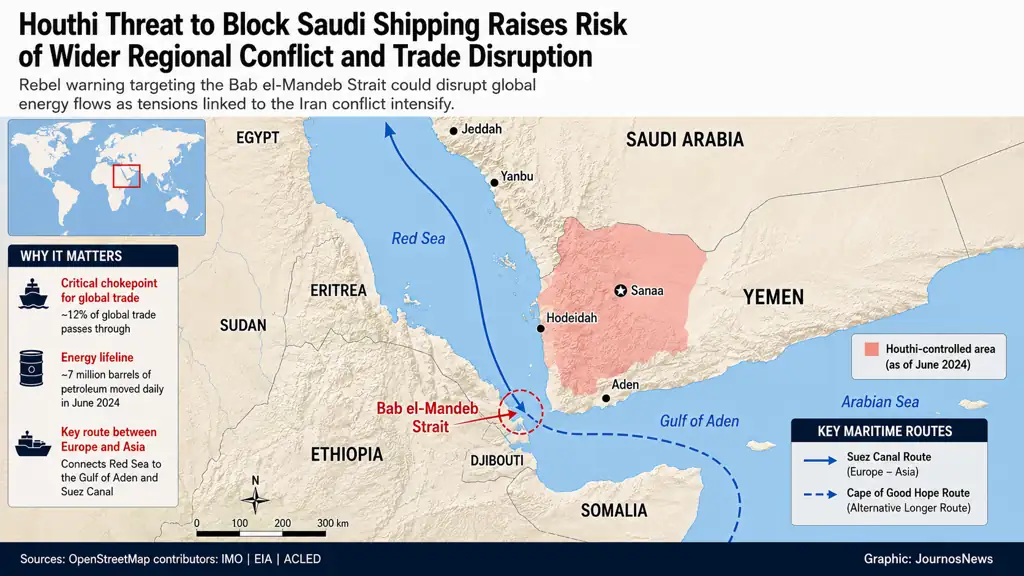
Located at the southern entrance to the Red Sea, the Bab el-Mandeb Strait connects the Red Sea with the Gulf of Aden and serves as a critical gateway between Europe and Asia via Egypt’s Suez Canal.
Roughly 12% of global trade, including about one-quarter of the world’s container traffic, passes through the narrow waterway.
The route has become increasingly significant for Saudi Arabia’s energy exports as shipping through the Strait of Hormuz has been constrained by regional tensions. According to an analysis by Allison Minor, director of the Atlantic Council’s Project for Middle East Integration, more than 7 million barrels of petroleum moved through the Bab el-Mandeb each day in June, compared with about 4 million barrels daily before the Iran conflict.
Saudi Arabia has recently exported around 4 million barrels of crude oil each day through its Red Sea port of Yanbu, helping offset reduced shipments through the Persian Gulf.
Houthis Outline Plans to Disrupt Maritime Traffic
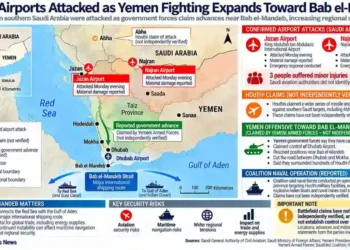
Although the Houthis do not control Yemen’s coastline along the Bab el-Mandeb Strait, they maintain positions within about 100 kilometers (60 miles) of the waterway.


Three Houthi officials told The Associated Press the group has spent months preparing operations aimed at disrupting commercial shipping. According to the officials, the plans include naval mines, explosive-laden boats, drones, and helicopters that could be used to deploy fighters onto vessels. They spoke on condition of anonymity because they were not authorized to discuss military planning publicly.
The officials said ships would first receive warnings not to enter designated areas before military action was taken against vessels that ignored those instructions.
The Houthis previously announced a maritime blockade targeting Israel during the war in Gaza. During that campaign, they attacked numerous commercial vessels, including some with little or no direct connection to Israel, heightening concerns among shipping companies about the risks of operating in the region.
Global Trade and Oil Markets Could Face Additional Pressure
Security analysts warn that simultaneous disruptions at both the Bab el-Mandeb Strait and the Strait of Hormuz could significantly affect international commerce.
Clionadh Raleigh, founder of the conflict-monitoring organization ACLED, said pressure on both waterways at the same time would disrupt two of the world’s most critical maritime trade routes.
While Saudi Arabia has alternative export options—including transporting crude across the Red Sea to Egypt’s SUMED pipeline or through the Suez Canal—those routes have more limited capacity.
Shipping companies could also divert vessels around the Cape of Good Hope at the southern tip of Africa, as many did during the height of the Gaza conflict. Such rerouting would add one to two weeks to voyages between Europe and Asia while increasing transportation costs.
Escalation Risks Extend Beyond Maritime Security
The latest threat also raises the prospect of renewed military confrontation inside Yemen, where large-scale fighting has largely remained paused since a 2022 truce.
President Donald Trump downplayed the Houthi announcement, telling reporters at the White House that no disruption had yet occurred and that the United States would “take care of business” if necessary.
Saudi Arabia’s military also vowed to keep the Bab el-Mandeb Strait open. Military spokesperson Maj. Gen. Turki al-Malki said threats against commercial vessels would be addressed “swiftly and firmly,” describing attacks on maritime traffic as violations of international law and acts of piracy.
Yemen’s civil war began in 2014 after the Houthis seized Sanaa and much of northern Yemen, prompting a Saudi-led coalition to intervene in support of the internationally recognized government. Saudi Arabia also imposed air and sea restrictions on Houthi-controlled territory, although those measures have eased in recent years.
Regional Tensions Continue to Build
The Houthis said their latest campaign followed what they described as a Saudi strike targeting Sanaa’s airport earlier this month in an attempt to stop an aircraft carrying Houthi leaders returning from Iran after attending the funeral of Supreme Leader Ayatollah Ali Khamenei. According to the group, the aircraft landed safely at another airport.
The rebels subsequently launched missiles and drones toward Saudi Arabia’s Abha International Airport, describing the attack as retaliation.
The Houthis say their campaign against Saudi-linked shipping is intended to pressure the Saudi-led coalition into ending its blockade of Yemen.
Ahmed Nagi, a senior Yemen analyst at the International Crisis Group, said the maritime campaign also advances Iran’s broader regional interests as Tehran faces continued U.S. military pressure.
Nagi said creating additional regional pressure points increases Iran’s leverage, while the Houthis provide Tehran with influence over one of the world’s most strategically important maritime chokepoints.
This report is based on reporting by The Associated Press.
Article Topics: Yemen | Houthis | Saudi Arabia | Bab el-Mandeb Strait | Iran Conflict | Global Trade | Oil Markets | Maritime Security