QUETTA, Pakistan – Pakistan’s Prime Minister Shehbaz Sharif on Thursday pledged to intensify operations against militant groups after coordinated attacks in the southwestern province of Balochistan killed 42 people, most of them security personnel, in one of the deadliest outbreaks of insurgent violence in recent months.
Sharif made the commitment during a visit to Quetta, the provincial capital, where he met grieving families and chaired a high-level security meeting attended by army chief Field Marshal Asim Munir and Balochistan Chief Minister Sarfraz Bugti.
Pakistani authorities said security forces have been conducting counterterrorism operations since Monday in response to the attacks, killing at least 54 insurgents, according to the military and local officials.

Deadliest attack targeted police officers
The most lethal assault occurred Monday in Balochistan’s Ziarat district, where militants attacked a police post, killing nine officers.
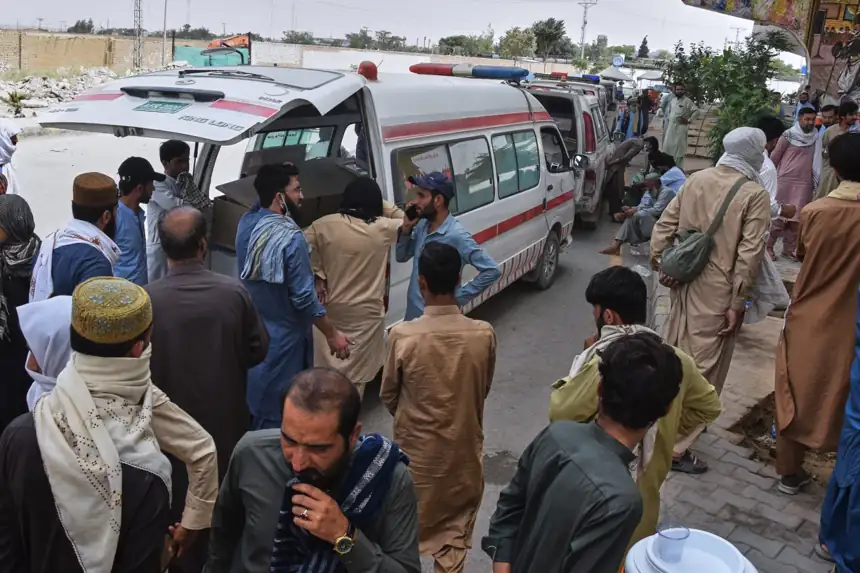
Authorities said 18 additional officers who were abducted during the attack were later killed by their captors, making the incident the deadliest of several coordinated assaults attributed to the outlawed Baloch Liberation Army.
The killings prompted relatives of about two dozen police officers to stage a sit-in protest in Quetta alongside the victims’ bodies, demanding justice and stronger action against those responsible.
Government vows continued operations
Speaking during the security meeting, Sharif said Pakistan would continue its campaign against militant groups.
“The war against terrorism will continue until the last terrorist in Pakistan is eliminated,” he said in televised remarks.

The prime minister said there was “no doubt” that Pakistan’s eastern neighbor was supporting the insurgency by supplying militants with weapons, funding and other assistance, although he did not directly name India.
Sharif also alleged that militants were using Afghan territory to launch attacks in both Balochistan and the northwestern province of Khyber Pakhtunkhwa, saying the government would defeat what he described as their “nefarious designs.”
There was no immediate response from authorities in Kabul or New Delhi. Both governments have previously rejected similar accusations from Pakistan.
Insurgency remains a major security challenge
Balochistan, Pakistan’s largest but least populated province, has experienced a long-running separatist insurgency, with armed groups demanding greater autonomy or independence from Islamabad.
The province has also faced attacks by Tehrik-e-Taliban Pakistan (TTP), a militant organization that is separate from but allied with Afghanistan’s Taliban rulers.
Pakistani officials say the TTP has become increasingly active since the Afghan Taliban returned to power in neighboring Afghanistan in 2021.
The latest attacks have heightened concerns that separatist groups previously viewed as relatively limited in capability are expanding both their operational reach and their ability to carry out coordinated assaults against Pakistan’s security forces.
This report is based on reporting by The Associated Press.
Article Topics: Pakistan | Balochistan | Shehbaz Sharif | Baloch Liberation Army | Terrorism | Security Forces | Insurgency | South Asia