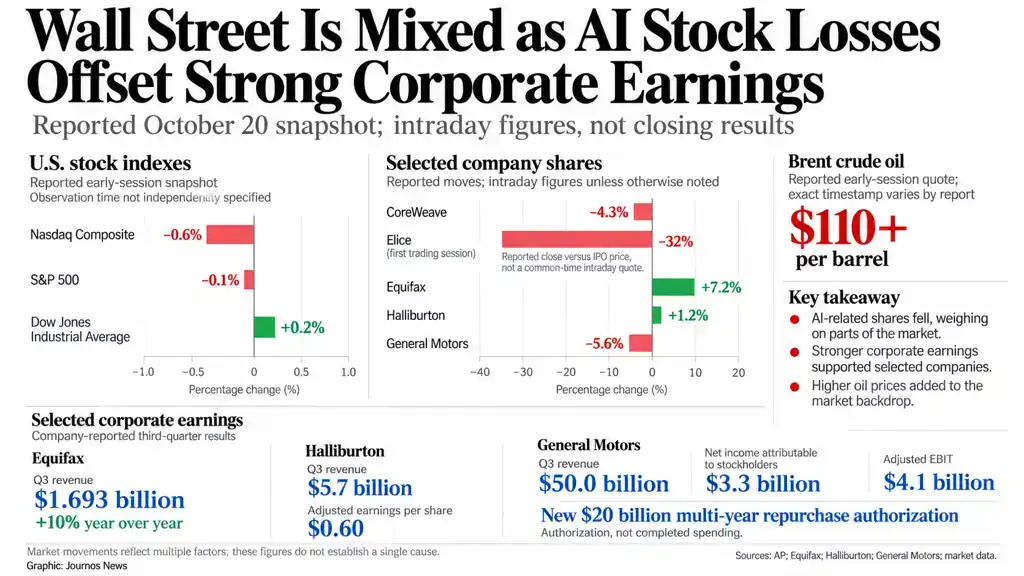
NEW YORK, United States – US stock indexes moved in different directions on October 20 as renewed losses in artificial intelligence-related shares offset stronger corporate earnings. The Nasdaq Composite fell 0.6% in early trading, while the S&P 500 slipped 0.1%. The Dow Jones Industrial Average rose 0.2%, or about 120 points, according to the Associated Press.
The mixed performance reflected competing pressures on investors. Some companies reported stronger-than-expected results, but concerns about the cost of financing AI infrastructure continued to weigh on technology and related shares. Brent crude also traded above $110 a barrel in early market reporting, adding another factor for investors to consider.
These figures describe an early-session snapshot, not the final results for October 20. Market prices and index performance may change throughout the trading day.

AI-related shares face renewed pressure
AI-linked stocks came under pressure as investors reassessed the costs and potential returns of expanding artificial intelligence infrastructure.
CoreWeave, a cloud computing company serving AI workloads, fell about 4.3% in the early trading figures reported by the Associated Press. The move followed volatility in AI-related shares during the previous week.
Investors have been weighing the expense of building data centres, buying computing equipment and securing enough power to run AI systems. These projects require substantial capital, while the revenue and profits generated by the investment may take time to materialize.
Borrowing costs matter because companies that use debt to finance expansion must account for interest expenses alongside construction, equipment and operating costs. Higher financing costs can make projects less attractive or increase the returns investors expect before committing additional capital.
The pressure has not been uniform across the sector. Individual companies have different financing arrangements, customer commitments and expectations for future revenue. A decline in one AI-related stock does not establish that all companies building AI infrastructure face the same financial problems.
■ Related News



South Korean AI company Elice also suffered a steep fall in its first trading session. The Associated Press reported a 32% decline, while other market coverage placed the drop closer to 33%. The differing figures reflect the need to verify the latest price and reporting cutoff before publication.
Corporate earnings support selected stocks
Stronger corporate results provided a counterweight to losses in technology-related shares.
Equifax rose 7.2% in the early market figures reported by the Associated Press after the credit reporting and data analytics company announced better-than-expected quarterly profit. Its official third-quarter release reported revenue of $1.693 billion, up 10% from a year earlier.
Halliburton gained 1.2% in the same market snapshot after reporting quarterly results that exceeded analysts’ expectations. The oilfield services company reported third-quarter revenue of $5.7 billion and adjusted earnings of 60 cents per share. Reuters reported that the adjusted earnings figure exceeded analyst estimates.
The companies operate in different sectors, but their results illustrate how earnings can influence individual stocks even when broader indexes are unsettled. Investors assess not only whether a company beats estimates, but also the outlook management provides and the risks facing its business.
Strong results do not guarantee a share-price increase. Prices also reflect expectations that may already be built into a stock, future guidance, operating costs and broader market conditions.
General Motors falls despite strong quarterly profit
General Motors shares also came under pressure after the automaker released its third-quarter results and updated its full-year outlook.
GM reported third-quarter revenue of $50 billion, net income attributable to stockholders of $3.3 billion and adjusted earnings before interest and taxes of $4.1 billion. The company narrowed its 2026 guidance range.
The Associated Press reported that GM shares fell 5.6% in early trading despite stronger-than-expected profit. Other market coverage reported a larger decline at a later point, illustrating why the precise share-price timestamp matters.
GM also announced that its board had approved a new $20 billion multi-year share-repurchase authorization. The authorization allows the company to buy back shares over time; it does not mean that $20 billion has already been spent or that the company must repurchase the full amount immediately.
The share-price decline shows that investors can react negatively even when reported earnings beat estimates. In GM’s case, the updated outlook and the expectations reflected in the share price are relevant to the market reaction. The available evidence does not establish that any single factor fully explains the decline.
Oil prices add to market uncertainty
Brent crude traded around $110.59 a barrel in the early-session figures provided in the assignment. Other market reports placed Brent above $110 and, at points, above $111. Those readings are time-specific and should not be treated as a single fixed price for the day.
Higher oil prices can increase costs for transport, manufacturing and other energy-intensive businesses. If elevated energy prices persist, they can also complicate the outlook for inflation and interest rates.
For investors, the effect depends on the company and sector. Higher crude prices may support some energy producers and service companies, while raising expenses for businesses that consume substantial amounts of fuel. Oilfield services companies such as Halliburton also have their own demand and operating conditions, so crude prices alone do not determine their share prices.
Market reports have linked the rise in oil to supply concerns and geopolitical tensions. Those explanations should be attributed to the relevant reporting rather than treated as proof that energy prices alone drove the session’s stock movements.
Why the major indexes diverged
The Nasdaq, S&P 500 and Dow Jones Industrial Average track different groups of companies and use different index weightings. Their daily performance can therefore diverge when technology shares weaken but companies in other sectors gain.
The Nasdaq’s heavier concentration in technology-related businesses can make it particularly sensitive to changes in sentiment toward AI and semiconductor stocks. The S&P 500 covers a wider range of sectors, while the Dow follows a smaller group of large US companies.
The early October 20 snapshot showed that divergence: the Nasdaq was down 0.6%, the S&P 500 was down 0.1%, and the Dow was up 0.2%. The figures do not establish a lasting trend, and they could change before the closing bell.
Investors were also watching the next wave of corporate earnings. Netflix was scheduled to report results on October 20, while Meta Platforms was among the companies expected to report later in the week. These releases could provide further information about consumer demand, advertising and technology spending.
AI investment, earnings and energy remain in focus
The session’s mixed performance reflected the competing forces affecting US stocks: concern over the cost and returns of AI investment, company-specific earnings results, borrowing costs and higher oil prices.
Equifax and Halliburton gained in the early market snapshot after reporting strong results, while AI-related shares remained under pressure. General Motors fell despite reporting quarterly profit above expectations and announcing a new share-repurchase authorization.
The figures available for this draft are intraday readings rather than closing results. The final assessment of October 20 trading must use verified closing prices and index levels, along with updated commodity prices and any material developments from corporate earnings releases.