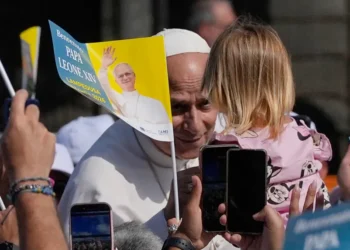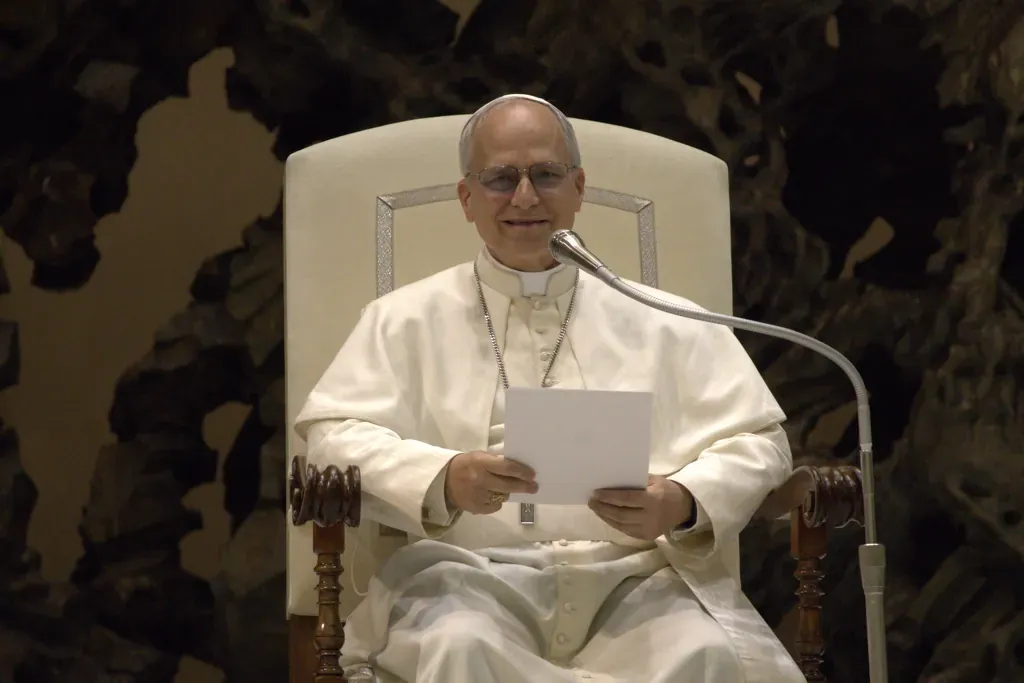
PARIS, France – Pope Leo XIV arrived in France Friday for a four-day visit that is drawing large crowds while placing the country’s distinctive model of secularism, or laïcité, in the international spotlight.
The Sept. 25-28 visit combines state diplomacy, Catholic ceremonies and public events across Paris, Lourdes and Metz. Leo met President Emmanuel Macron at the Élysée Palace after arriving in Paris and is scheduled to address French authorities, civil society and diplomats before visiting UNESCO and celebrating Vespers at Notre-Dame.
The scale of the public response has added another dimension to the visit.

French authorities expect about 1 million people in Paris over the first two days, including roughly 600,000 for an outdoor Mass at Place de la Concorde and along the Champs-Élysées on Saturday. Officials have mobilized about 15,000 personnel for the Paris portion of the visit.
For France, the challenge is not whether a pope can appear publicly in a secular republic. French law protects freedom of religion.
It is how a state that maintains institutional neutrality toward religion manages a visit by the head of the Catholic Church when hundreds of thousands of people are expected to gather for religious events in some of the capital’s most prominent public spaces.
France’s secular system separates state neutrality from religious freedom
France’s Constitution defines the country as an “indivisible, secular, democratic and social” republic and says it respects all beliefs.
The principle is rooted in the 1905 law separating churches and the state. Its first article guarantees freedom of conscience and the free exercise of religious worship subject to restrictions required for public order. Its second article establishes that the Republic does not recognize, pay or subsidize any religion, subject to specified arrangements such as public chaplaincies.
■ Related News

The French presidency describes laïcité as both protection for religious freedom and a requirement for state neutrality. It explicitly says secularism does not require religion to disappear from public life.
That distinction allows French officials to receive the pope as both a religious leader and the sovereign of Vatican City.
France’s ambassador to the Holy See, Charles Personnaz, described the visit as having both diplomatic and pastoral dimensions. He said France can maintain dialogue with the Holy See while representing the principles of the secular republic.
A pope can be both head of state and religious leader
Leo’s meetings with French authorities therefore carry two distinct meanings.
The Vatican’s official program includes a courtesy visit to Macron at the Élysée Palace and a meeting with French authorities, civil society and the diplomatic corps. The pope will also visit UNESCO, the U.N. cultural agency headquartered in Paris.
The remainder of the itinerary is more explicitly pastoral.
Leo is scheduled to celebrate Vespers with Catholic clergy and religious communities at Notre-Dame, hold a prayer vigil with young people at the Stade de France and celebrate Mass at Place de la Concorde. He will then travel to Lourdes for two days before ending the trip in Metz, where he is scheduled to participate in an interreligious meeting and a conference focused on Europe, peace and unity.
The combination illustrates why the French government treats the visit as an official state event without making the state itself a participant in Catholic worship.
The government can provide security, facilitate transportation and receive the pope diplomatically while maintaining its formal religious neutrality.
Public enthusiasm is testing the scale of that balance
The expected crowds have made the distinction more visible.
France’s Interior Ministry says around 600,000 people are expected for Saturday’s Paris Mass, while about 150,000 are expected for Sunday’s Mass at the sanctuary in Lourdes. It says approximately 1 million visitors and faithful are expected in Paris across Sept. 25 and 26.
The government is also treating the visit as a major security operation.
Protection perimeters will be established around major venues, and people entering designated areas will be subject to security checks. In Paris, police, gendarmes, military personnel and specialist units are being deployed alongside emergency medical personnel.
Lourdes presents an even larger logistical challenge for a much smaller city. French police said 150,000 people had preregistered for the Sunday Mass and that authorities were preparing for potentially 200,000 people in the city that day.
The scale reflects the continuing ability of a major religious event to draw large numbers in a country where religious affiliation and practice have changed significantly over recent decades.
The visit comes as Catholic life shows mixed signals
France remains a historically Catholic country, but the role of the Church in everyday public life has declined.
At the same time, the French Catholic Church has reported a recent increase in adult baptisms. The French bishops’ conference said more than 13,000 adults were baptized at Easter this year, with adult baptisms having more than tripled since 2016.
Church officials have pointed to the numbers as evidence of renewed interest among some French adults.
They do not, however, reverse the longer-term decline in religious practice. The same reporting notes that the number of infant baptisms has fallen substantially over several decades.
The crowds expected for Leo’s visit therefore do not by themselves establish a broad religious revival.
They demonstrate that a papal visit can still generate significant public interest in a country where the state maintains a strict separation between political authority and religious institutions.
Some of Leo’s messages will touch sensitive French debates
The visit also brings the pope into a country whose laws on several social issues differ sharply from Catholic teaching.
France constitutionally protected abortion access in 2024 and Parliament recently approved legislation establishing a form of assisted dying for certain adults with incurable conditions. Catholic leaders have opposed the legislation.
Leo is expected to emphasize the protection of human life and human dignity during his visit.
The Vatican’s official program does not identify a specific address devoted to French abortion or assisted-dying policy. But his itinerary places him in a country where those questions are part of the wider debate over religion, individual rights and the role of religious teaching in public life.
The pope is also scheduled to visit the Maison Bakhita center, which supports migrants and people experiencing social exclusion, and to meet victims of clergy sexual abuse during the Lourdes portion of the trip.
Those encounters broaden the visit beyond questions of Catholic doctrine.
France is hosting the pope without abandoning laïcité
French officials have emphasized that secularism does not prohibit dialogue with religious institutions.
The French government maintains diplomatic relations with the Holy See, and Macron has previously met Leo at the Vatican. The French presidency has also described laïcité as requiring state neutrality rather than the removal of religion from public life.
That principle is particularly visible during this visit.
French authorities are facilitating a religious event that will occupy Place de la Concorde and the Champs-Élysées, while the pope is simultaneously being received through the country’s diplomatic and constitutional institutions.
The arrangement does not make France a religious state.
It reflects the distinction built into French secularism: citizens remain free to practice their faith, religious institutions can operate publicly, and the state is expected to remain neutral among religions.
Leo’s visit is therefore less a test of whether Catholicism has a place in France than a demonstration of how that place is negotiated within a secular republic.
For four days, the pope will move between government buildings, international institutions, churches, pilgrimage sites and enormous public gatherings.
France’s constitutional framework remains unchanged.
What the visit shows is how visible religion can still become in a country whose political system is formally secular.
Reporting Credit: French Ministry of the Interior — official security arrangements, attendance estimates and deployment figures; Élysée Palace — French constitutional principles and state approach to secularism; French Ministry for Europe and Foreign Affairs — France-Holy See diplomatic relationship and visit context; Holy See Press Office — Pope Leo XIV’s official Sept. 25-28 itinerary; French Bishops’ Conference — Catholic participation and official preparations for the visit.