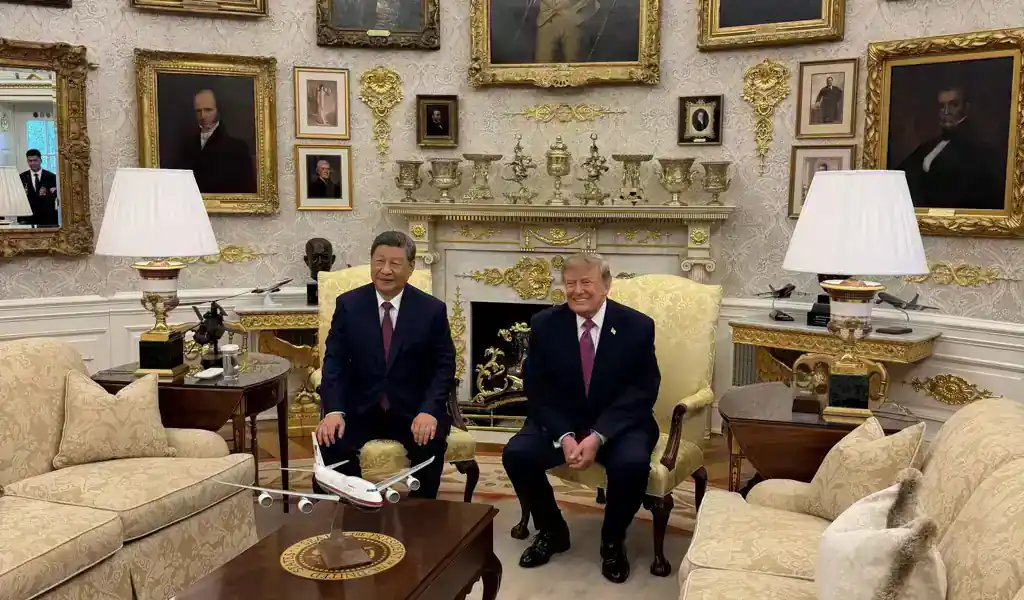
WASHINGTON, United States – Chinese President Xi Jinping said he expects to meet U.S. President Donald Trump twice more before the end of the year as he concluded a three-day state visit to Washington, extending a sequence of high-level meetings between the leaders of the world’s two largest economies.
Xi said Friday that the two presidents could meet again at the Asia-Pacific Economic Cooperation summit in Shenzhen, China, in November and at the Group of 20 summit in Miami in December. Trump later confirmed the two meetings, saying he would travel to China in November and meet Xi again at the G20.
The announcements came as Xi wrapped up his first U.S. state visit in more than a decade.

The two leaders met privately for about 90 minutes Thursday and held additional public engagements before Xi departed Washington. Their governments have sought to maintain a more stable relationship while disagreements remain over trade, technology, Taiwan and other strategic issues.
Two more meetings planned
Xi invited Trump and first lady Melania Trump to visit China for the APEC summit in Shenzhen.
“We do welcome you, Mr. President and the First Lady to visit China,” Xi said during a White House tea ceremony Friday. Trump responded that the couple would go and said they would be speaking frequently.
Trump later stated that the next meetings would take place in November in China and in December at the G20 summit in Miami.
The schedule would give the leaders four face-to-face meetings during 2026. They had already met in Beijing in May and Washington in September.


The planned meetings also reflect the two countries’ roles as hosts of the year’s major APEC and G20 gatherings.
Xi describes relationship as strategically stable
During the visit, Xi said China and the United States had developed a constructive relationship of “strategic stability” based on respect, fairness and reciprocity.
At a state dinner Thursday, he said the two leaders had held “sincere and in-depth exchanges” and reached common understandings on a number of issues.
That language follows the framework established during Trump’s May visit to China, when the two governments agreed to pursue what the White House described as a constructive relationship of strategic stability.
Xi said the latest meeting had added new substance to that relationship and provided new strategic guidance for bilateral ties.
The White House has described the Washington visit as highly productive, but the two sides have released relatively few details about what was agreed behind closed doors.
Trade and technology remain unresolved
The summit took place against a backdrop of continuing disputes over trade and technology.
Trump said Friday that the talks had produced “great strides” and suggested American farmers would benefit, but he did not initially provide detailed figures or terms. U.S. Trade Representative Jamieson Greer said details of limited trade arrangements would be released later.
The two governments have also been trying to manage disagreements over advanced technology and artificial intelligence.
AI was discussed during the Washington visit, but no major public breakthrough was announced on the safety or governance of the technology. The countries remain strategic competitors in advanced computing and semiconductor technology.
The earlier May agreement included mechanisms for managing bilateral trade in non-sensitive goods and established U.S.-China boards dealing with trade and investment. The White House also said China had committed to addressing U.S. concerns over rare-earth supply restrictions and to purchasing U.S. agricultural products.
Implementation of those commitments remains an ongoing issue.
Other global issues were discussed
The private Trump-Xi meeting also covered issues beyond the bilateral economic relationship.
China’s official account said the presidents discussed major international issues, including the Middle East, Ukraine and the Korean Peninsula. The White House has not released a comparable detailed readout of the private conversation.
Trump confirmed Friday that the war in Iran had been discussed but did not provide details.
The Middle East conflict has complicated the wider international environment in which the U.S.-China relationship is being managed, particularly because energy markets, shipping routes and regional security have consequences for both countries.
Washington visit ends with National Archives tour
Xi and Trump concluded the visit Friday with tea at the White House before traveling to the National Archives.
The presidents and their wives viewed documents including the Declaration of Independence, the U.S. Constitution and the Bill of Rights as the United States marks the 250th anniversary of its founding.
The symbolic visit followed a state dinner Thursday attended by prominent business and technology figures.
Xi thanked Trump and his family for the arrangements and described the visit as successful. Trump likewise praised the visit and said the two countries had made progress.
Xi then left Washington for China.
The next scheduled encounters will move the relationship back into a summit format, first in Shenzhen in November and then in Miami in December.
The meetings will provide further opportunities for the two governments to address trade, technology and other disputes, while testing whether the current emphasis on sustained leader-level dialogue can translate into concrete implementation of agreements already reached.
Reporting Credit: Chinese Ministry of Foreign Affairs — Xi Jinping’s statements, state-visit activities and official account of the Trump-Xi discussions; White House — official information on the September state visit and the existing U.S.-China strategic-stability framework; Office of the U.S. Trade Representative — statements concerning implementation of bilateral trade arrangements.